Rising appeals, difficulties in probing judges, staffing pressures highlight systemic challenges
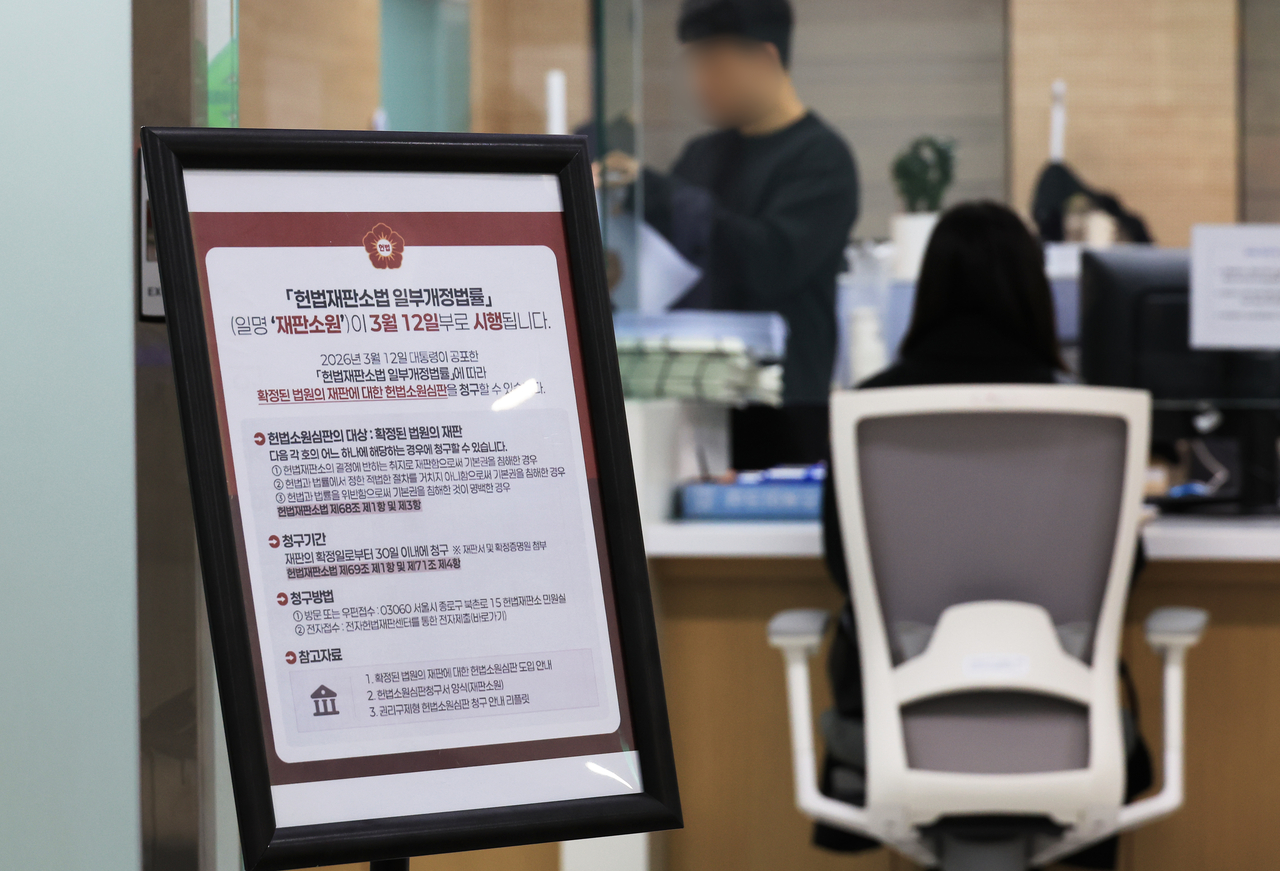
Over 100 constitutional appeals against court rulings had been filed as of Wednesday, within just a week of a reform measure taking effect that allows direct challenges to court judgments, raising concerns over potential abuse.
A set of judicial reform laws was promulgated on March 12 that allow constitutional appeals against Supreme Court rulings, introduce penalties for judges who intentionally distort legal principles and expand the Supreme Court.
The reforms mark the first major overhaul of the judiciary since South Korea’s 1987 constitutional amendment.
However, some in the legal community already say flaws in the new system must be addressed.
Early strain on the Constitutional Court
The number of constitutional appeals filed against court rulings is averaging more than a dozen a day in the first week.
More than 3,000 constitutional complaints were filed in 2025, before the reform allowing appeals against court rulings took effect.
Before the revision, South Korea’s Constitutional Court Act stipulated that “any person whose fundamental rights guaranteed by the Constitution are infringed due to the exercise or non-exercise of governmental power, excluding judgments of the courts, may request adjudication on a constitutional complaint with the Constitutional Court.”
The recent reforms removed the phrase “excluding judgments of the courts” from the law and added procedural guidelines for filing appeals.
The Constitutional Court estimates the total number of complaints — including those filed under new laws — could more than triple to between 10,000 and 15,000 this year. The court expects only a fraction of the cases to be formally deliberated.
Critics warn that the large volume of cases filed could be a sign that the system is vulnerable to abuse.
"Indiscriminate and redundant constitutional appeals against court rulings should be prevented," Shin Bong-ki, a law professor at Kyungpook National University, told local media.
According to critics like Shin, the system could effectively function as a "fourth trial," as the new bill allows the Constitutional Court to annul Supreme Court judgments and return the case for a retrial if it finds that the ruling violates the Constitution.
“Criminals whose sentences have already been finalized are now seeking to overturn their rulings by taking advantage of the constitutional appeal system,” said attorney Kim Tae-yeon Wednesday.
“The system opens a path for perpetrators to prolong their trials, while shifting the burden of pain and anxiety onto their victims.”
Critics warn that abuse of the system could prolong disputes and be used strategically by powerful litigants — a concern already reflected in early reactions from high-profile figures.
Former Democratic Party of Korea Rep. Yang Moon-seok has said he may file a constitutional complaint after the Supreme Court on March 12 upheld a lower court ruling convicting him of loan fraud.
Meanwhile, Jang Young-ha, the People Power Party’s district chair for Sujeong-gu in Seongnam, Gyeonggi Province, also said he plans to file a constitutional complaint after the top court found him guilty of spreading false information.
Strengthening preliminary reviews
Legal experts say the key to preventing abuse and overburdening the Constitutional Court lies in establishing strict preliminary screening procedures to filter out inadmissible constitutional complaints.
Under Article 72 of the Constitutional Court Act, a three-justice panel conducts a preliminary review of constitutional complaints. If a petition fails to meet legal requirements, the panel may dismiss it without referring the case to the full bench.
Cases may be dismissed if filing deadlines are missed, other legal remedies have not been exhausted, required legal representation is not appointed or the claim clearly lacks constitutional grounds.
However, legal circles say the process needs to be refined to better screen a large influx of cases.
“The preliminary review system is an essential mechanism in successfully implementing the constitutional appeal system against court rulings,” said Kim Jin-han, an attorney and former constitutional law professor.
“Deciding how to build this preliminary review process is a critical first step,” Kim added.
Meanwhile, Son In-hyuk, secretary-general of the Constitutional Court, said the court is preparing detailed criteria for the preliminary review process.
“As this is a newly introduced system, we are examining whether to apply new admissibility requirements and how to interpret existing standards,” Son said.
The court is expected to refine the system by referring to practices in countries such as Germany and Spain, which allow constitutional appeals against court rulings.
According to a November report by the National Assembly Research Service, both countries operate similar screening mechanisms, with three-justice panels empowered to unanimously dismiss cases without oral hearings.
Most cases in those countries are resolved at the screening stage. Over the past five years, the share of cases concluded during preliminary review ranged from 91 to 94 percent in Germany and 97 to 99 percent in Spain.
However, the report’s author, legislative researcher Jung Jae-ha, noted that preliminary screening alone does not automatically resolve caseload pressures.
In Spain, courts continue to face criticism over slow case processing despite strengthened screening procedures, while Germany has debated adopting a US-style review system to better manage its docket, according to the report.
In the US, there are no statutory criteria governing which cases are accepted. A case proceeds only if at least four of the nine justices on the Supreme Court vote to grant certiorari. Although thousands of petitions are filed with the top court each year, fewer than 100 are ultimately accepted for review.
Meanwhile, others propose imposing institutional obstacles to make filing appeals more difficult.
“In the case of constitutional appeals against final court rulings, there is a need to introduce measures such as filing fees or security deposits to prevent indiscriminate and duplicative filings,” said Shin, the law professor, adding that the absence of additional costs associated with filing such appeals could lead to abuse of the system.
Challenges of investigating judges
Police authorities are already facing difficulties investigating judges after criminal complaints were filed against top justices under the new reforms.
Police said Wednesday that the Seoul Metropolitan Police Agency’s anti-corruption investigation unit will look into Supreme Court Chief Justice Jo Hee-de and Seoul Central District Court Judge Ji Gwi-yeon over allegations they distorted legal principles — a felony under the new laws.
The case involving Jo was initially filed by attorney Lee Byung-chul at Yongin Seobu Police Station before being transferred to the Seoul Metropolitan Police Agency.
The investigation is expected to hinge on whether Jo intentionally distorted the law for a specific purpose — in other words, whether prosecutors can establish subjective intent.
However, legal experts and investigators question whether such a standard can be met. Determining whether a judge’s legal reasoning constitutes a criminal act is inherently difficult, they say.
“It is unclear whether a judge’s subjective legal decision can be proven through objective evidence,” a police investigator in Seoul told Yonhap News Agency. “Unless there is clear evidence or a confession, it will be difficult to proceed with the investigation.”
Securing evidence also poses a major hurdle.
To examine the Supreme Court’s deliberation process, investigators would likely need access to justices’ communications and internal reports. However, it remains uncertain whether courts would approve warrants for such materials.
Amid concerns that the new offense of “distorting the law” could undermine judicial independence, courts may respond defensively to attempts to investigate sitting justices.
At a meeting of chief judges held March 12-13, court leaders also called for measures to protect criminal court judges from potential pressure stemming from the new law.
Expanding the Supreme Court
During the March meeting, chief judges nationwide also voiced concerns over plans to expand the Supreme Court.
They warned that increasing the number of justices to 26 from the current 14 could require around 100 lower court judges to be reassigned as Supreme Court researchers, potentially weakening lower court capacity and worsening trial delays.
“Some trial divisions handle more than 400 cases a month. If presiding judges responsible for lower court rulings are reassigned to the Supreme Court, those divisions would have to take on an additional 100 to 200 cases (per month),” said a presiding judge in Seoul.
Meanwhile, the main opposition People Power Party also raised concerns over “court packing,” noting that President Lee Jae Myung could appoint 22 of the 26 justices under the expanded bench, including 12 new appointments phased in from 2028.
seungku99@heraldcorp.com