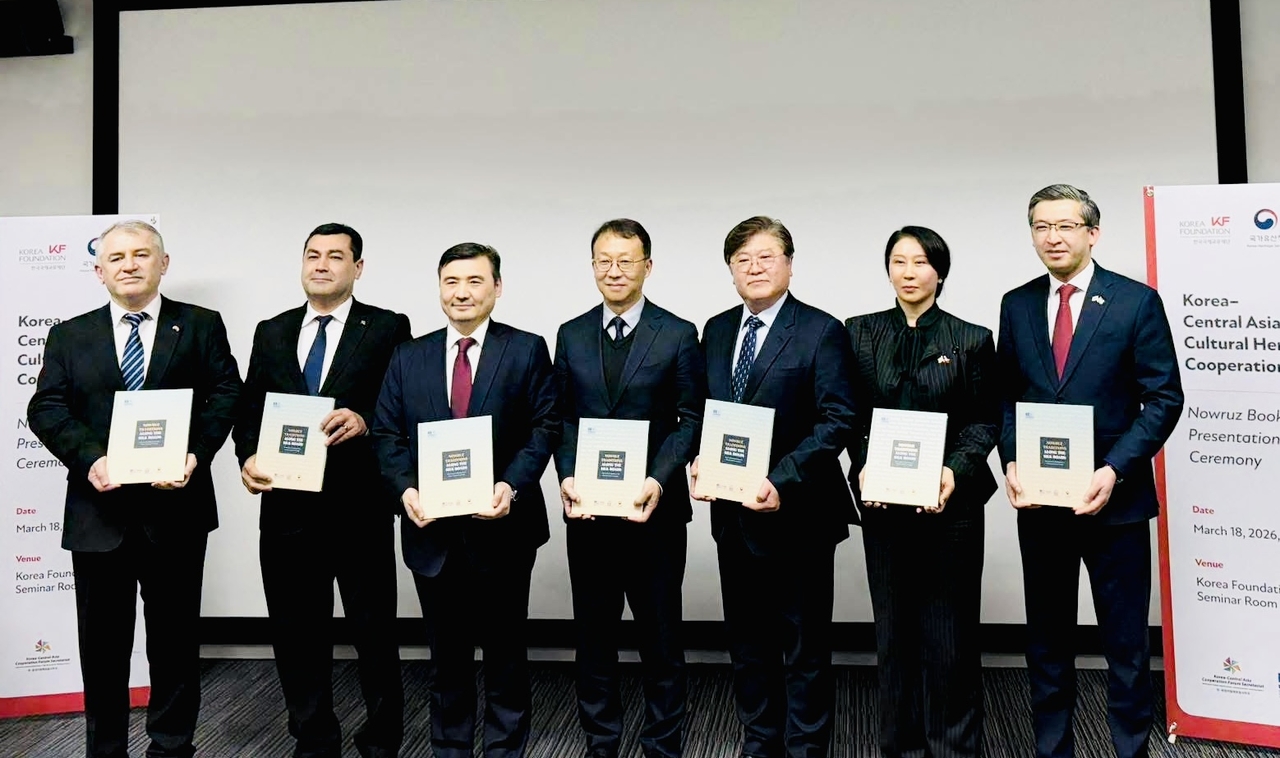
The Korea-Central Asia Secretariat and five Central Asian nations highlighted the cultural heritage of the Nowruz festival as a link between Korea and Central Asia on Wednesday.
Nowruz means "New Day," symbolizing the rejuvenation of nature and the start of a new year. The festival is celebrated on the first day of spring, typically on March 21, coinciding with the astronomical vernal equinox.
The festival is said to have a history spanning thousands of years in regions along the Silk Road, including the Balkans, the Black Sea Basin, the Caucasus, Central Asia and the Middle East. It is celebrated in Afghanistan, Azerbaijan, India, Iran, Iraq, Kyrgyzstan, Kazakhstan, Pakistan, Tajikistan, Turkey, Turkmenistan and Uzbekistan.
Inaugurating a book on the ancient spring festival Nowruz, Choi Bo-geun, vice administrator of the Korea Heritage Service, recalled the depiction of a Goguryeo envoy in Uzbekistan’s Afrasiab murals, highlighting historical intercivilizational exchanges between Korea and Central Asia.
Discovered in 1965 at Afrasiab Palace in Samarkand, the 11-meter mural shows two envoys whose feathered hats confirm their Korean origin, underscoring Korea’s diplomatic presence in Central Asia via the Silk Road as early as the 7th century.
“Based on this foundation, the Korea-Central Asia Summit in September will elevate cooperation between our regions to the next level,” Choi added.
Rhee Jong Kook, executive director of the Korea-Central Asia Cooperation Forum Secretariat, described Nowruz as “one of the most significant cultural heritages representing Central Asia,” and said the book offers comprehensive insights into the festival’s history, traditions and living cultural practices.
Celebrated this year on March 21, Nowruz has been designated as part of the intangible cultural heritage of humanity by UNESCO, and the United Nations designated the International Day of Nowruz in 2010.
Ambassadors from Kazakhstan, Kyrgyzstan, Tajikistan, Turkmenistan and Uzbekistan praised Nowruz as a symbol of renewal, harmony and cultural solidarity.
Kazakh Ambassador Nurgali Arystanov emphasized the festival’s role in fostering regional cooperation, while Kyrgyz Ambassador Aida Ismailova highlighted its role in transmitting cultural and spiritual values across generations.
Tajik Ambassador Kirom Salohiddin stressed Nowruz’s role in reinforcing moral and societal foundations, and Turkmen Ambassador Begench Durdiyev detailed traditional celebrations, including “Ak Oy” yurts, folk music, handicrafts and springtime rituals.
The Ak Oy, a traditional felt-covered Turkmen yurt, symbolizes purity, prosperity and the sun, and is traditionally used for newlyweds or honored guests.
Uzbek Ambassador Alisher Abdusalomov described Nowruz as “a symbol of hope, renewal and resilience,” underscoring the connection between human effort and prosperity.
The event was co-hosted by UNESCO’s International Information and Networking Center for Intangible Cultural Heritage in the Asia-Pacific Region, the Central Asian embassies in Korea and the Korea-Central Asia Cooperation Forum Secretariat.
It comes ahead of the first Korea–Central Asia Summit, scheduled for September 2026 in Seoul, which officials say will boost economic, cultural and diplomatic ties between South Korea and Central Asia.
sanjaykumar@heraldcorp.com