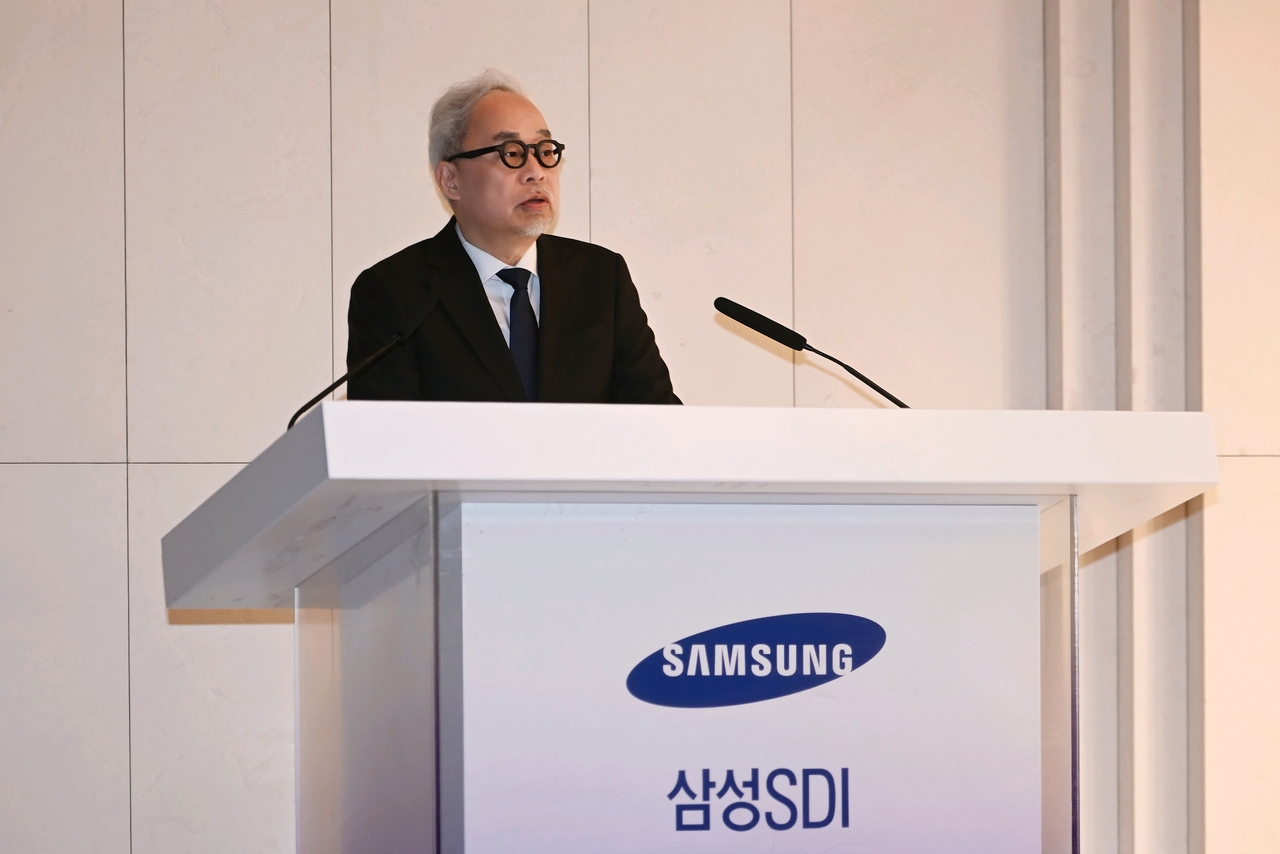
Samsung SDI CEO Choi Joo-sun said the company is in talks with Stellantis and General Motors to maintain their respective strong joint venture partnerships, amid a strategic shift from premium electric vehicle batteries toward more cost-competitive products and rapidly expanding energy storage systems.
During a shareholders meeting in Gangnam, southern Seoul, Wednesday, Choi addressed speculation concerning Stellantis potentially withdrawing from its joint venture, stating, “We are discussing various options.” He said that with slowing US demand for EVs, the Indiana battery plant is shifting part of its production lines to energy storage systems, with mass production targeted for this year.
Rumors of Stellantis withdrawing from the $6.3 billion StarPlus Energy joint venture surfaced in February, when Bloomberg reported that the automaker was looking to scale back EV investments and preserve cash after announcing over 22 billion euros ($25.4 billion) in asset writedowns — a significant reduction in the value of key assets.
Based in Kokomo, Indiana, StarPlus Energy’s first plant began operations in December 2024 as a key production hub to target the North American EV market, with the second plant under construction for launch next year.
Asked about potential changes to its GM joint venture in a brief press briefing, Choi said “no major shifts” are expected, all but ruling out the likelihood of a partnership breakdown. “We’ve just begun constructive discussions with GM and will share any updates if there are changes.”
Samsung SDI and GM signed an agreement in 2024 to invest $3.5 billion in a battery plant in Indiana, targeting 27 gigawatt-hours of annual capacity and mass production by 2027.
Unlike GM’s “Ultium” brand — used for its joint ventures with LG Energy Solution and Posco Future M — the partnership with Samsung SDI has been named “Synergy Cells.” The new branding is seen as reflecting GM’s shift toward more cost-competitive battery chemistries, such as lithium iron phosphate, or LFP, and lithium manganese rich, or LMR, rather than the high-cost, high-nickel batteries associated with the Ultium platform.
Sources say the Synergy Cells plant is reviewing plans to produce LFP or LMR batteries alongside the originally planned premium nickel-cobalt-aluminum cells, though any final decision has yet to be confirmed.
Highlighting that Samsung SDI is expected to turn a profit by the second half of this year, Choi noted, “The company will strengthen its patent strategy to maintain technological leadership” in key areas such as prismatic and all-solid-state batteries.
Choi’s also reaffirmed the company’s zero-tolerance policy on patent infringement. At the InterBattery 2026 conference last week, Samsung SDI warned it would not tolerate intellectual property violations related to prismatic battery technologies, while unveiling its new PrismStack prismatic battery brand and SolidStack all-solid-state cell brand.
hyejin2@heraldcorp.com