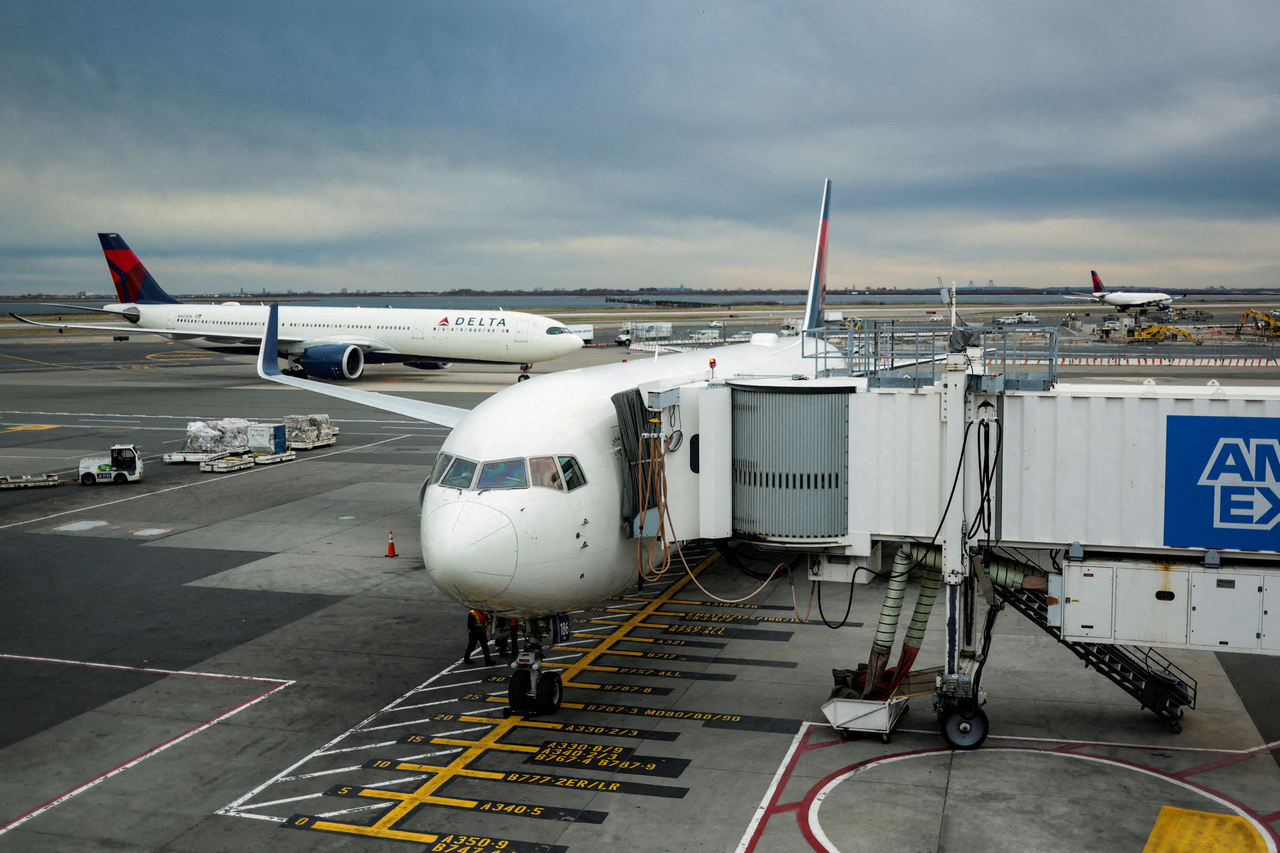
Global airlines sounded the alarm Tuesday over soaring jet fuel prices triggered by the US-Israeli war against Iran, warning of hundreds of millions of extra costs, higher fares and cuts to some routes.
Delta Air Lines Chief Executive Ed Bastian said the dramatic run-up in jet fuel prices had increased the airline's costs by as much as $400 million in March alone. The industry is moving quickly to pass on higher expenses through fare hikes, he told a JPMorgan industrials conference.
American Airlines said it expects a $400 million increase in first-quarter expenses due to fuel costs.
Among the first to act, Scandinavia's biggest airline SAS AB said it is cutting a limited number of flights because of the "sharp and sudden increase" in fuel prices.
"The entire European aviation system is now feeling the pressure from a sudden fuel shock," it said in an email.
The war, now in its third week, has thrown global aviation into turmoil, with flights cancelled, rescheduled or rerouted as most Middle East airspace remains closed amid fears of missile and drone attacks.
Jet fuel prices have emerged as a major challenge, pushing up operating costs, with European prices doubling and Asian prices up almost 80 percent since the start of US and Israeli strikes on Iran in late February.
Fuel is the industry's second-largest expense after labor, typically accounting for a fifth to a quarter of operating costs. US airlines largely stopped hedging fuel in the past two decades, and SAS said last year it had not hedged any of its fuel consumption for the following 12 months.
Vietnamese authorities have warned the country's aviation industry to prepare for potential flight reductions from April after China and Thailand halted jet fuel exports due to the war, heightening the risk of shortages.
The United Arab Emirates briefly closed its airspace Tuesday in response to incoming missile and drone threats from Iran, the second straight day of disruption after a drone caused a fire near Dubai airport Monday.
About 86,000 passengers traveling through Frankfurt airport, one of Europe's largest, were affected by cancellations in the first two weeks of the war. Only one-third of weekly connections between the airport and the Middle East are operating now, CEO Stefan Schulte said Tuesday.
The mounting cost warnings show how the shockwaves from the conflict are spreading far beyond the Middle East as airlines navigate their biggest crisis since the COVID-19 pandemic.
Delta's Bastian said the carrier is well positioned to recover fuel costs and can adjust capacity if elevated prices persist. Still, airlines will need to tread carefully with fare hikes at a time of fragile consumer confidence.
Air France-KLM announced plans last week to increase long-haul ticket prices to offset surging fuel costs.
Some carriers have introduced fuel surcharges, but these risk eroding profits.
American Airlines said Tuesday its first-quarter revenue is now expected to rise more than 10 percent, above its previous forecast of 7 percent to 10 percent, as demand outperformed expectations. But its adjusted loss per share will now be towards the lower end of its earlier guidance range of 10 cents to 50 cents. (Reuters)










