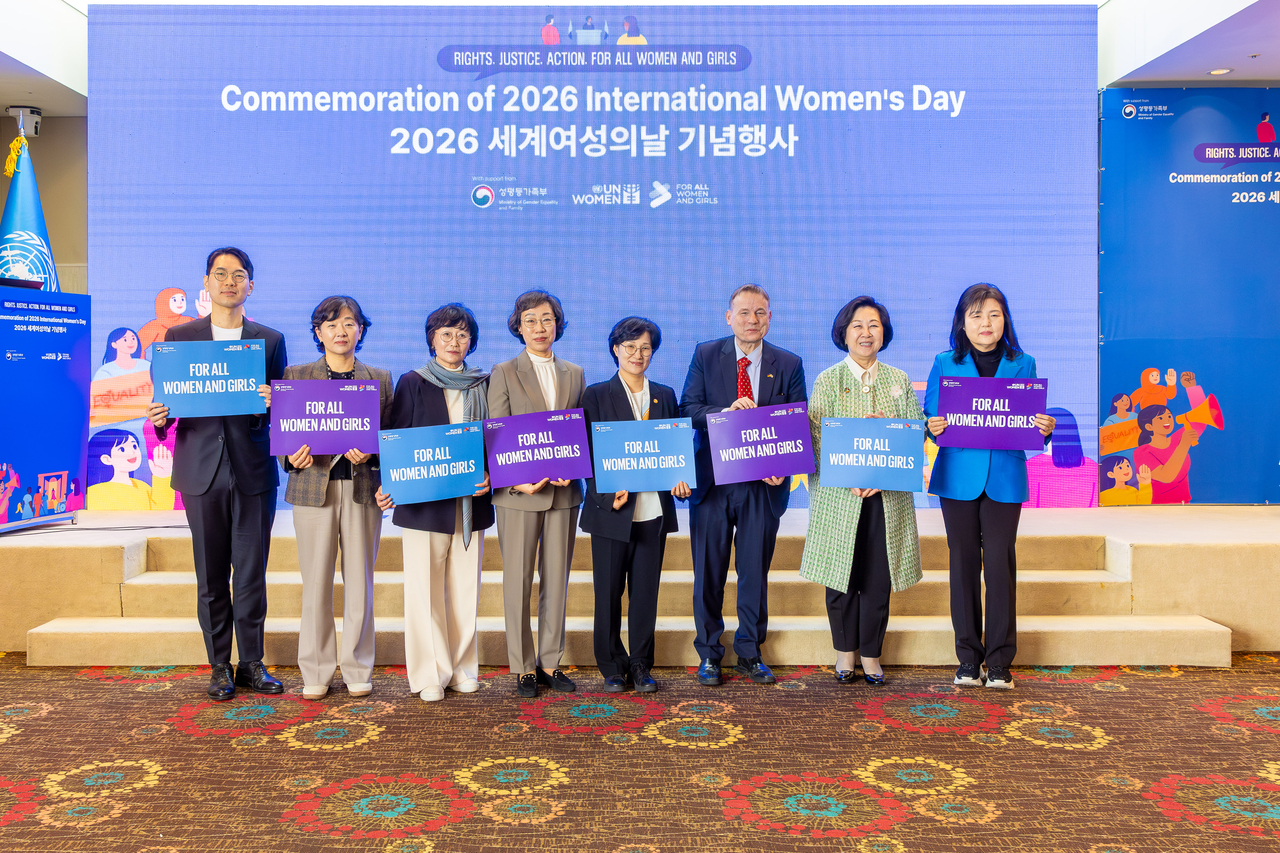
Experts urged coordinated efforts to tackle structural discrimination that continues to shape women’s lives across society during an event hosted by the UN Women Knowledge and Partnerships Center in the Republic of Korea.
They stressed that true equality requires dismantling entrenched barriers, not merely helping women navigate around them.
The center, supported by the Ministry of Gender Equality and Family, held a commemoration marking the 2026 International Women’s Day in Seoul on Wednesday under this year’s global theme, “Rights. Justice. Action. For ALL Women and Girls.”
Hwang Yun-jeong, director of the UN Women Knowledge and Partnerships Center, said no country had yet achieved full legal equality for women.
“Worldwide, women are guaranteed only 64 percent of the legal rights held by men,” she said, noting that 44 percent of countries still lack laws guaranteeing equal pay for work of equal value. “Gender equality is still unfinished, and action is needed now more than ever.”
Gender Equality Minister Won Min-kyong cited persistent disparities in South Korea. Women’s economic participation rate remains about 16 percentage points lower than that of men, she said, while women earn roughly 29 percent less on average.
Across the panels, experts outlined how discrimination continues to shape institutional systems in their fields — from courtrooms to algorithms to sports federations — often in ways that remain invisible to those who do not experience them.
Attorney Kim Soo-jung pointed to gender bias embedded in the justice system, referring to a landmark case involving Choi Mal-ja, who was cleared after being stuck with a criminal record for 60 years for resisting sexual assault.
Kim said judicial norms often still rely on outdated expectations of an “ideal victim,” while digital sex crimes and economic inequality show that structural discrimination persists across sectors of society.
In science and technology, structural gaps are deepening as artificial intelligence spreads, said Kwon Oh-nam, president of the Korea Federation of Science and Technology Societies.
“AI learns from data, and that data is produced by society. If society contains discrimination, the data reflects it, and AI reproduces it,” she said.
She also described a “leaking pipeline” in Korea’s science sectors, where women account for 54.9 percent of university graduates but only 12.4 percent of managers, among the lowest levels in the OECD.
“That gap is not just a percentage,” she said. “It represents dreams abandoned and voices society failed to hear.”
Sports remain another arena where structural discrimination shapes opportunity, said Shin Jung-hee, chair of the Gender Equality Committee at the Korea Sports & Olympic Committee.
Reflecting on being denied a judging position at the 1988 Seoul Olympics despite full qualifications, she said, “I thought it was my own failure, but later I realized it wasn’t. The system itself was missing.”
Although gender parity has been achieved among athletes, with women making up 50 percent of participants at the Paris 2024 Olympics, leadership remains imbalanced, she added.
“Women account for only 44.9 percent of IOC members and 24.4 percent of Korean Sports Council executives.”
jychoi@heraldcorp.com
![[Graphic News] 6 in 10 people living alone feel lonely](https://wimg.heraldcorp.com/news/cms/2026/10/13/news-p.v1.20261013.78692699312346e2a2817fabedf14bb6_T1.gif?type=h&h=800)