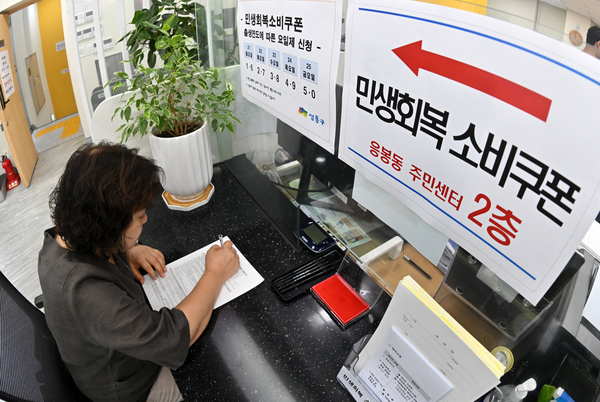
The National Human Rights Commission of Korea said Wednesday that it had advised the interior minister and other relevant officials to expand eligibility for government relief payments, including the so-called “consumption coupons for livelihood recovery,” to cover more foreign residents.
The government distributed coupons worth up to 550,000 won ($375) to Korean residents in 2025 as part of efforts to stimulate domestic consumption.
The policy largely excluded foreigners, though it allowed limited access for certain foreign residents, including permanent residents, marriage migrants and recognized refugees. They also had to be enrolled in the national health insurance system, registered as dependents or receiving medical aid.
Migrant rights groups filed a complaint with the country’s human rights watchdog in July 2025, arguing that the exclusion of most foreign residents from the stimulus coupons amounted to discrimination.
The commission partially upheld the complaint in January and delivered its opinion to the ministers of interior, health and finance, recommending that the scope of eligible foreign recipients be expanded.
It noted that excluding migrants from economic stimulus policies could weaken social equality and integration, particularly given their economic contributions.
“More than 2 million foreign residents live in Korea, and migrant workers contribute to society and the economy by paying taxes and social insurance and participating in local consumption, while working in key industries such as manufacturing, construction and agriculture,” the human rights commission said in a document sent to the Interior Ministry.
“Excessively excluding migrants from economic stimulus policies risks undermining social fairness and community solidarity and may hinder social integration,” the commission said.
It also pointed to examples of other countries that extended economic stimulus support to foreign residents.
"Similar policies in the future must be improved to expand the category of those receiving aid to include foreign residents under different visa schemes," the commission added.
However, the commission dismissed the civic groups' claims that the exclusion of foreigners from the policy constitutes an abuse of government discretion.
Instead, it accepted the Interior Ministry’s explanation that budget constraints made it difficult to extend the benefits to all foreigners. It also said that balancing policy objectives, fiscal burden, administrative feasibility and expected outcomes falls within the government’s discretionary authority.
seungku99@heraldcorp.com


![[Legal updates in Korea] New insurance mandate protects firefighters on the job](https://wimg.heraldcorp.com/news/cms/2026/10/01/news-p.v1.20261001.76835f19eb424f18814ac3bb65d896a9_T1.jpg?type=h&h=800)