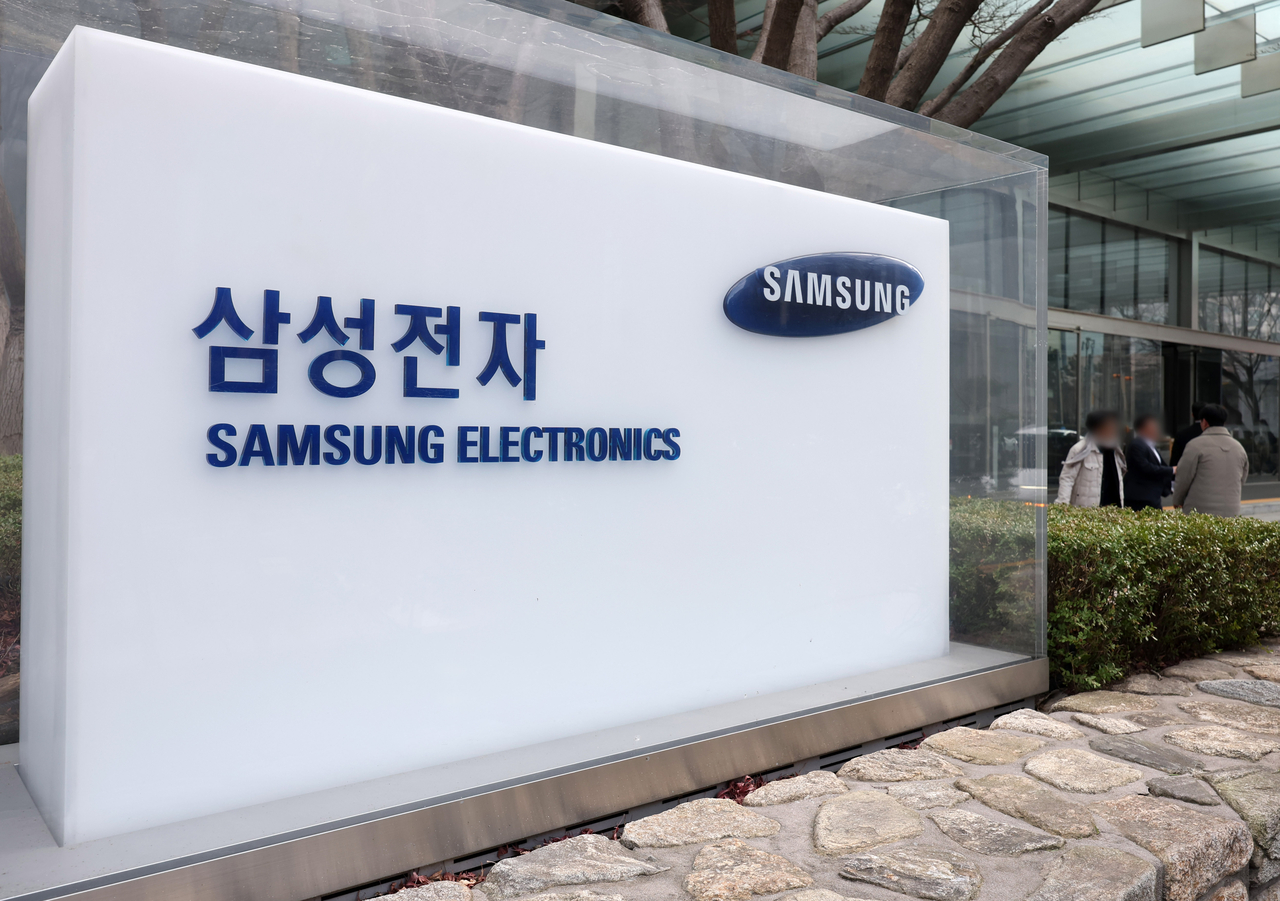
Samsung Electronics spent a record 37.7 trillion won ($25.7 billion) on research and development last year despite heightened global economic uncertainty, according to its 2025 business report Tuesday.
The figure is a 7.8 percent increase from 35 trillion won a year earlier, equivalent to more than 100 billion won spent each day on technology development.
Industry observers say a significant portion of the investment likely went toward next-generation memory technologies, particularly high-bandwidth memory (HBM), as Samsung moves to keep pace with surging demand for artificial intelligence chips.
Samsung said its HBM4 adopts a sixth-generation 10-nanometer-class DRAM process, one generation ahead of rival technologies.
The chip delivers data transfer speeds of 11.7 gigabits per second, about 46 percent faster than the standard set by the Joint Electron Device Engineering Council, the global semiconductor standards body.
Meanwhile, facility investment across semiconductors, displays and other businesses reached 52.7 trillion won last year, exceeding the company’s initial plan by more than 5 trillion won.
Samsung said the spending reflects efforts to strengthen future production capacity, including construction of the NRD-K advanced R&D complex at its Giheung campus in Gyeonggi Province.
The company also disclosed its five largest customers in 2025: Alphabet, Apple, Deutsche Telekom, Hong Kong-based Techtronic Industries and Supreme Electronics. Compared with the previous year, Alphabet replaced Verizon on the list.
As of the end of last year, Samsung’s total inventory stood at 52.64 trillion won, up 1.7 percent from 51.76 trillion won a year earlier.
Inventory accounted for 9.3 percent of total assets, down from 10.1 percent the previous year.
yeeun@heraldcorp.com