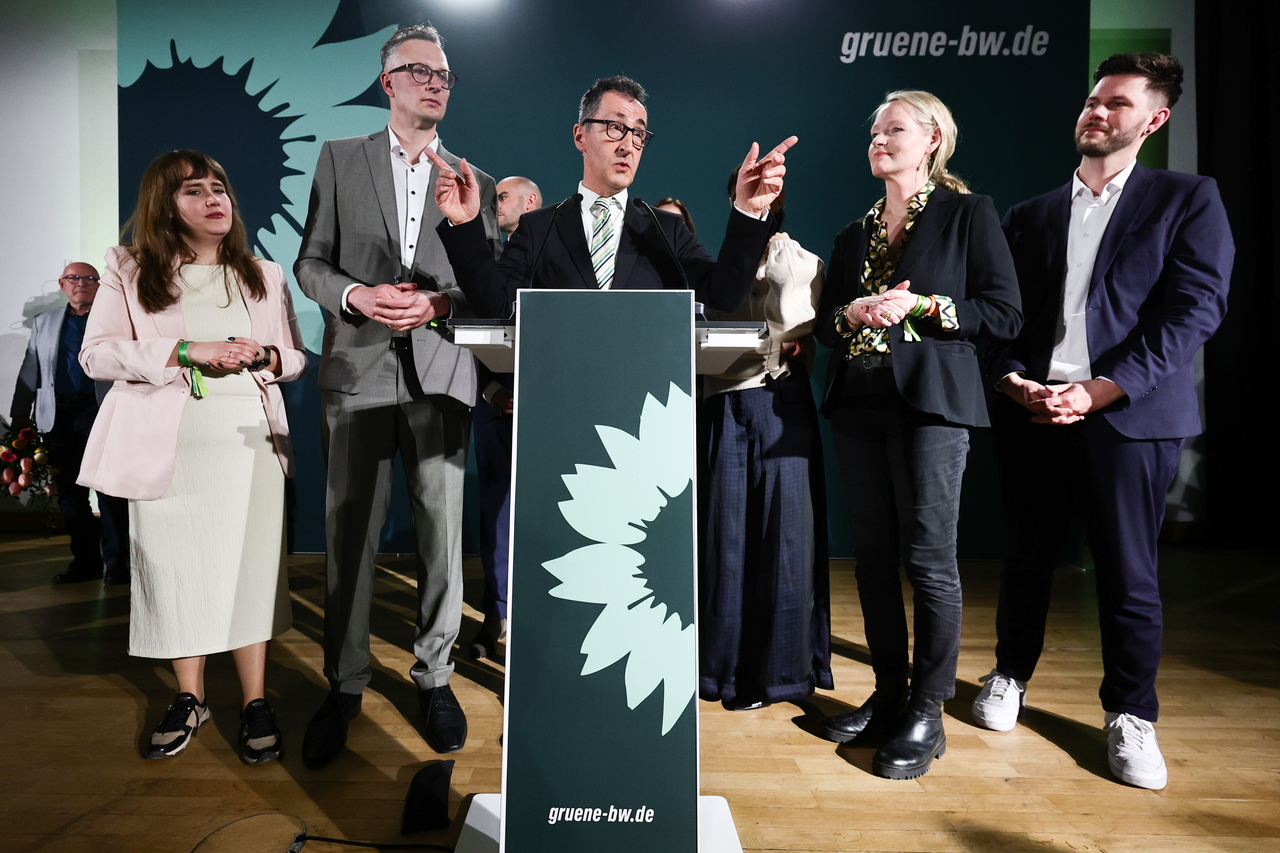
The German Greens on Sunday beat Friedrich Merz's conservative CDU in a state poll, exit polls showed, marking a blow for the chancellor ahead of elections this year as polls show the far right surging.
Almost 32 percent of voters opted for the Greens led by Cem Ozdemir, according to exit polls by broadcasters ARD and ZDF, edging out the CDU with around 30 percent.
Updated exit polls for both broadcasters showed the far-right Alternative for Germany almost doubling its result compared with 2021 elections, taking third place with about 18 percent of the vote.
Some in the CDU might be hoping that the Green's lead evaporates as results roll in through the night.
But the gap between the two was larger than that in polls ahead of the vote and CDU leader Manuel Hagel told ZDF that the Greens were clearly in the driving seat.
"If this proves to be the actual result, then the Greens will be tasked with forming a government," he said, adding "the ball is in their court."
Baden-Wuerttemberg's neighbor, Rhineland-Pfalz, votes in a couple of weeks and September will see a series of regional votes in ex-communist eastern Germany, where the AfD can expect to perform well.
Hagel, a 37-year-old former bank manager, led the CDU in the campaign and hit a rough patch after an eight-year-old video emerged in which he commented on female students' appearances after a school visit, earning condemnation from across the political spectrum.
Speaking after the exit polls emerged, Hagel thanked his family for their patience.
"I would like to thank my family, especially my wife, because, frankly speaking, the last few weeks have been an enormous strain on my wife, my family and me personally," he said.
The Greens' candidate, Cem Ozdemir, 60, is now likely to become Germany's first state premier of Turkish heritage, subject to coalition negotiations.
"The next chapter won't be one that we write by ourselves but rather with a coalition partner," he said.
"It will be, it has to be a partnership of equals," he added.
The AfD's result is its record in Baden-Wuerttemberg and not far off its record of 18.4 percent for a west German state, achieved in Hessen in 2023, but behind the 25 percent it polls nationally.
On Friday, Merz attended the CDU's final campaign rally and said the vote would be watched outside Germany to answer the question, "Is the CDU still able to win elections, even when in government at such a turbulent time?"
A prosperous part of Germany that is a bastion of the country's ailing automotive industry, Baden-Wuertemberg was for years a stronghold of the conservative CDU.
Polls showed that the economy was the most important topic for voters by some distance but not everyone thought it was taken seriously.
Brian Fuerderer, 34, the head of a local company making surgical equipment, told Agence France-Presse ahead of the vote that he had found the electoral campaign "weak."
The parties were "avoiding the most essential issue ... the economy" as well as the country's dependence on foreign energy supplies, thrown into stark relief by the Middle East war.
Merz has repeatedly promised to boost Germany's moribund economy and to that end lobbied the EU to weaken its ban on new combustion-engine cars after 2035.
Even the Greens' Ozdemir has said there should be more flexibility in the transition to electric vehicles.
Ozdemir has a national profile in Germany, having become one of the first members of Parliament of Turkish origin in 1994 and serving as agriculture minister under former SPD chancellor Olaf Scholz.
The AfD's lead candidate, Markus Frohnmaier, has attracted national attention for his links to Russia and US President Donald Trump's Make America Great Again movement.
Speaking after the vote, Frohnmaier said the results showed there was a clear "conservative majority" in Baden-Wuerrtemberg.
But the CDU, in common with Germany's other major parties, refuses coalitions with the AfD, considering it a dangerous far-right force. (AFP)