Rebound tracks Wall Street gains, easing oil price concerns
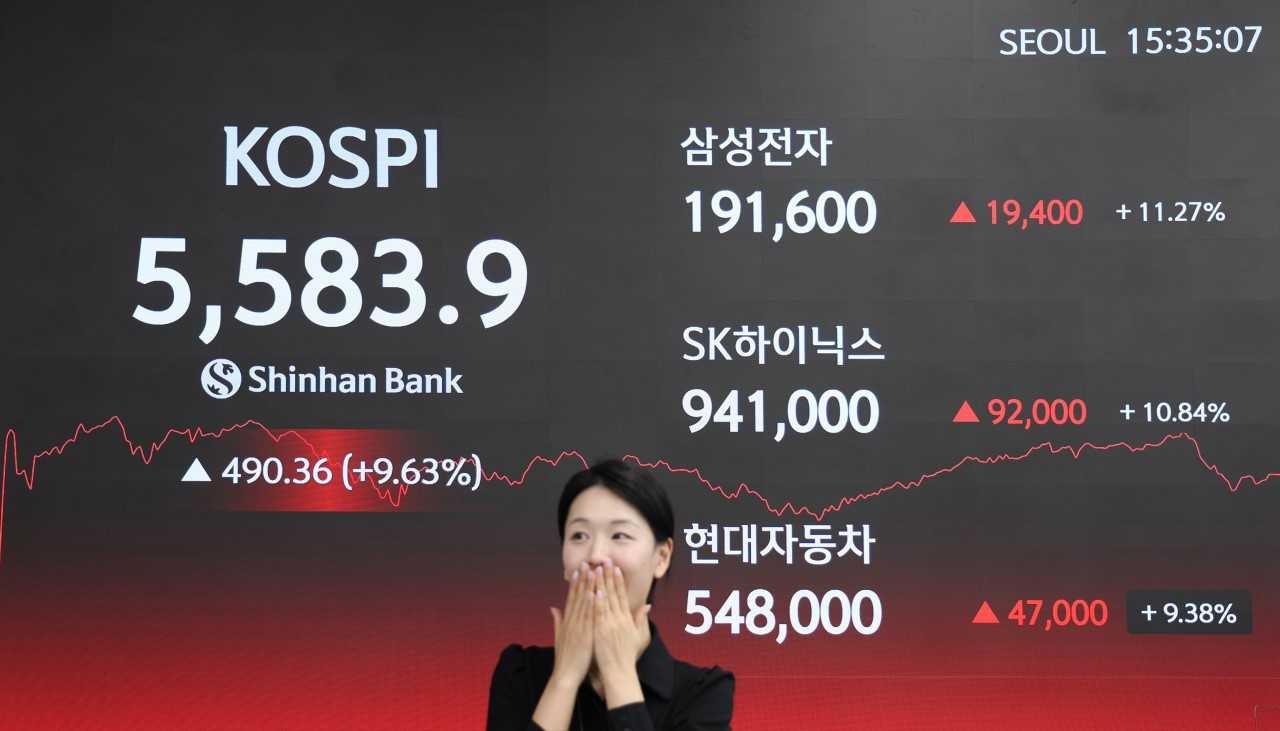
South Korean stocks staged a sharp rebound Thursday, partially recovering from a two-day rout that rattled local markets. Surging buying pressure lifted the benchmark Kospi more than 9 percent and the secondary Kosdaq over 14 percent, triggering buy-side sidecars on both bourses.
Amid market turbulence, President Lee Jae Myung urged the government to swiftly implement the 100 trillion won ($68 billion) market stabilization program designed to curb instability in the capital market.
“We must respond proactively to the heightened volatility in financial markets, including stocks and the foreign exchange market,” he said at a Cabinet meeting Thursday, citing tensions in the Middle East as a threat to investor confidence.
The benchmark Kospi closed at 5,583.9, gaining 490.36 points, or 9.63 percent, from the previous session. After opening at 5,250.92, the index continued to extend its gains and touched an intraday high of 5,715.3, advancing 12.21 percent.
The Kospi's gain of 490.36 points on the day marked an all-time high. The previous record was 338.41 points, set on Feb. 3. The 9.63 percent increase is the second-largest on record, following the 11.95 percent surge on Oct. 30, 2008.
The rebound follows one of the steepest two-day declines on record for the Kospi. The index had plunged 7.24 percent on Tuesday and 12.06 percent on Wednesday.
Retail investors led the rally, buying a net 1.79 trillion won worth of shares on the main market. Foreign investors started the session as net buyers, but later shifted to net selling, offloading a total of 144.5 billion won. Institutional investors dumped 1.72 trillion won.
Most large-cap stocks rebounded strongly. All of the top 100 companies by market capitalization on the Kospi recorded gains during the session.
Shares of Samsung Electronics and SK hynix jumped 11.27 percent and 10.84 percent, respectively. Hyundai Motor advanced 9.38 percent, while LG Energy Solution gained 6.91 percent.
The tech-heavy Kosdaq also surged, closing at 1,116.41, climbing 14.1 percent — the largest jump in the bourse’s history, surpassing the previous record of 11.47 percent, also set on Oct. 30, 2008.
Opening at 1,023.84, the index reclaimed the 1,000-point threshold and extended its gains further through the session. During trading, it touched as high as 1,149.54.
Amid the steep early rally, buy-side sidecars were triggered on both the Kospi and Kosdaq at 9:06 a.m. The mechanism imposes a five-minute trading halt in futures markets when prices surge sharply, helping curb excessive volatility.
Thursday’s market marked a dramatic reversal from the previous session, when both the Kospi and Kosdaq experienced sharp declines that triggered sell-side sidecars and circuit breakers, a higher level of market intervention designed to stabilize trading.
The surge in Korean equities tracked overnight gains on Wall Street, where US stocks closed higher amid reports of back-channel contacts between Washington and Tehran and signs of stabilization in global crude oil prices, which helped revive risk-on sentiment among investors.
With risk aversion easing, the Korean won also managed to regain ground against the dollar, compared with its recent spike toward the 1,500 level in overnight trading.
The won was quoted at 1,468.1 per dollar as of daytime trading’s close, strengthening by 8.1 won from the previous session. After kicking off trading at 1,464 per dollar, the won strengthened as much as 1,455.5 per dollar during the session, but trimmed its losses on bargain hunting.
Still, local analysts expect the currency to remain under pressure for a while as geopolitical tension in the Middle East shows little sign of easing.
“Considering the potential prolongation of the current conflict, the won-dollar exchange rate is expected to continue reflecting a heightened geopolitical risk premium for some time,” said Choi Ye-chan, an analyst at SangSangIn Investment & Securities, adding that the won could weaken to around 1,525 per dollar.
silverstar@heraldcorp.com