Foreign selloff of over 5 trillion won deepens losses as geopolitical tension jolts markets
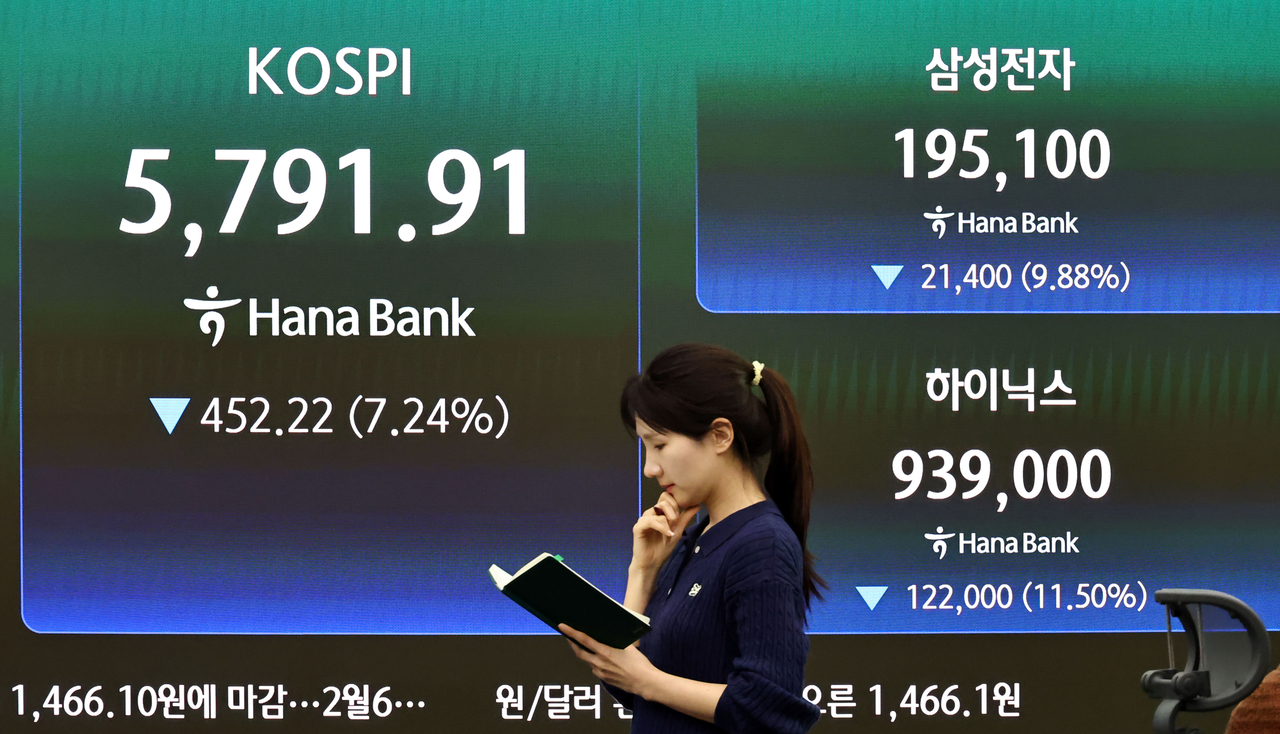
South Korea’s benchmark Kospi plunged over 7 percent Tuesday amid escalating tensions in the Middle East following US-Israeli strikes on Iran. A temporary trading curb was triggered during the session.
The Kospi closed at its day low of 5,791.91, down 7.24 percent from the previous session, marking the first trading day after the joint US-Israel attack on Iran. While the index initially opened at 6,165.15 and held above the 6,000 level in early trading, losses accelerated through the afternoon hours, pulling it below the 5,800 level.
At 12:05 p.m., the Korea Exchange activated a sell-side sidecar — a five-minute halt on program trading for Kospi 200 futures — after sharp declines in derivatives. It was the first such trigger since Feb. 6. At the time, Kospi 200 futures were down 5.09 percent at 890.05.
Retail investors hunting bargains bought a net 5.79 trillion won ($4 billion) worth of shares, but heavy foreign selling of 5.14 trillion won outweighed the inflows. Institutional investors also offloaded 886.3 billion won.
Losses were concentrated in large-cap stocks that had rallied in recent weeks. Samsung Electronics closed at 195,100 won, sliding 9.88 percent, while SK hynix wrapped up at 939,000 won, down 11.5 percent.
Hyundai Motor and Kia each shed 11.72 percent and 11.29 percent.
In contrast, defense and energy stocks surged. LIG Nex1 and Hanwha Systems hit their daily upper limits while S-Oil gained 28.45 percent.
Shipping shares rallied on expectations of higher freight rates amid concerns over the blockade of the Strait of Hormuz. Korea Line Corp. and Heung-A Line both hit their daily ceilings.
The tech-heavy Kosdaq also retreated, closing at 1,137.7, down 4.62 percent. The index opened 1.92 percent lower and briefly turned positive in early trading, but later reversed course and slid again.
The won weakened alongside equities. It was quoted at 1,466.1 per dollar as of daytime trading's close, weakening by 26.4 won from the previous session and returning to its weakest level in a month.
“The short-term correction triggered by Iran-related concerns presents an opportunity to ease valuation pressures," said Yoo Myoung-gan, a researcher at Mirae Asset Securities, adding, "Structural drivers, including improved corporate earnings, market-friendly policies, and liquidity inflow, remain intact.”
silverstar@heraldcorp.com