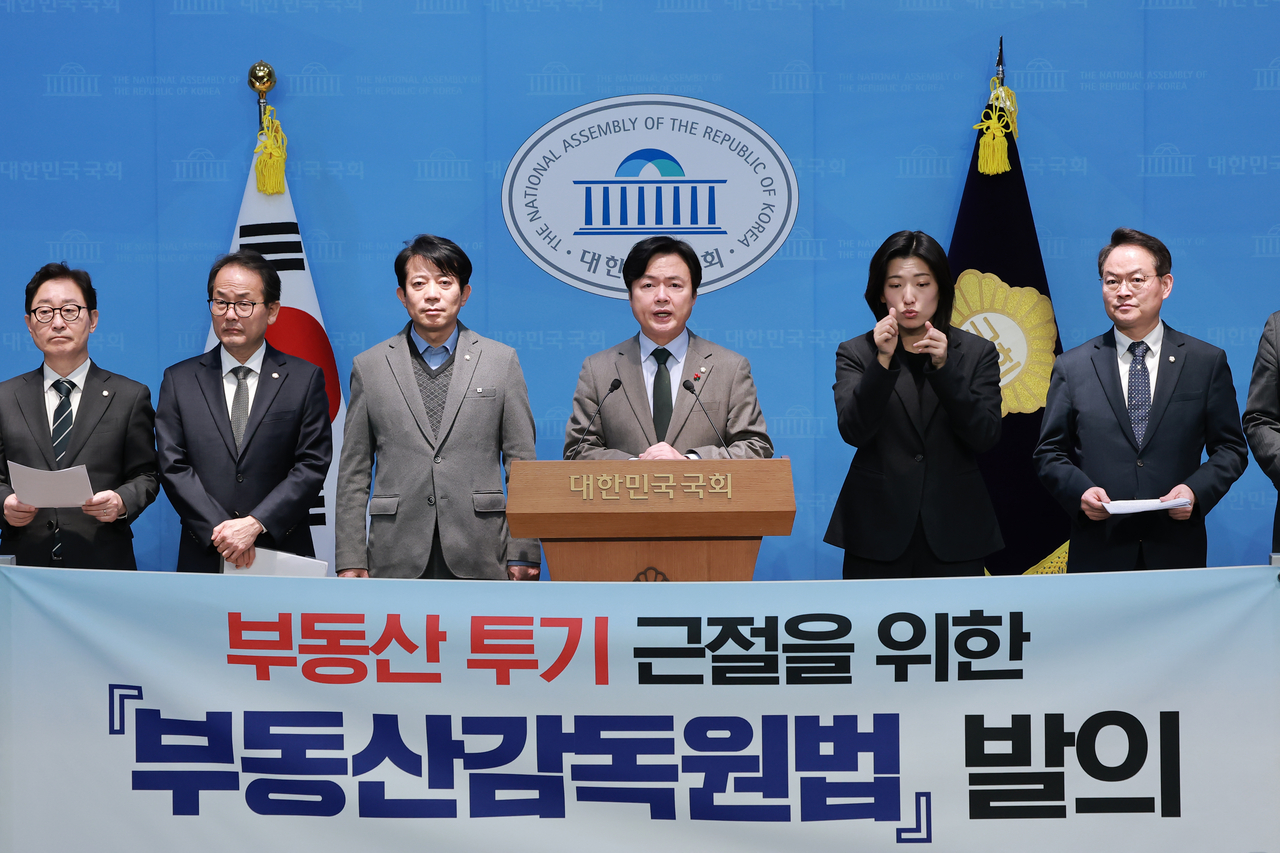
South Korea’s ruling Democratic Party of Korea on Tuesday proposed a bill to establish a centralized agency for cracking down on irregularities in housing transactions, as part of broader efforts aligned with President Lee Jae Myung’s push to rein in housing prices.
“South Korea bears the stigma of being a ‘real estate republic.’ More than 70 percent of household assets remain tied to property,” Rep. Kang Jun-hyeon of the Democratic Party said during a press briefing held at the National Assembly in Seoul.
“The Lee Jae Myung administration and the Democratic Party seek to address market overheating driven by speculative investments. The establishment of the supervisory service is part of that effort,” he added.
Under the bill, the Real Estate Supervisory Service — to be established under the Prime Minister’s Office — would function as a control tower overseeing real estate surveillance functions currently dispersed across multiple agencies, including the Land Ministry, National Tax Service, police and the Financial Supervisory Service.
The agency would also be granted the authority to conduct direct investigations when necessary.
According to the Democratic Party, agency employees would be granted special judicial police status, enabling them to directly investigate violations of real estate-related laws.
“The government and the Democratic Party will eliminate blind spots in monitoring through the Real Estate Supervisory Service,” Democratic Party spokesperson Rep. Kim Hyun-jung said during Tuesday's briefing at the National Assembly.
“We will firmly establish the principle that not a single won of illicit gains can be made through real estate crimes,” he added.
Under the legislation, the agency could request transaction records from financial institutions when deemed necessary for real estate crime investigations.
Financial firms would be required to provide such data without a warrant, including details on bank accounts used in property deals. The agency could also obtain related credit information and access relevant data held by government bodies such as the Land Ministry, tax authorities and the police.
However, the bill has drawn criticism from the main opposition People Power Party, which argues the proposed body would wield excessive authority over personal data.
“There are already sufficient institutional mechanisms in place to detect and crack down on abnormal real estate transactions,” Rep. Choi Eun-seok, senior floor spokesperson of the People Power Party, said during a party policy meeting at the National Assembly on Tuesday.
“Treating the entire public as potential criminals and allowing state power to broadly inspect sensitive personal information is surveillance, not enforcement,” he said.
The Democratic Party defended the bill, saying cross-verification of contract, taxation, registry and financial data is essential to strengthening responses to real estate crimes. It also said that financial data obtained without a warrant could not be directly used once a case transitions from an investigation to a formal criminal probe.
The party aims to pass the legislation and launch the agency in November, with an initial workforce of around 100 employees.
The move comes as President Lee Jae Myung accelerates broader measures to curb housing prices.
During a Feb. 3 Cabinet meeting, Lee said, “In South Korea, the real estate issue has become a malignant problem that blocks social progress as a whole.”
As part of such efforts, the Lee administration is also preparing to end the suspension of heavier capital gains taxes on owners of multiple homes.
The measure traces back to a tax framework introduced in 2021 under the Moon Jae-in administration, but was delayed over concerns about a transaction freeze and falling home prices.
flylikekite@heraldcorp.com