Jeong Eun-bo says valuations remain below developed markets, flags ‘Korea premium’ beyond that level
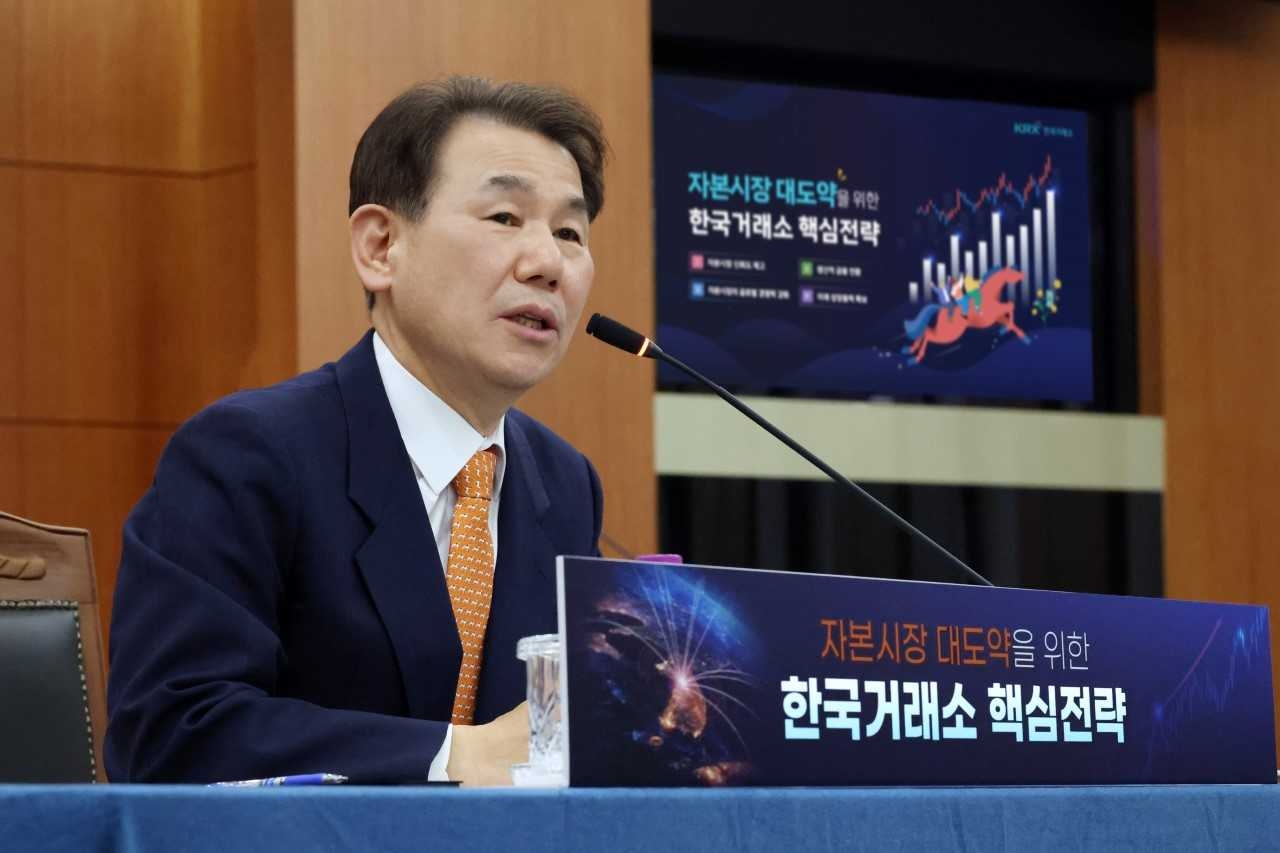
Korea Exchange CEO Jeong Eun-bo said Thursday the Kospi had room to rise beyond 6,000 points, adding that further gains would signal a “Korea premium.”
With the Kospi’s historic rally lifting the index to nearly double its level from a year earlier, Jeong said he expects the benchmark to climb past 6,000 “without major hiccups.”
“If the Kospi rises above the 6,000 or 6,200 mark, the index’s price-to-book ratio would climb to around 2.23 based on Morgan Stanley Capital International standards, bringing it into line with the average level of developed markets,” Jeong said at a press conference held at the bourse operator’s office in Yeouido, western Seoul.
Despite the Kospi's recent rally, the valuation of the Korean equity market remains low relative to major developed markets.
For the time being, the combined price-to-book ratio of the Kospi and secondary bourse Kosdaq stands at around 1.9 on an MSCI index basis, he explained, highlighting that this compares with roughly 2.3 for the UK, France and Germany, and about 5 for the US.
“While JPMorgan has suggested an upper target of 7,500, levels beyond that could be considered a premium valuation,” he added, referring to how the global investment bank set a 7,500 upside scenario for the Kospi on Tuesday.
Jeong also outlined the bourse operator’s plan to introduce a 24-hour trading system by December 2027. As a first step, the KRX plans to extend trading hours starting June 29, adding premarket and after-hours sessions that will lengthen daily trading to around 12 hours.
He added that cross-border competition among global exchanges has already intensified.
“The New York Stock Exchange and Nasdaq have officially announced plans to move toward round-the-clock stock trading,” Jeong said, stressing the move targets Asian investors.
“In light of these global trends, extending trading hours is unavoidable if we are to ensure a level playing field.”
Jeong warned that without an extension of trading hours, Korea risks losing global liquidity, which could weigh on the market.
“Last year, Nasdaq announced that about 80 percent of its after-hours trading was conducted by foreign investors, and more than half of that activity came from Koreans — meaning over 40 percent of total after-hours trades were made by Korean investors,” he said.
Jeong also said he believes the local stock market has become sufficiently advanced to support longer trading hours.
“Foreign investors account for more than 36 percent of the Korean market, making it a truly global market,” he said.
“It has reached a scale where it is difficult to construct a global portfolio without exposure to Korea. From an systemic standpoint, Korea has much to be proud of.”
silverstar@heraldcorp.com