Occupation of Sejong logistics hub leaves dealers, service centers, Chevrolet owners facing prolonged disruption

A labor standoff at a critical GM Korea logistics facility has paralyzed the automaker's after-sales network, leaving parts dealers and service centers struggling financially. Chevrolet owners are also facing lengthy delays in vehicle repairs.
Since former subcontractor workers occupied the automaker's main parts logistics center in Sejong in January, nationwide parts supplies have been crippled. Dealers say shipments have been stalled for over a month, with most critical replacement components unavailable.
"We are practically shut down," said Byun An-seop, an owner of an authorized GM Korea parts dealership in western Seoul. "There haven't been any parts coming in for over a month, so we basically have nothing to sell."
Authorized parts dealers like Byun normally get their supplies from Sejong Parts Distribution Center — the carmaker's sole Korean hub — and sell them to service centers, workshops and individual customers.
Byun said essential maintenance and repair components have all but vanished from stock. Items including spark plugs, wiring, ignition coils, fuel pumps, headlights, taillights, suspension parts, control arms and side mirrors are all out of stock. Customers have turned to aftermarket parts or overseas platforms instead.
How the conflict began
The conflict began in November when GM Korea selected JS Distribution as the new subcontractor to operate the Sejong facility. The move followed the expiration of its contract with Woojin Logistics, which had managed the site for two decades, on Dec. 31, 2025.
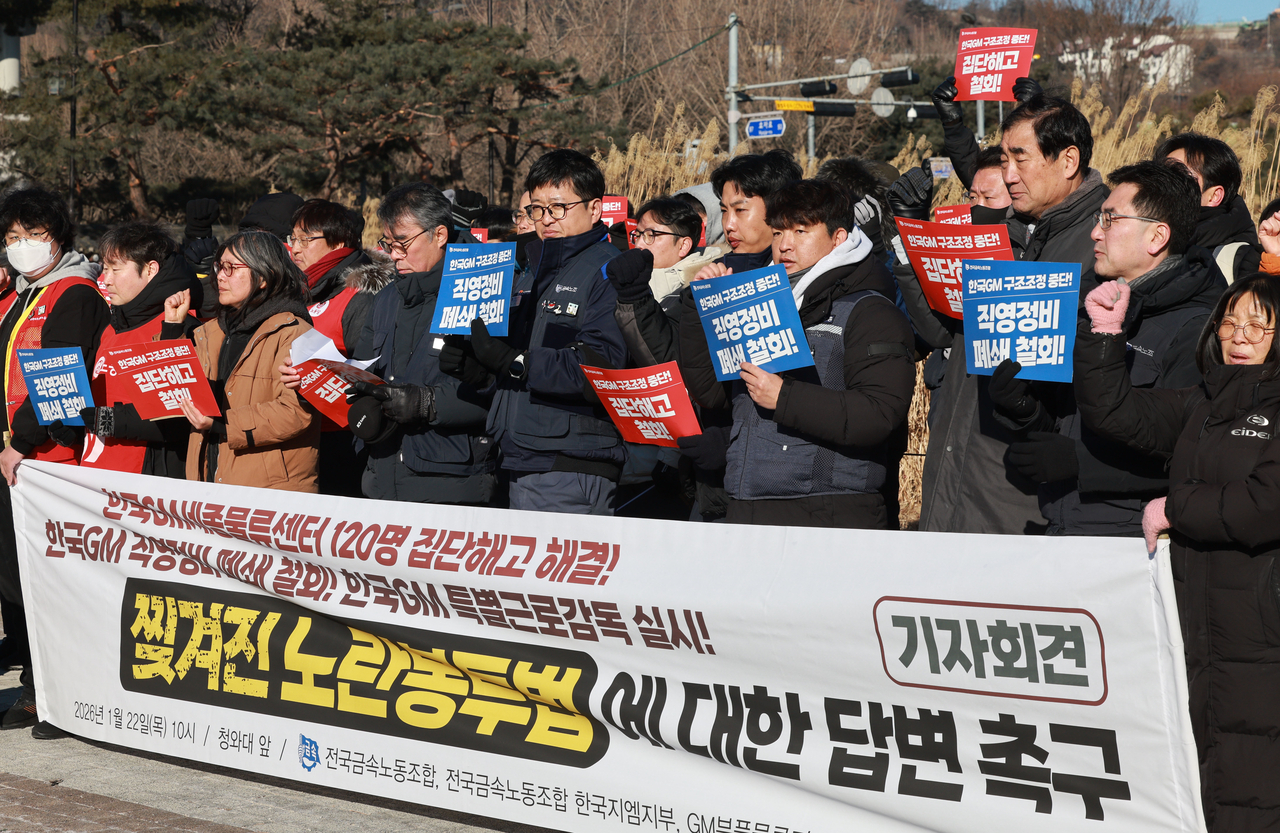
On Jan.1, Woojin dismissed around 120 employees who worked at the Sejong facility and began shutdown procedures. The displaced workers subsequently occupied the center, demanding the withdrawal of the layoffs and job guarantees under the new operator.
Since January, they have barred the new operator's access to the facility and blocked all parts from entering or leaving the premises.
Union representatives say GM Korea replaced Woojin after its employees formed a labor union in July to demand higher wages, accusing the carmaker of retaliatory behavior. GM Korea denies the allegation.
GM Korea says it bears no responsibility for the layoffs and instead offered all affected workers full-time positions at its Bupyeong and Changwon factories in Incheon and South Gyeongsang Province, respectively, despite having no legal obligation to do so. Most workers rejected the proposal, citing the relocation requirement and concerns about losing their legal claims.
Service centers under strain
The prolonged disruption has cascaded across GM's service network.
As parts shipments stalled, service centers have reported growing backlogs, particularly for accident repairs during the winter, while routine maintenance has become increasingly difficult.
"Because parts are not coming in properly, the service center is not operating the way we used to," said the owner of a GM partner service center in Incheon.
The center, which services both Chevrolet and Cadillac vehicles, previously handled about 2,000 cars a month. But the number fell to less than 1,500 in January due to parts shortages and is expected to decline further this month.
About 500 vehicles are currently on hold, waiting for components, while more than 40 cars sit stranded inside the facility as they cannot be moved without certain parts.
"We are exchanging parts with other centers and searching elsewhere for the parts," the owner said. "But that's unsustainable, and I don't know how long this will last."
Dealers face cash crunch
Without sufficient components, many parts dealers and service centers are facing severe cash-flow problems, while still having to cover rent, wages and operating expenses.
"We still have to run the shop and pay employees," said Byun. "Sales have fallen sharply, and I am concerned about if I will be able to meet payment obligations."
Byun said he has applied for government-backed loans for small businesses.
"The impact is enormous. It's not only us. But more than 600 small and midsized businesses are directly affected," said the Incheon service center owner. "Chevrolet car owners are also suffering if the situation continues, as they cannot get their cars fixed."
The crisis comes as GM Korea plans to overhaul its domestic service network. The carmaker announced it will close its nine directly operated repair centers across the country in February and shift services to about 380 partner workshops.
Some dealers are concerned that this restructuring, coupled with the ongoing supply disruption, could further weaken after-sales support. They are urging authorities to step in to restore operations at the logistics center or for GM Korea to take legal action to end the dispute.
Legal uncertainty
GM Korea has signaled it could pursue further legal action against workers occupying its Sejong parts center, alleging they are "illegally disrupting business operations."
According to union officials, GM Korea sent a formal legal notice on Jan. 20 demanding an end to what it described as "illegal occupation and obstruction."
In the notice, the company said that packaging and distribution operations at the Sejong warehouse were lawfully transferred from Woojin Logistics to a new operator, JS Distribution, after the previous contract expired. It added that the blockade has severely disrupted parts shipments, delaying vehicle repairs across the country.
A labor law expert said the workers occupying the facility could face serious legal risks.
"The key issue is whether the workers obtained the legal right to strike, and in this case, they didn't," said an attorney familiar with the case, who requested anonymity.
"For a strike to be lawful, workers must first secure legitimate collective bargaining rights. While a strike against Woojin may be justified, taking industrial action against GM Korea without prior negotiations is likely illegal."
Even if the layoffs were legally deemed unfair, workers would still need mediation by the labor commission and a strike authorization vote, the attorney added.
"None of these procedures were followed to gain collective bargaining rights, meaning they lack legal grounds for the strike," he said.
If the occupation continues, GM Korea could consider criminal charges for obstruction of business, seek court injunctions or pursue compensation claims for financial losses, the attorney added.
But for now, GM Korea said it remains focused on restoring logistics operations and its continued negotiations with the labor group.
"We hope employees will accept job offers and allow business to normalize," an official at GM Korea said.
sahn@heraldcorp.com