Presidential commission, special funding created; labor issue deferred
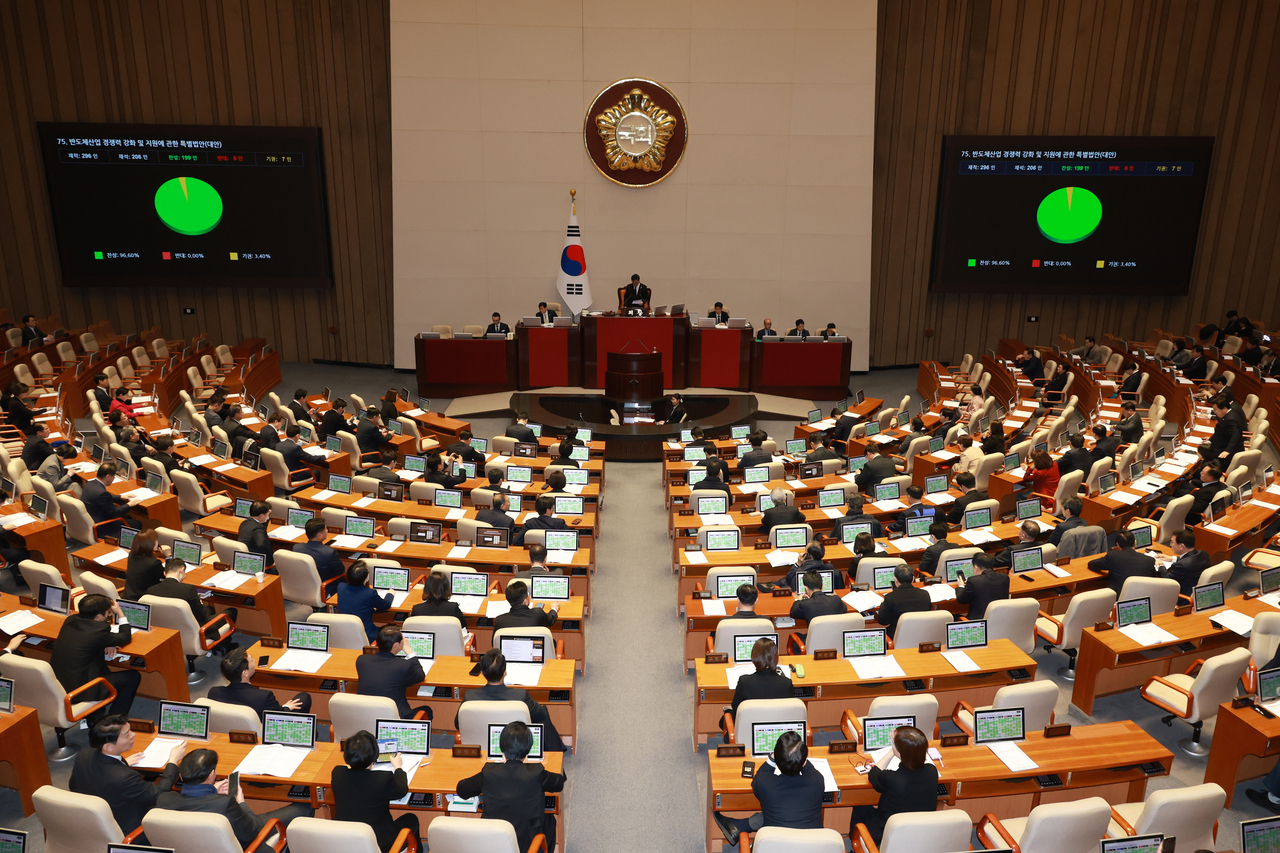
After 18 months of political deadlock, South Korea’s National Assembly on Thursday passed a long-delayed special law aimed at bolstering the country’s semiconductor industry, a cornerstone of its export economy and a strategic pillar in the global AI race.
The bill, formally titled the Special Act on Strengthening and Supporting the Competitiveness of the Semiconductor Industry, establishes a comprehensive institutional framework to support the entire semiconductor supply chain, encompassing memory and system semiconductors, design, manufacturing and packaging, as well as key materials, parts and equipment.
A clause that would have exempted semiconductor firms from the country’s 52-hour workweek cap — one of the bill’s most contentious provisions — was removed following strong opposition from labor groups. Instead, a supplementary opinion was added, recognizing the need for greater flexibility in working hours within the industry and noting that the matter would be further discussed at the committee level.
Until now, government support for the semiconductor sector has been dispersed across separate budget items and ministerial programs. The new law enables more centralized and sustained backing through institutional mechanisms.
A Presidential Commission for Enhancing Semiconductor Competitiveness will be established to oversee national chip policy, while a master plan will be drafted to guide future initiatives. A dedicated special accounting unit will also be created to secure funding for these efforts.
The law also lays the foundation for balanced regional development. Semiconductor clusters may be designated in regions outside the greater Seoul area, with the government supporting the development and operation of industrial infrastructure and offering incentives to firms and institutions that relocate to these clusters.
It further provides the legal basis for a broad range of business support measures. These include national projects for research and development, pilot testing centers, ecosystem development for materials, foundries and system semiconductors, workforce training programs, efforts to attract foreign talent, and exemptions from certain regulatory processes such as licensing, permitting and preliminary feasibility studies.
“Semiconductors are not only Korea’s top export item but also a strategic asset that will define our national and economic security in the era of AI,” said Industry Minister Kim Jung-kwan.
“With the enactment of this law, we will move swiftly to establish the necessary enforcement ordinances and ensure that support is felt on the ground. We aim to solidify and expand Korea’s technological lead, especially in AI semiconductors, where global competition is intensifying,” he added.
The legislation had been a key campaign pledge of President Lee Jae Myung during his presidential bid. Now that it has passed the Assembly, the law will proceed to the Cabinet for promulgation. Once the corresponding enforcement ordinances are finalized, it is expected to take effect as early as the third quarter of this year.
yeeun@heraldcorp.com