The South Korean presidential official said Tuesday that the United States had not provided an official explanation on President Donald Trump’s announcement that he will raise tariffs on certain South Korean imports and “reciprocal tariffs” to 25 percent.
“As of now, the US government has not issued any official notification or provided details regarding the measure,” Cheong Wa Dae said Tuesday in a statement released after Trump’s post.
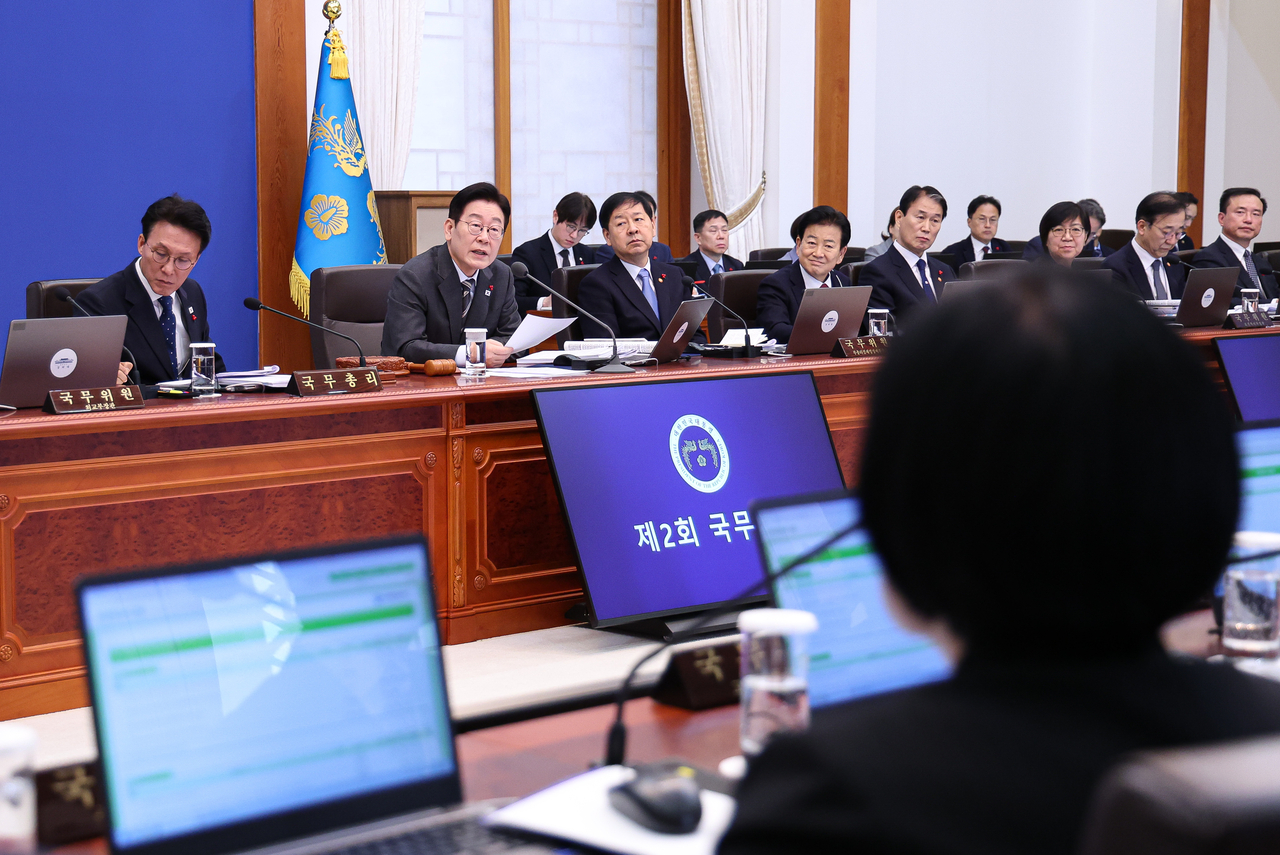
Cheong Wa Dae explained that an interagency response meeting involving relevant ministries, chaired by Kim Yong-beom, the presidential chief of staff for policy, would be held later Tuesday morning.
Minister of Trade, Industry and Resources Kim Jung-kwan, who is currently in Canada, also plans to visit the United States soon to discuss the matter with Commerce Secretary Howard Lutnick, according to Cheong Wa Dae.
In a Truth Social post on Monday, Trump said he would increase tariffs on South Korean autos, lumber and pharmaceuticals — as well as other “reciprocal tariffs” — from 15 percent to 25 percent.
Trump claimed the move was “because the Korean legislature hasn’t enacted our historic trade agreement, which is their prerogative.”
On Truth Social, Trump claimed that South Korea’s National Assembly had not approved the trade deal reached between the allies on July 30, and reaffirmed during his second summit with President Lee Jae Myung on Oct. 29.
“Our trade deals are very important to America. In each of these deals, we have acted swiftly to reduce our tariffs in line with the transaction agreed to,” Trump said. “We, of course, expect our trading partners to do the same.”
Trump also claimed that “South Korea’s legislature is not living up to its deal with the United States.”
Although Trump did not name the legislation, he appeared to be referring to the Special Act on Managing Korea-US Strategic Investments, introduced by South Korea’s ruling Democratic Party of Korea on Nov. 26.
The bill was submitted less than two weeks after the allies released a joint fact sheet and signed a memorandum of understanding (MOU) on strategic investment on Nov. 14, following their Oct. 29 summit in Gyeongju, North Gyeongsang Province.
Under the fact sheet, South Korea pledged $350 billion in US-bound investment, while Washington agreed to lower tariffs on South Korean automobiles.
In the MOU, the two sides agreed that any tariff reductions would apply retroactively from the first day of the month in which the bill is submitted to the National Assembly.
On Dec. 4, the US retroactively lowered tariffs on South Korean automobiles to 15 percent after the measure was published in the Federal Register.
While Trump has pointed to delays in South Korea’s legislative process, it remains unclear whether that alone explains the decision to raise tariffs.
Washington has also voiced dissatisfaction with revisions to South Korea’s Information and Communications Network Act approved by the National Assembly in late December, as well as with the repeated introduction of bills aimed at regulating online platforms.
Prime Minister Kim Min-seok said Vice President J.D. Vance also raised concerns during their meeting in Washington, questioning whether South Korea would pursue a “discriminatory and aggressive investigation” into Coupang’s massive data breach.
dagyumji@heraldcorp.com