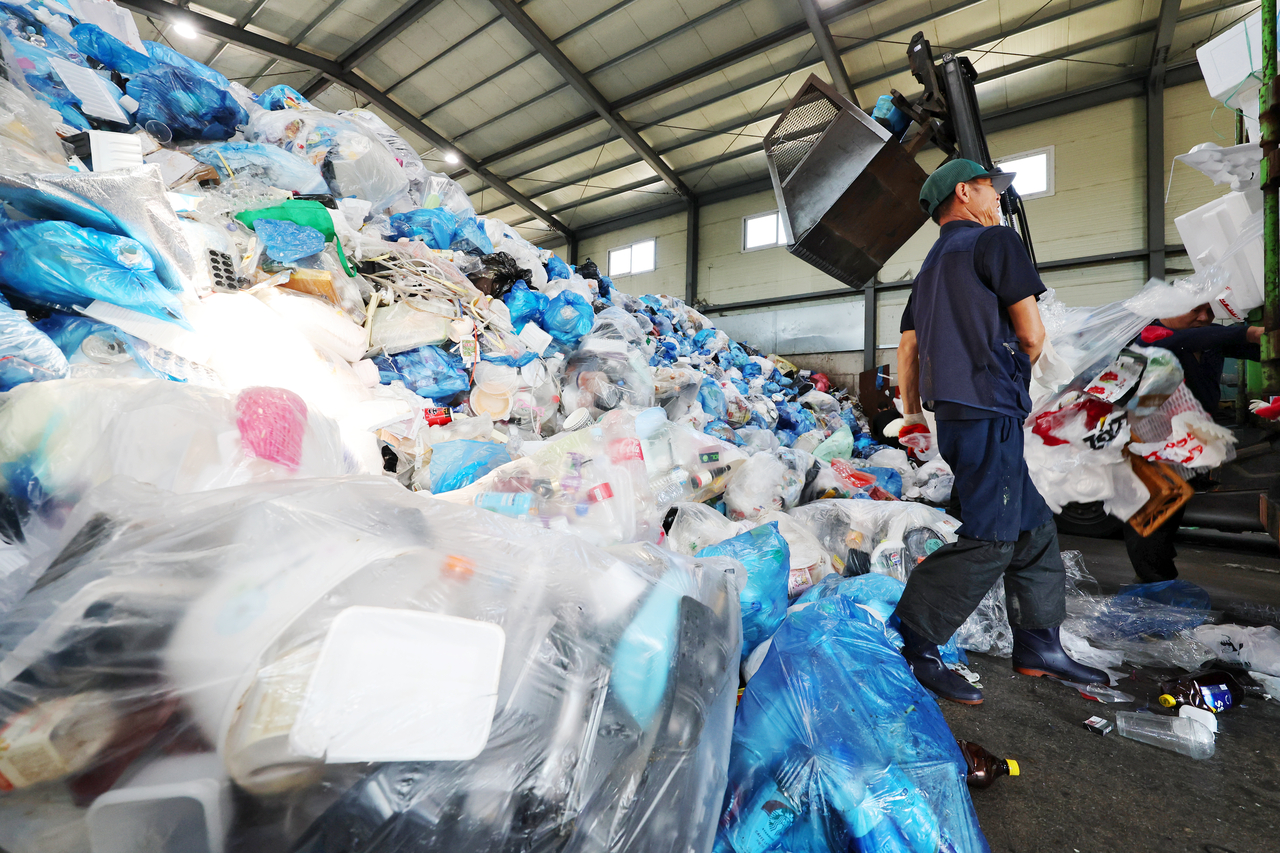
Seoul announced an aggressive plan to cut household waste in preparation for a nationwide ban on dumping garbage in landfills.
Under the initiative, the city aims to reduce the annual volume of general residential waste by 10 liters per person over the next two years — about the same as one standard volume-based trash bag. The total reduction target is comparable to the daily waste output of an entire district, or about 120 metric tons.
The announcement comes as Korea enters a new regulatory phase this year. Local governments can no longer bury household waste in landfills unless it has first been processed through sorting and incineration. Only incineration ash may now be dumped in landfil sites.
The shift brings a formal end to Korea's long-standing practice, which for decades allowed municipalities to send volume-based trash bags straight into landfill pits with minimal treatment. The system had raised persistent environmental concerns, including odor complaints and the leakage of pollutants.
In Korea, residents pay for household waste based on the volume they discard rather than a flat fee. Individuals must purchase official city-issued trash bags ranging from 5 to 50 liters, with the price of the bag serving as the disposal charge.
Seoul's four public incineration plants, in Gangnam-gu, Mapo-gu, Nowon-gu and Yangcheon-gu, currently handle about 2,200 tons of waste a day. The city, however, generates around 3,000 tons daily, leaving a sizable gap that must be filled through private incinerators.
Facing pressure to comply with the new national rules, city officials say the only sustainable path is to sharply reduce household waste at the source, while expanding public processing capacity over the long term.
The city's strategy centers on large-scale public participation programs coupled with upgrades to waste-sorting systems and infrastructure. Seoul plans to gradually build the conditions needed for all household waste to be processed through public incineration facilities by 2033.
"Our priority for the first half of this year is building a citywide consensus on the need to reduce waste," a Seoul official said, adding that public participation must come before any structural reform.
The first phase of the civic campaign aims to encourage proper recycling practices. Beginning in February with Mayor Oh Se-hoon and followed by the heads of all 25 city districts, the city hopes to collect 100,000 public pledges.
The pledge includes everyday actions such as preventing food waste from mixing with general trash, keeping plastic and vinyl out of volume-based bags, separating paper materials, prioritizing reusable containers and carrying shopping bags and coffee tumblers.
A second program, the "100-Day Household Waste Diet," invites 354 residents and civic groups — symbolizing the city's per-capita daily waste generation of 354 grams — to track and reduce their household waste output over a 100-day period.
Top-performing participants will be recognized with city awards and Eco Mileage points. The city will also recruit 25 apartment complexes to take part in a yearlong project measuring and reducing recyclable materials thrown into general waste, with high-performing complexes eligible for up to 10 million won ($7,000) in Eco Mileage benefits and environmental upgrades.
Seoul will additionally deploy teams to residential neighborhoods, traditional markets and areas with large foreign resident populations to carry out waste-sorting education there.
In areas with a high proportion of trash that is not properly sorted, officials will conduct spot checks by opening volume-based bags to identify improperly mixed items and reinforce proper recycling methods.
The city estimates that achieving the goal of reducing one trash bag per person per year would eliminate about 60 tons of household waste per day — equivalent to roughly 44,000 tons over two years.
Such reductions are urgently needed, given the mismatch between the pace of new regulations and the region's current disposal capacity. Yet the construction of new public incinerators has stalled since 2021 due to fierce local opposition and difficulties securing appropriate sites.
Experts warn that raising incineration capacity alone will not provide a lasting solution. Studies show that more than half of the material inside volume-based trash bags consists of recyclable plastics that were discarded incorrectly.
Advanced presorting technologies could reduce the amount requiring incineration or landfilling by up to 80 percent, they say, but only if paired with sweeping public education and improvements in local recycling systems.
"Reducing household waste is a starting point for resource circulation and a crucial task linked to expanding public waste-processing capacity," said Kwon Min, head of the Seoul Climate and Environment Headquarters.
He added that the city aims to use broad public engagement to prepare for the nationwide landfill ban and to lay the foundation for Seoul's 2050 carbon neutrality ambitions.
jychoi@heraldcorp.com