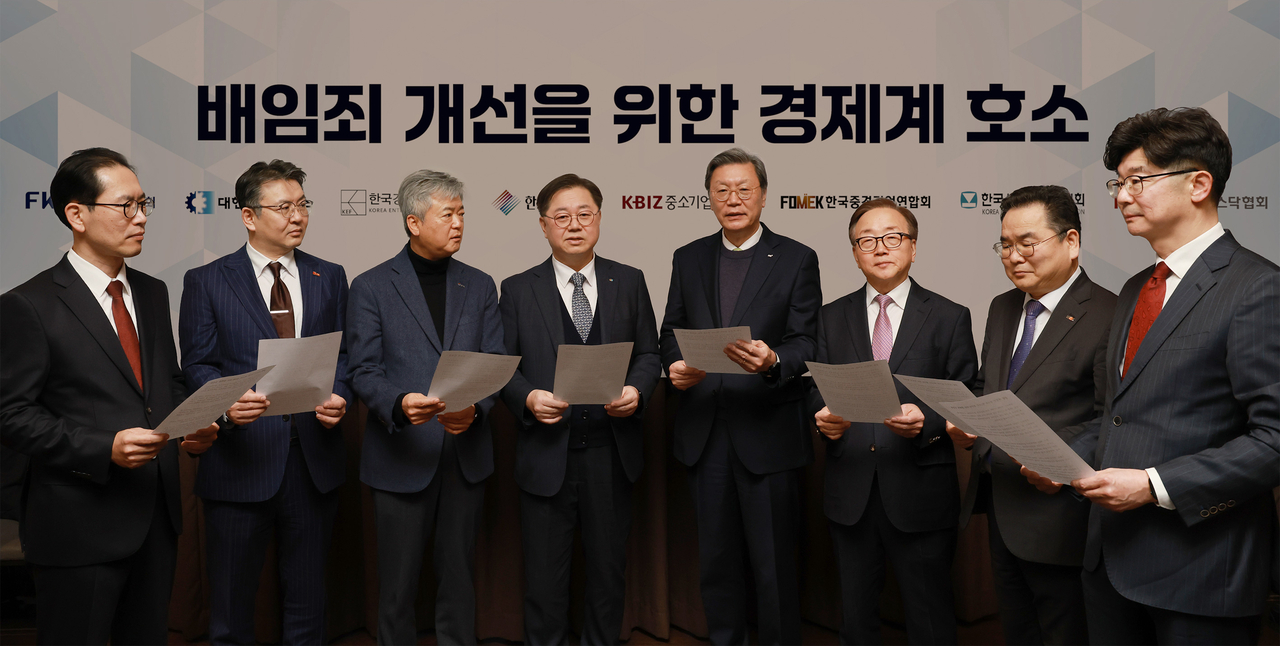
South Korea’s eight major business groups on Monday urged the government and the National Assembly to follow through on a promised overhaul of the breach of trust provision in the Criminal Act, warning that vague legal standards are stifling business decision-making and deterring investment in new industries.
A proposal calling for swift legislative action has been submitted to the National Assembly and the Justice Ministry, said the coalition comprising the Korea Chamber of Commerce and Industry, the Federation of Korean Industries, the Korea International Trade Association, the Korea Enterprises Federation, the Korea Federation of SMEs, the Federation of Middle Market Enterprises of Korea, the Korea Listed Companies Association, and the Kosdaq Listed Companies Association.
The Democratic Party of Korea and the government proposed scrapping the breach of trust law last September, citing concerns that it overly restricts business activities. However, business lobbies said little progress has been made, even as measures seen as increasing corporate burdens — such as expanded collective bargaining rights and mandatory cumulative voting revisions — have moved forward.
The breach of trust provision criminalizes corporate executives or directors who violate their fiduciary duties and cause financial harm to their companies through negligent or self-serving decisions. Governed by three statutes — the Criminal Act, the Commercial Act, and the Act on the Aggravated Punishment of Specific Economic Crimes — the provision has been applied in high-profile merger and financial cases. Korea is among the few countries that criminalize such conduct, and it imposes some of the harshest penalties.
“The breach of trust charge contains ambiguous definitions of who may be punished and what constitutes wrongdoing, creating a significant risk that even rational management decisions could be penalized,” the groups said in a joint statement. “This has undermined entrepreneurial spirit by discouraging business leaders from entering new industries or making bold investment decisions.”
The groups called for an “unconditional and full overhaul” of breach of trust provisions under the three statutes, proposing that relevant violations instead be punished under fraud or embezzlement laws, as in the US or the UK, or addressed through civil proceedings.
If a full repeal proves difficult and lawmakers opt to introduce replacement measures under separate laws, the groups urged that legal elements be clearly defined, as in Germany and Japan, including explicit limits on who is covered and what behavior is punishable.
They also suggested adding “intent to benefit oneself or a third party or to harm the principal” as a requirement for establishing the offense, ensuring that only deliberate illegal acts are punished. In addition, the groups called for financial loss to be clarified as “actual loss incurred,” arguing that companies should not face prosecution based solely on the possibility of harm.
sahn@heraldcorp.com