Korean National Symphony Orchestra's new music director lays out vision
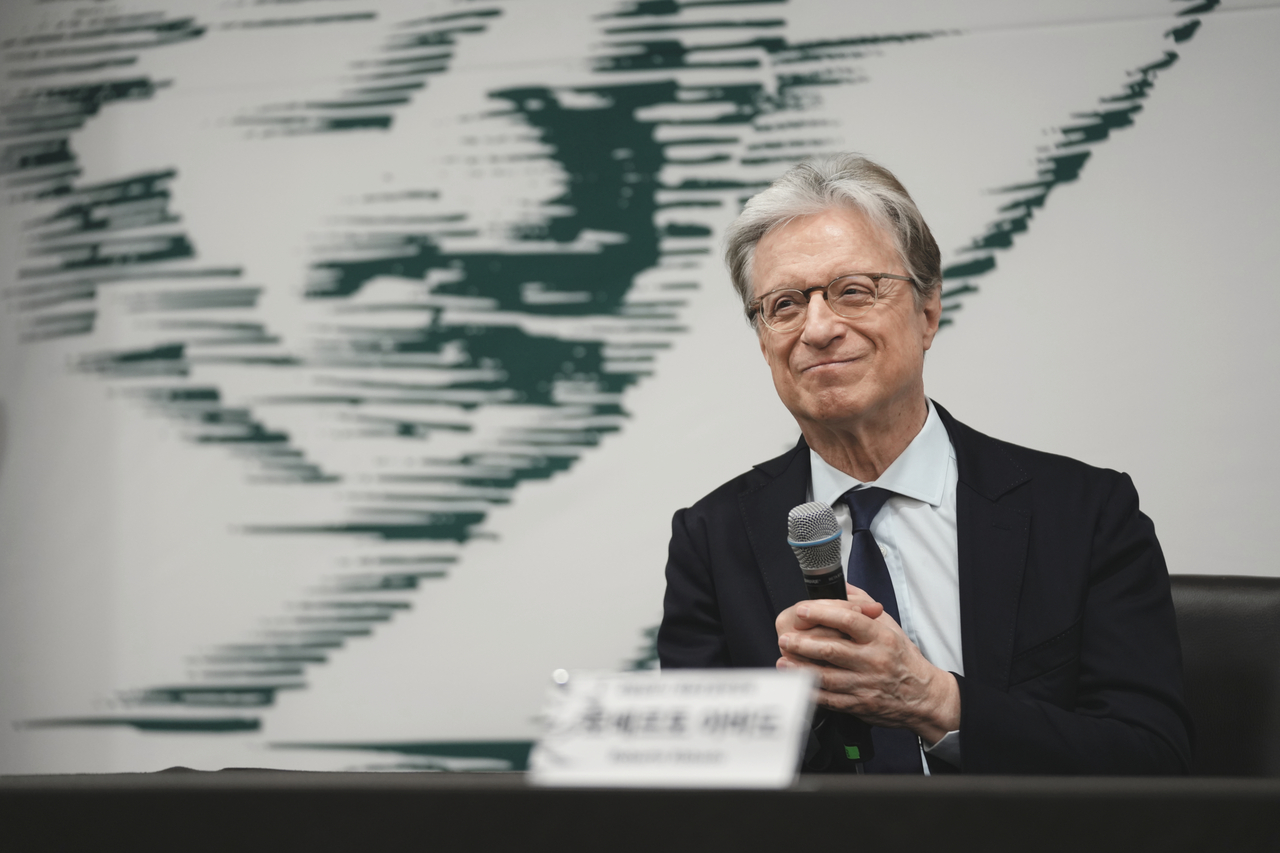
Korean National Symphony Orchestra’s new music director, Roberto Abbado, first encountered the orchestra in 2023, when he conducted Bellini’s "Norma" with the ensemble.
Recalling the experience, the 71-year-old maestro described it as immediately positive, noting that when working with an orchestra, the first few seconds can be decisive. "Norma," he explained, is an intensely Italian opera, one in which the music depends on the flexibility of Bellini’s phrasing.
“I was genuinely surprised by how naturally the orchestra responded from the outset, translating what I had envisioned operatically into sound," he said during a press conference held at the Seoul Arts Center, where the orchestra is based, Wednesday.
Their second collaboration followed in March 2025 with Verdi’s “Requiem,” a process Abbado described as organic and effortless. Soon after, he was offered the role of music director.
Abbado’s three-year programming plan at the national orchestra is built on three main pillars, the Italian conductor explained.
One examines the contrasting musical paths of Mendelssohn and Schumann, contemporaries who developed markedly different voices within romanticism. Another explores the relationship between literature and music, focusing on the influence of Johann Wolfgang von Goethe. A third centers on William Shakespeare and the rich musical legacy inspired by works such as "Romeo and Juliet," "The Tempest" and "A Midsummer Night’s Dream."
With the musicians of the orchestra, Abbado said he will try to balance multiple criteria of the music, all of which carry equal weight.
“Sound quality, rhythm, musical pulse, precision of phrasing and intonation are all essential, and none can be treated as secondary. What matters most is achieving a sense of balance among these elements, so that they function together as a coherent whole rather than as isolated technical goals.”
He also emphasized the importance of developing experience in both opera and symphonic music, allowing the two fields to engage in a meaningful dialogue.
“It is important to preserve and further develop this dual identity of the Korean National Symphony Orchestra,” he added.
The role of the KNSO spans symphonies, opera and ballet.
Noting the growing visibility of Korean culture in Europe — spanning film, pop and rock music, fashion, food and classical music — he said that visibility has only heightened his curiosity about contemporary Korean artists.
“Over nearly 50 years on the podium, wherever I have worked around the world, I have encountered Korean musicians, composers, soloists and singers,” he said. “The fact that Korean artists are active everywhere internationally speaks to the strength of Korea’s younger generation of composers as well. That is one of the reasons I am here, and why I intend to devote a significant part of my work to contemporary music.”
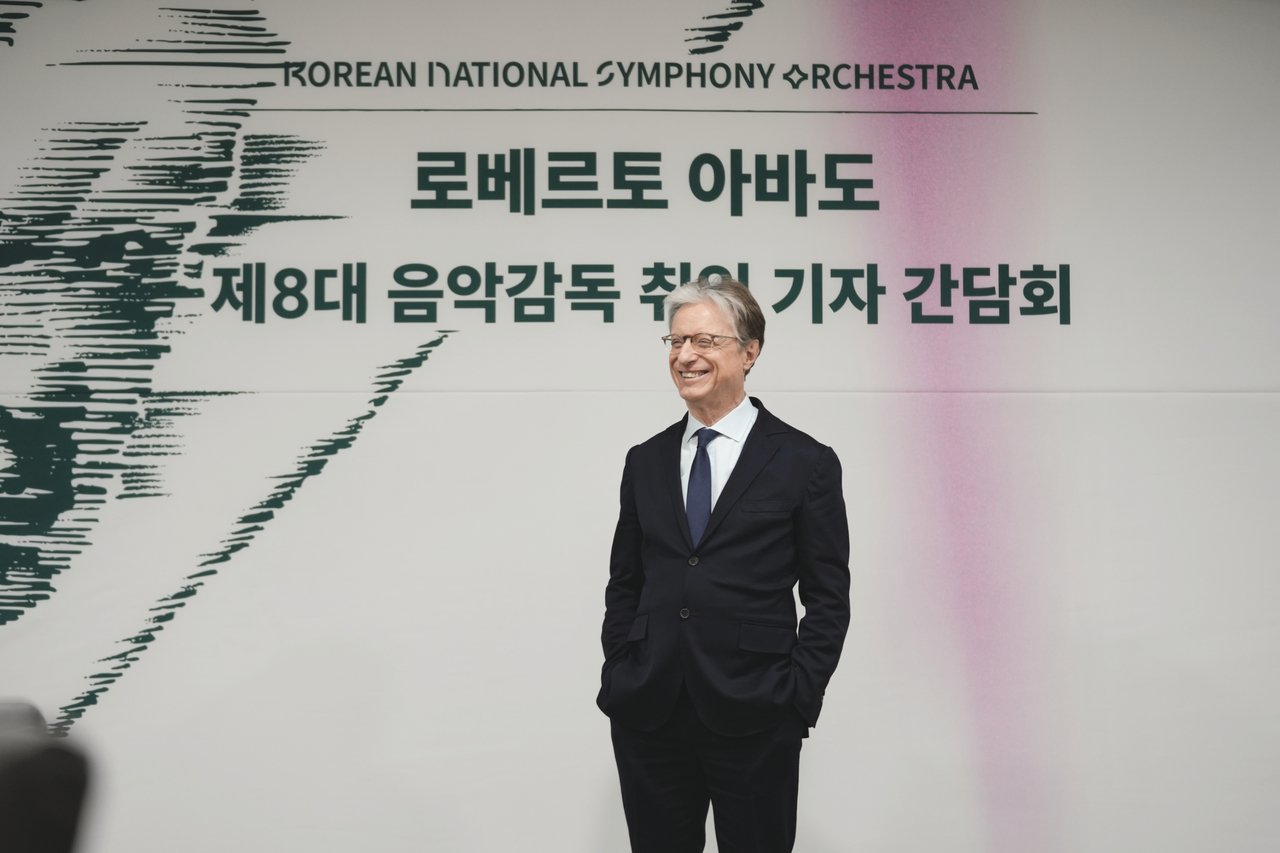
Abbado traced this approach to his family background, where curiosity about musicians of his own time — and engagement with living composers — was a natural part of everyday musical life.
In the 1930s, his grandfather, Michelangelo Abbado, founded Italy’s first orchestra dedicated exclusively to baroque music for a string ensemble. Rehearsals for the ensemble were held in the family apartment.
Growing up in this environment were Roberto Abbado’s father Marcello Abbado — a composer who later served as director of the Milan Conservatory — and his uncle Claudio Abbado, who would go on to become one of the most influential conductors of his generation. Claudio Abbado later served as music director of La Scala, principal conductor of the Berlin Philharmonic and the London Symphony Orchestra, music director of the Vienna State Opera and founder and director of the Lucerne Festival Orchestra.
That early exposure to living musical ideas shaped Claudio Abbado’s outlook. As a boy in wartime Milan, he admired the music of modernist composer Bela Bartok (1881-1945), famously scrawling “Viva Bartok!” on a wall — an episode often cited as an early sign of his deep affinity for 20th-century music.
Roberto is similarly known as a passionate advocate of contemporary music, premiering works by Charles Wuorinen, Pascal Dusapin, Luca Francesconi and Silvia Colasanti, as well as 20th-century composers such as Luciano Berio and Olivier Messiaen.
Along with his role at the KNSO, the conductor, recipient of the Franco Abbiati Prize from the Italian National Association of Music Critics, also serves as principal conductor of the Philharmonic Orchestra of the Bologna Municipal Theater.
Previously, he served as music director of the Munich Radio Orchestra, Queen Sofia Palace of Arts in Valencia, Spain, and the Festival Verdi in Parma, Italy. He has appeared with some of the world’s most celebrated orchestras, including the Royal Concertgebouw Orchestra, Leipzig Gewandhaus Orchestra, Vienna Symphony Orchestra and the Los Angeles Philharmonic.
His inaugural concert takes place Sunday at the Seoul Arts Center, featuring a program that includes Respighi’s "The Fantastic Toy Shop," Verdi’s “The Four Seasons” from the opera "Les Vepres Siciliennes (The Sicilian Vespers)" and Rossini’s "William Tell Overture."
In shaping the program, Abbado said he was mindful of the symbolic nature of a New Year's concert, aiming for brightness, sparkle and lightness, while allowing for a touch of lingering melancholy as the year turns, ultimately offering a positive message to welcome the year ahead.
gypark@heraldcorp.com