Chipmakers hit new highs, lifting Seoul benchmark near record
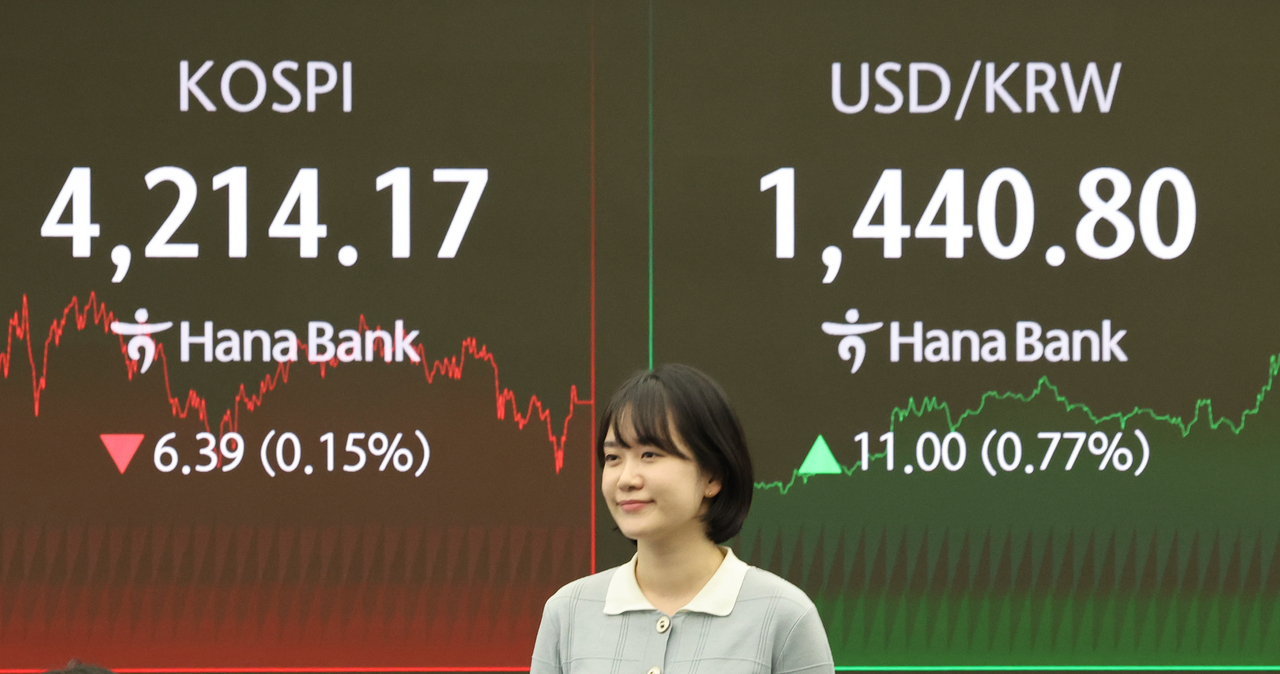
South Korean equities wrapped up a standout year in 2025, with the Kospi brushing aside global skepticism to deliver the world’s strongest annual performance and finish near record levels.
On Tuesday, the final trading day of the year, the benchmark index closed at 4,214.17, up 76 percent from where it ended 2024 and marking the highest year-end finish in its 43-year history.
The index briefly raised expectations of a fresh record after climbing as high as 4,226, just shy of its all-time peak of 4,226.75, buoyed by new highs in heavyweight chipmakers. Yet, the rally proved short-lived, with trading remaining tight around 4,220 before the index slipped back below 4,200 toward the close.
Foreigners led the sell-off, dumping about 470 billion won ($325 million) in Kospi shares in year-end profit-taking, alongside institutions that sold roughly 370 billion won. Retail investors were the sole net buyers, purchasing around 820 billion won.
While the index was little changed, its two largest heavyweights — Samsung Electronics and SK hynix — both hit record intraday highs, with Samsung at one point rising to 121,000 won and SK hynix to 659,000 won, before finishing the session at record closes of 119,000 won and 651,000 won.
SK hynix’s advance also lifted AI-focused investor SK Square to a new high. Its shares surged more than 6 percent, briefly touching 370,000 won and pushing its market capitalization to about 48 trillion won, propelling the firm up several notches to finish the year as the Kospi's eighth-largest company.
The Kospi surged 76 percent over the year, the strongest performance among major global markets, far outpacing gains of 17 percent on the S&P 500 and 22 percent on the Nasdaq. It marked only the third such boom for the index, after rallies of 93 percent in 1987 and 83 percent in 1999.
Few had anticipated such a turnaround a year ago. The benchmark entered 2025 under pressure after then-President Yoon Suk Yeol’s sudden declaration of martial law in December, which sent the Kospi sliding below 2,400.
The market remained subdued through the first half as political uncertainty lingered until Yoon’s impeachment in April and a presidential election in June, while US tariff-driven trade tensions weighed on Korea's export-driven economy. Foreign investors sold about 16 trillion won of local shares through May, leaving the index mired near 2,700 when the new administration took office.
Sentiment shifted sharply after President Lee Jae Myung’s pro-market agenda and a global AI boom reignited risk appetite. The Kospi reclaimed 3,000 on June 20 — its first return above the level in more than three years — less than a month after Lee’s election, and went on to hit a record 3,000 trillion won in market capitalization on Oct. 15, when the index also pierced 3,650.
The rally accelerated into the fourth quarter, lifting the Kospi past 4,000 for the first time on Oct. 27. The index went on to set a record closing high of 4,221.87 on Nov. 3, followed by an all-time intraday peak of 4,226.75 the next day.
Korea's strength in semiconductors helped the market ride the global AI boom, with surging shares of Samsung Electronics and SK hynix leading the advance. Samsung gained 125 percent over the year, while SK hynix nearly quadrupled, with the two companies now accounting for almost 35 percent of Kospi's 3,480 trillion won market cap.
While trailing the Kospi’s outsized advance, the Kosdaq, Korea's secondary board, also posted solid gains of 37 percent for the year. Renewed expectations for policy support fueled a December rally, with analysts projecting the tech-heavy index could reach 1,000 in early 2026, potentially followed by further upside.
Kosdaq ended Tuesday's session down 0.76 percent at 925.47, with individuals net buying 535 billion won and foreigners and institutions offloading 313 billion won and 191 billion won, respectively.
Another surprise in the stock market’s surge was its resilience in the face of persistent weakness in the local currency. The won endured a volatile year, weakening to near-crisis levels above 1,480 per dollar in April amid peak US tariff concerns, and again in early December as demand for dollars rose alongside overseas equity investment.
After hitting a daytime low of 1,487 against the greenback on April 9, the won has since stabilized below 1,450, trading around 1,445 as of 5 p.m. Tuesday.
jwc@heraldcorp.com