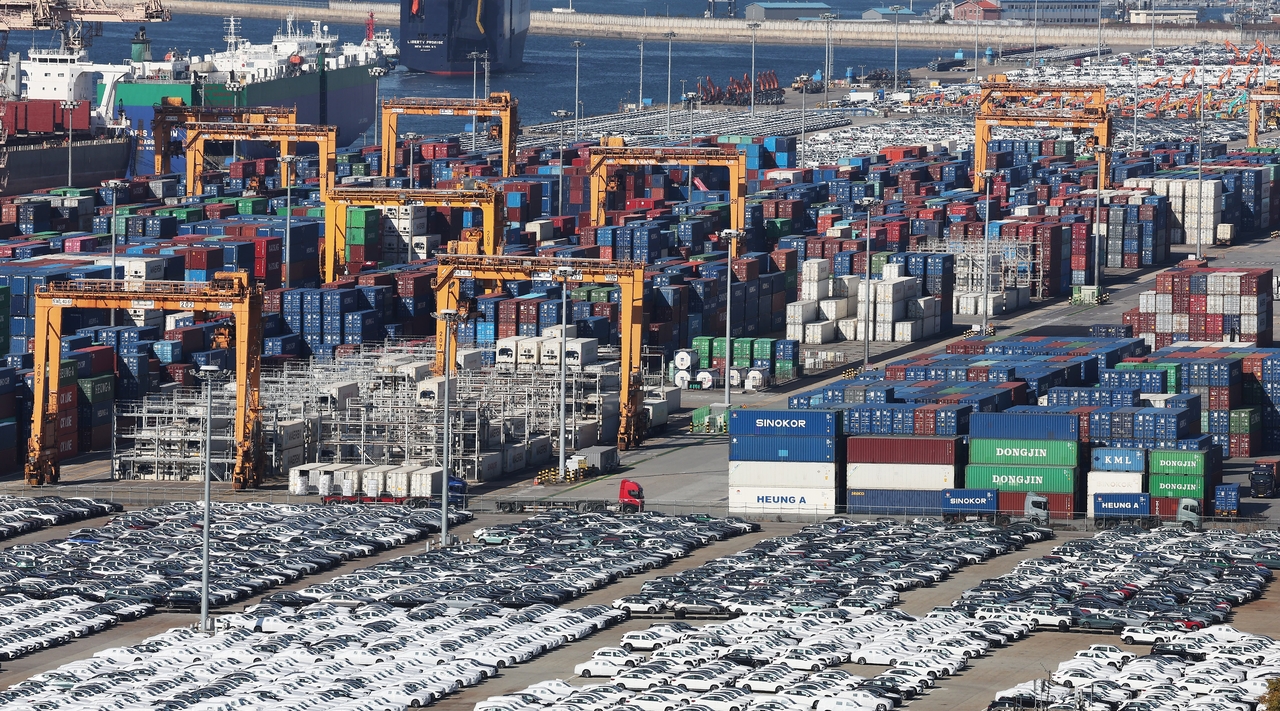
South Korea has crossed a $700 billion annual export threshold for the first time, cementing its position as the world’s sixth-largest exporting country as geopolitics, technology and supply chain realignment reshape global trade.
According to provisional data released Monday by the Korea Customs Service and the Ministry of Trade, Industry and Energy, cumulative exports reached $700 billion on Monday. The milestone comes seven years after the country first surpassed $600 billion in exports in 2018, marking the fastest advance between the two levels among major exporting economies, the government said.
Only China, Germany, Japan, the Netherlands and the United States have previously exceeded $700 billion in annual exports.
The headline figure masks a sharply bifurcated year: Exports weakened in the first half amid domestic and external uncertainty, then rebounded decisively from June as policy uncertainty eased and global demand for high-value-added industrial goods strengthened.
From June through November, South Korea posted six consecutive months of record-high exports for each respective month, with September setting an all-time monthly high of $65.9 billion, according to the ministry.
Semiconductors were the central driver of the rebound. Chip exports totaled $152.6 billion from January through November, up 19.8 percent year on year, accounting for 23.8 percent of total exports over the period, government data showed. Officials attributed the surge to strong global demand for AI server-related components and rising memory prices.
The semiconductor trade surplus alone exceeded the country’s overall trade surplus during the same period.
Other core manufacturing sectors also contributed. Automobile exports reached $66.0 billion in the January to November period, up 2.0 percent on-year, despite tariff-related headwinds in the US market. Shipbuilding exports climbed 28.6 percent to $29.0 billion, reflecting deliveries of high-value-added vessels such as LNG carriers ordered during the 2022-2023 upcycle. Biohealth exports rose 6.5 percent to $14.7 billion, supported by biosimilar approvals and contract manufacturing orders.
Geographically, export growth increasingly came from outside South Korea’s two largest markets. China’s share of exports fell to 18.4 percent from 19.5 percent a year earlier, while the US share declined to 17.3 percent from 18.6 percent. In contrast, the share from ASEAN member states rose to 17.2 percent, and exports to the European Union and Latin America also edged higher, according to the ministry.
Trade performance translated into a solid external balance despite structural vulnerabilities. From Jan. 1 to Dec. 28, energy imports totaled $117.4 billion, while the overall trade surplus reached $73.0 billion, the customs agency said.
Foreign direct investment moved in tandem with exports. The ministry said FDI notifications in 2025 exceeded $35 billion, surpassing the previous record of $34.57 billion set in 2024. Greenfield investment, defined as new facilities built from the ground up rather than mergers and acquisitions, accounted for a record share. Investment plans announced during the year included projects by Amazon Web Services in AI data centers, Renault in future vehicles and Amkor Technology in semiconductor back-end processing.
The government said it is targeting exports of at least $700 billion again next year and inbound foreign investment above $35 billion, citing policy priorities that include manufacturing innovation, changes in trade structure and stronger incentives for investment outside the Seoul metropolitan area.
mjh@heraldcorp.com