Strong dollar keeps won near record levels
With the Korean won poised to post its weakest year on record, global investment banks expect the currency’s weakness to persist into the new year, with levels above 1,400 won per US dollar becoming the norm in 2026.
According to industry data released Sunday, the average three-month forecast for the won from 12 major investment banks stands at 1,440 per dollar. HSBC was the most optimistic at 1,400, while Nomura and Standard Chartered were the most bearish, both projecting 1,460.
The six-month outlook eases to an average of 1,426, with the nine-month and one-year forecasts inching slightly stronger to 1,424.
Over a 12-month horizon, views diverge sharply. Nomura projected the strongest won at 1,380 per dollar, while Barclays Capital forecast continued depreciation, with the exchange rate rising by about 20 won every three months from 1,430 in the first quarter to as weak as 1,490 over the full year. Bank of America and Goldman Sachs, alongside Nomura, were the only banks among the 12 to project a sub-1,400 annual average.
The projections broadly point to a won even weaker than in 2025, a year that has already seen the currency slide to levels near 1,500 per dollar. As of Sunday, the won was averaging 1,421.9 against the greenback, a record-high annual level. With just three trading days left in 2025, the year is expected to close at around 1,420 on average.
The predictions are far weaker than the International Monetary Fund’s estimate of the won’s “fair value” at 1,330, outlined in a recent External Sector Report. The IMF benchmark was based on 2024 trends, when the currency averaged about 1,346 per dollar.
Still, the forecasts may be revised, as most were compiled before the won’s recent rebound following the government’s strong verbal intervention on Wednesday. Underscoring its determination to rein in the excessive weakness in the currency, foreign exchange authorities warned that markets would soon see how measures rolled out in recent weeks would “put the situation in order.”
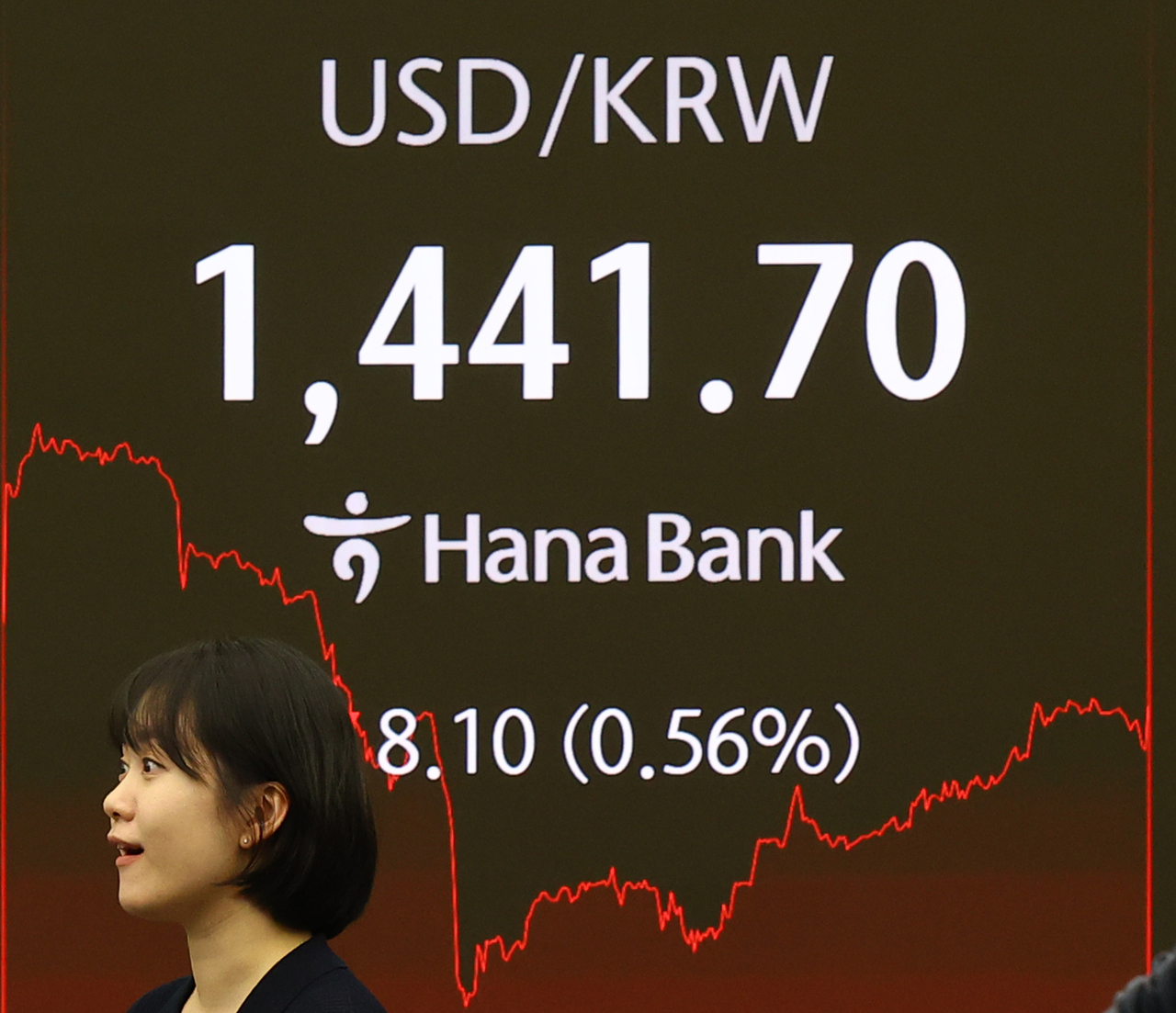
Following the intervention, the won strengthened against the dollar by nearly 34 won in a single session, the biggest daily move in more than three years, closing at 1,449.8 and breaking the closely watched 1,450 level. The won extended gains into the next session on Friday, briefly strengthening to 1,429.5 before paring some of the gains to end at 1,440.3.
The currency has stayed above 1,400 throughout most of October to December, extending an uptrend that briefly pushed it past 1,480 from Dec. 22-24, a level last seen in April when foreign exchange volatility peaked amid heightened uncertainty over US tariff hikes.
Despite easing external risks and improving macro indicators, the authorities and market experts say the recent weakness has been driven largely by structural imbalances in dollar demand and supply, as overseas investments by individual investors and large institutions such as the National Pension Service surged in the second half. Government measures have targeted those pressures, including expanded foreign exchange hedging with the pension fund and tax incentives aimed at drawing retail capital back into local markets.
Local analysts expect the won to strengthen in the new year as the measures take effect, though the gains are likely to be limited.
“The government’s series of strong measures and its clear resolve to prevent further depreciation are likely to cap additional upside in the exchange rate,” said Jeong Yong-taek, an economist at IBK. “But expectations for a sharp drop should be tempered as the equilibrium level itself has shifted higher, and policy steps are better seen as efforts to manage elevated volatility rather than to change the underlying trend.”
jwc@heraldcorp.com