South Korea’s main opposition People Power Party is exploring multiple routes to regain its political footing, both inside the party and externally, as it struggles to reverse slipping public support ahead of next year’s local elections.
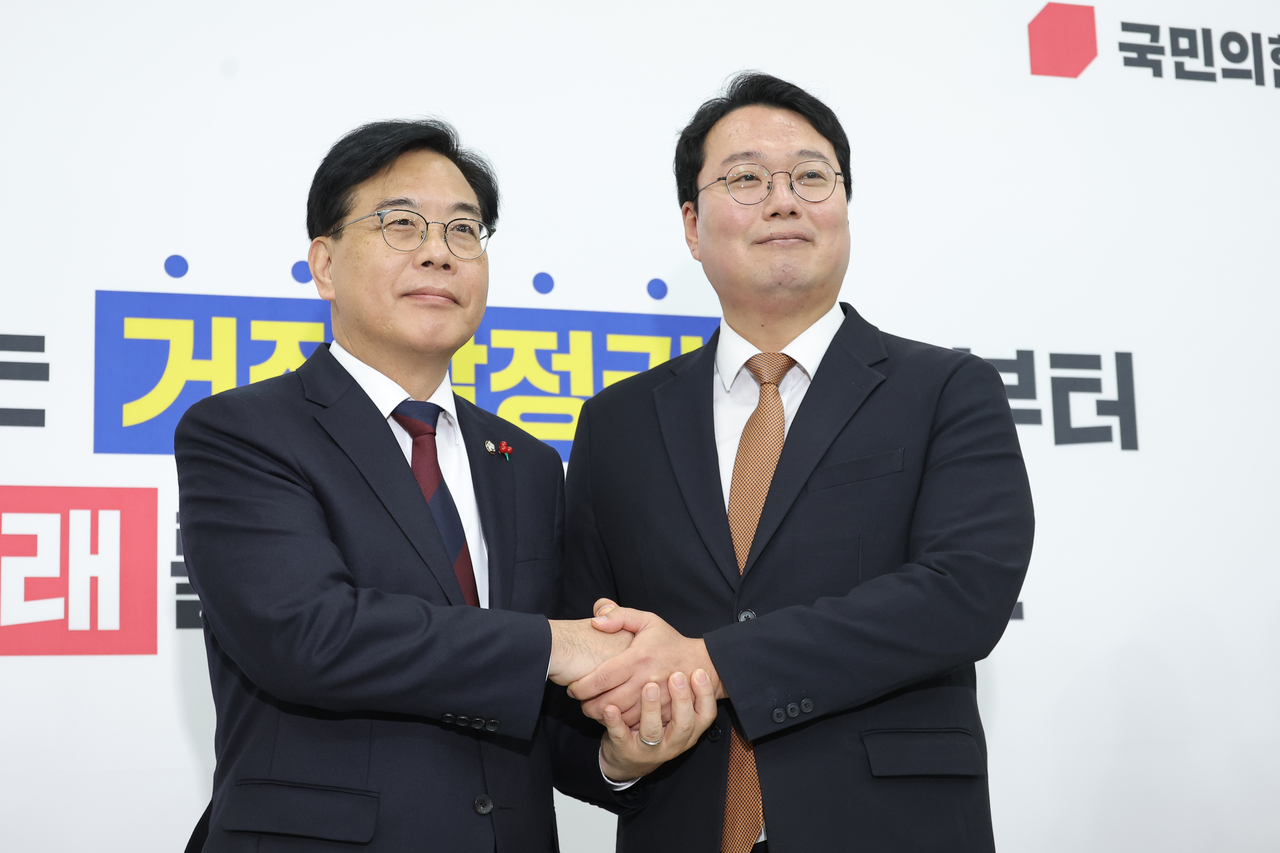
On Wednesday, the party held talks with the minor conservative New Reform Party to coordinate a proposed special counsel investigation into allegations that ruling party figures received illegal political funds linked to the Unification Church, a move widely seen as an effort by the People Power Party to regain momentum by unifying the conservative bloc.
During the meeting at the National Assembly in Seoul, People Power Party Floor Leader Rep. Song Eon-seog and New Reform Party Floor Leader Rep. Chun Ha-ram agreed on the need for an independent investigation, while leaving key details unresolved, including the scope of the probe and who should hold the authority to recommend a special prosecutor.
Chun said the New Reform Party, which he argued has “no known ties to the Unification Church controversy,” should be given the right to recommend the special counsel to ensure impartiality. Song, meanwhile, suggested assigning the role to external legal bodies such as the Supreme Court or the Korean Bar Association to minimize political involvement.
While seeking external leverage through cooperation with a smaller conservative party, the People Power Party is also grappling with continued internal tensions, prompting its leadership to signal openness to more fundamental changes — including a possible rebranding of the party itself.
According to local media reports, party Chair Rep. Jang Dong-hyeok recently told fellow lawmakers that he is considering changing the party's name as part of broader efforts to overhaul its image, amid criticism that the party has failed to expand its appeal beyond core supporters.
Jang, who had previously taken a negative view of rebranding the party, reportedly raised the possibility during a series of one-on-one meetings with lawmakers earlier in December, saying a shift in direction may be needed ahead of the local elections.
People Power Party spokesperson Rep. Choi Bo-yun confirmed that the idea has been discussed internally, though she downplayed the likelihood of an imminent change.
“If it is deemed necessary, it could be considered,” Choi said. “But it remains at the level of internal discussion, with no timeline or specific alternatives.”
The conservative party has repeatedly changed its name over the past two decades, often in the wake of major political setbacks.
In 2017, following the impeachment of then-President Park Geun-hye, the Saenuri Party rebranded itself as the Liberty Korea Party. In February 2020, after a landslide defeat in the 2018 local elections and continued struggles to recover public support in the post-impeachment period, it changed its name again to the United Future Party.
The party adopted its current name, the People Power Party, just seven months later.
Some within the party remain skeptical about whether rebranding or outreach efforts alone can resolve deeper issues, including lingering divisions over former President Yoon Suk Yeol and last year’s martial law declaration.
An official from the People Power Party said internal consensus on renaming remains limited.
“Unless a majority of lawmakers agree on its necessity, it would be difficult to push through a name change simply at the chair’s initiative,” the official said, speaking on condition of anonymity.
Park Chang-hwan, a professor of political science at Jangan University, said frequent name changes tend to reflect unresolved structural problems rather than serving as a solution in themselves.
“Renaming can create the appearance of renewal,” Park said. “But without a clear reckoning with past leadership and policy directions, it risks being seen as superficial.”
Meanwhile, despite ongoing contacts between the People Power Party and the New Reform Party, prospects for broader cooperation remain limited, as New Reform Party leader Rep. Lee Jun-seok has drawn a clear line against any electoral alliance.
“We can cooperate on specific matters. Legislative proposals are naturally something parties can work on together,” Lee said. “But there will be no electoral alliance.”
Lee founded the New Reform Party in January 2024 after leaving the People Power Party, which he led as party chair from 2021 to 2022, following internal disputes.
flylikekite@heraldcorp.com