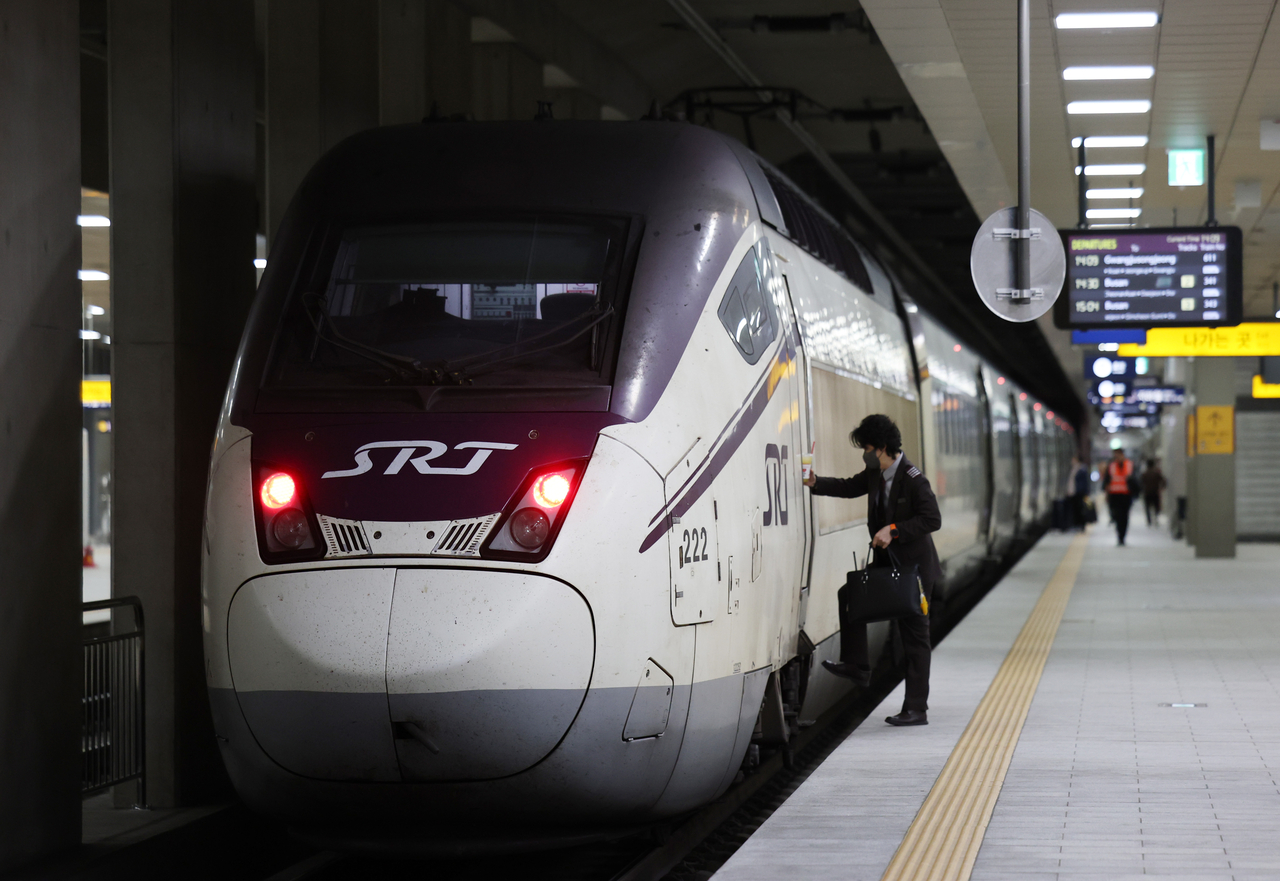
South Korea will push ahead with merging the country’s two largest high-speed rail services, KTX and SRT, by the end of next year, the Ministry of Land, Infrastructure and Transport said Monday.
In an integration roadmap unveiled at the government complex in Sejong, the ministry said it will implement transitional measures between KTX, operated by the state-run Korea Railroad Corp., and SRT, run by its subsidiary SR Corp., with the goal of a full merger.
The proposed merger between KTX and SRT has been under consideration for years, driven by concerns of operational efficiency and chronic seat shortages. SRT, which runs from Suseo Station in southern Seoul, has long struggled to meet demand. Officials have concluded that merging SR Corp. into the bigger state operator Korail could solve this ongoing problem. Momentum picked up steam this year as the merger was one of President Lee Jae Myung's key election pledges.
Under the plan, the two train systems will begin cross-operation. Beginning in March, some KTX trains will operate from SRT’s main terminal, Suseo Station.
By June, mixed operations will begin on a trial basis, with KTX and SRT trains operating both at Seoul Station and Suseo Station. Trains will also run between Seoul Station and Suseo Station.
For example, a KTX train currently running on the route between Seoul Station and Busan could adopt a circular route such as Seoul Station to Busan to Suseo to Pohang to Seoul Station.
In the meantime, ticketing systems will also be partially combined. Searches in either the Korail or SRT mobile apps will show trains departing from Seoul-area high-speed stations -- Seoul, Yongsan and Suseo -- regardless of operator.
By the end of 2026, a single integrated mobile app will be launched for passengers to purchase tickets for both KTX and SRT in one place. Transfer discounts will be introduced for passengers switching from SRT to Korail’s other train services, such as ITX-Maum. Cancellation fees will be waived when changing between KTX and SRT trains.
Korail projects that a complete operational merger would boost the country’s high-speed rail seat capacity by approximately 16,000 seats daily, roughly a 6 percent increase over the existing combined capacity of 255,000 seats.
“After gathering input from stakeholders and experts, the government has decided to move towards integrating the dual high-speed rail systems,” said Land Minister Kim Yun-duck in a statement. “The integration of KTX and SRT will not be a simple absorption-type merger, but a way to enhance the competitiveness of Korea’s railway industry.”
He added that the government “will take special care to ensure that SR employees do not face any disadvantages during the integration process.”
The government said it will work toward completing the merger by the end of 2026 after collecting opinions from SR Corp. and other stakeholders and carrying out all required legal procedures.
A new consultative body comprising labor, management and government will be formed to manage legal processes, such as approval of the railway safety management system and corporate merger assessment.
sahn@heraldcorp.com