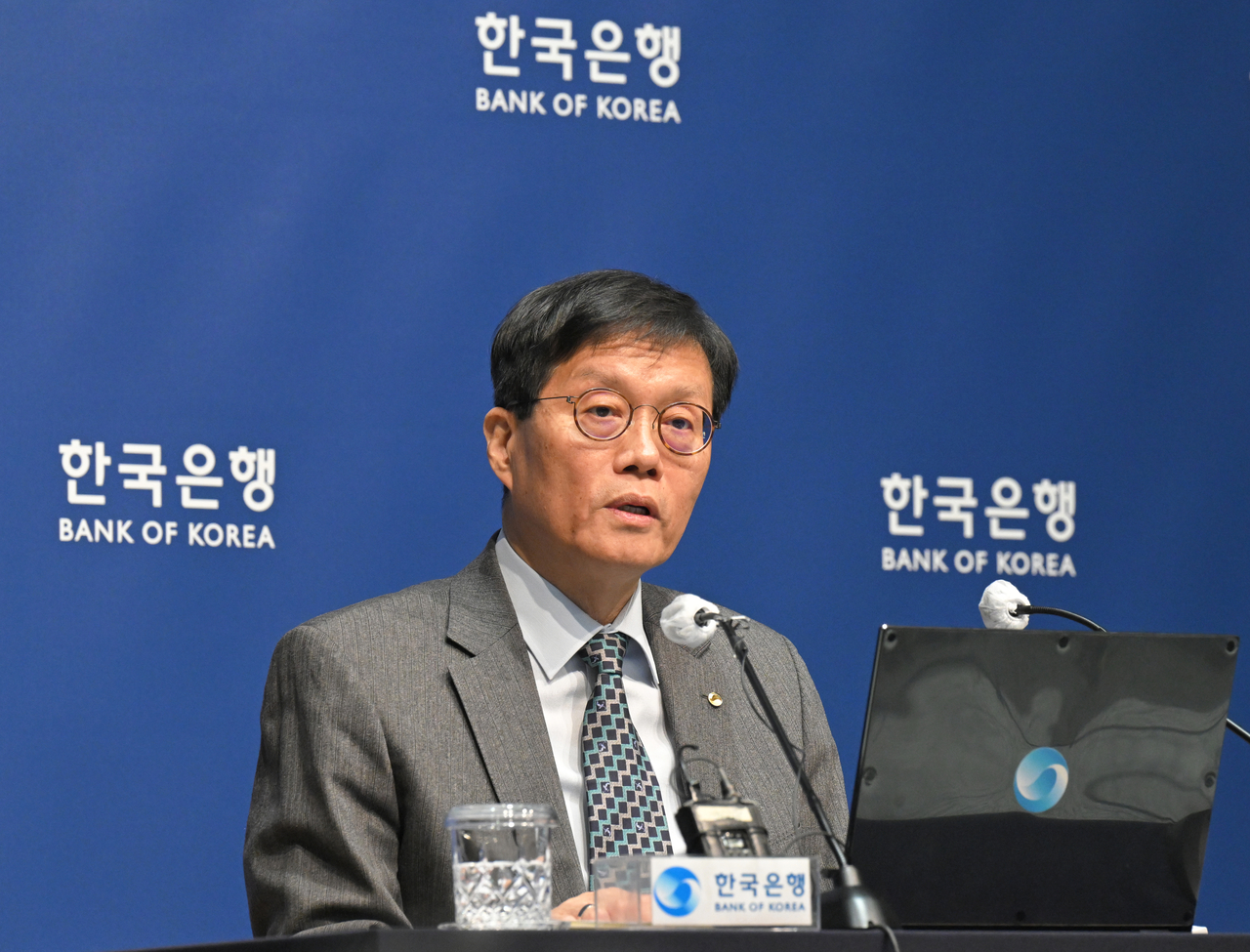
South Korea’s central bank kept its benchmark interest rate unchanged at 2.5 percent on Thursday, citing the won’s rapid depreciation as a key risk factor.
The rate freeze was supported by five out of six members of the monetary policy board, excluding Bank of Korea Gov. Rhee Chang-yong, whose individual vote is not disclosed. One of the six members suggested bringing down the rate by 0.25 percentage point.
Regarding the recent devaluation of the won, Rhee said, "One-sided movement (of the currency exchange rate) has been more concerning than the volatility itself."
“Unlike in the past when Korea had high levels of external debt, the market is not mentioning (the possibility of) a financial crisis, showing there is no instability in the foreign exchange market.”
However, he noted, “What is concerning instead is that a prolonged weak won could fuel inflation.”
After executing two rate cuts earlier in the year, the BOK has been extending its rate freeze, in place since May. With the market interpreting the BOK as having shifted to a hawkish stance, Rhee highlighted that a rate hike was not on the table at Thursday's rate-setting meeting.
“It does not seem to be the stage to discuss a rate hike yet,” he said, adding, “When we talked about the current situation and the outlook three months from now, none of the board members suggested discussing the possibility of raising the rate."
Rhee further explained that the National Pension Service will continue to maintain autonomy in its pension fund management.
With the currency sliding to a seven-month low, Korea’s foreign exchange authorities — including the BOK, the Finance Ministry, the NPS and the Health Ministry, which supervises the fund — held their first four-way meeting Monday to address the need to stabilize the won.
While there have been concerns that the NPS adopting a currency hedge to provide more dollar demand for the forex market can jeopardize the pension fund's profitability, Rhee responded that the NPS can "defend the retirement savings of the public" through the move.
“The NPS' expansion in overseas investments can contribute to a weaker won, while it can put upward pressure on the won when repatriating funds later, which would escalate the return volatility," he said.
"Locking in gains when the won's value tumbles and securing profitability through hedging can be a way to protect the retirement savings in the long term.”
Separately, the central bank projected the country's gross domestic product to expand by 1 percent in 2025, raising the forecast by 0.1 percentage point from its previous estimate made in August. It projected the economy to grow by 1.8 percent next year, up 0.2 percentage point as well.
The upgraded growth outlooks suggest that the country's economy is back on track for recovery.
“Next year, growth is expected to rise to 1.8 percent, but excluding the semiconductor and IT sectors, our internal calculations suggest growth will remain around 1.4 percent,” he said, cautioning that the growth outlook remains well below the potential growth rate.
The BOK further forecast the economy to expand by 1.9 percent in 2027.
silverstar@heraldcorp.com