Automakers relieved, while chip industry still faces uncertainty
GYEONGJU, North Gyeongsang Province -- After months of deadlock, South Korea and the US reached an agreement on details of their trade deal on Wednesday, easing major uncertainties over automobile exports and the broader economy, though follow-up negotiations on the massive investment package still need to be ironed out, experts say.
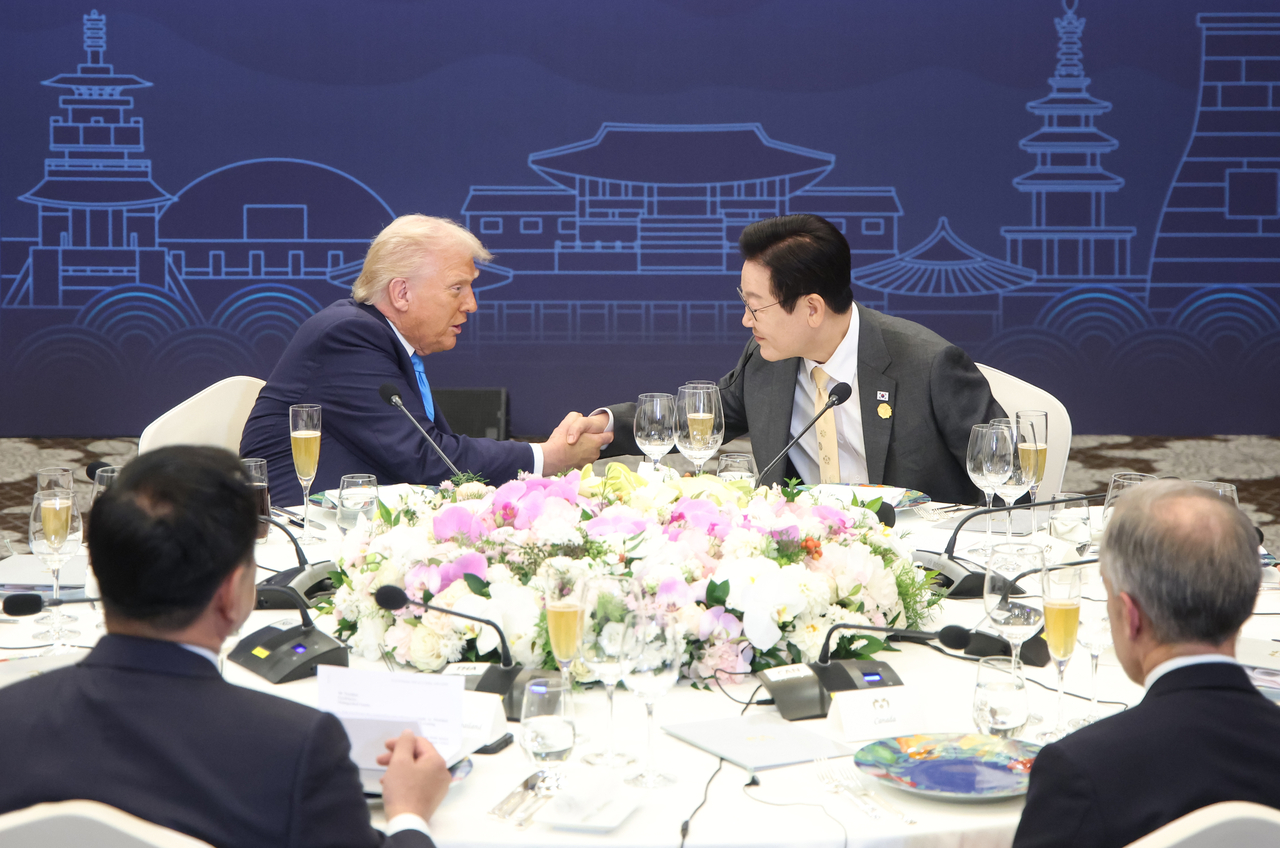
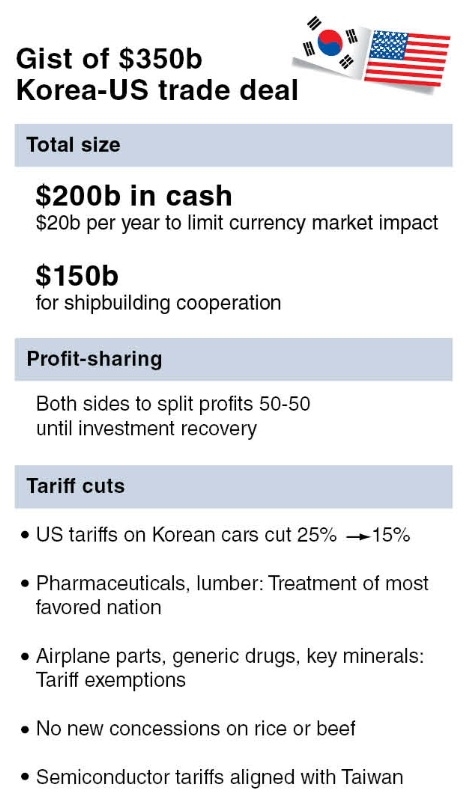
Meeting in Gyeongju, North Gyeongsang Province, on the sidelines of the Asia-Pacific Economic Cooperation summit, South Korean President Lee Jae Myung and US President Donald Trump sealed an agreement detailing how Seoul’s $350 billion investment pledge in the US will be structured, in return for tariff cuts from 25 percent to 15 percent on Korean goods.
The breakthrough follows months of wrangling since the two sides struck a framework deal in July. But discrepancies over how to structure and finance the accord have stalled its implementation, keeping South Korean exports exposed to high tariffs.
The two sides agreed that the $350 billion would be split into $200 billion as a direct cash payment distributed over multiple years with an annual cap of $20 billion, while the remaining $150 billion would be injected toward shipbuilding investments, the so-called “Make America Shipbuilding Great Again” project, according to Seoul officials.
Analysts see the bilateral shipbuilding cooperation, led by Korean companies, as a decisive factor in breaking the stalemate in the tariff negotiations.
Officials said the project effectively reduced the cash portion of the $350 billion investment fund, while giving Korean companies more control over how the capital will be deployed.
Presidential chief of staff for policy Kim Yong-beom said the $150 billion MASGA fund will include not only direct investments but also loans, loan guarantees and ship-financing arrangements, allowing long-term funding for new vessels, while minimizing strain on Korea’s foreign exchange reserves.
“It appears that shipbuilding proved uniquely powerful in this round of negotiations,” said Shin Won-kyu, a research fellow at the Korea Economic Research Institute. “Within the $200 billion portion, there could be some ambiguity regarding the commercial viability of certain investments. But for the shipbuilding segment, stronger safety mechanisms are in place to ensure investment recovery.”
He suggested that Korea focus more on shipbuilding — even by channeling part of the $150 billion fund into it — could therefore be a strategic move that yields favorable results.”
Trade experts generally welcomed the deal as a step toward easing uncertainty that had clouded Korean exporters for months.
“Overall, it’s a positive result, and the fact that the trade deal was finalized during the APEC summit helped clear lingering uncertainty,” said Lee Jae-min, professor of law at Seoul National University. “Had the talks fallen through, the burden would have been greater for both sides. The agreement shows that the two governments were able to align their position to a meaningful extent, easing uncertainty.”
Cho Seong-dae, director of trade studies and cooperation at the Korea International Trade Association, echoed the stance, noting the agreement was particularly meaningful for the auto industry, where Korean firms feared unequal treatment by competitors in the critical US market.
“We’ve been worried about the automobile sector facing disadvantages, but the deal brings it to an equal footing,” said Cho. “Companies had been unable to finalize business strategies or sign contracts due to uncertainty regarding follow-up agreements since the July deal. But now that the issue is resolved, companies can move forward with greater clarity.”
Auto industry breathes sigh of relief
South Korean automakers were seen as gaining the biggest relief in the latest deal that lowered tariffs on automobiles from 25 percent to 15 percent — the same level as Japanese and European rivals.
“If the tariff deal was not reached during the APEC week and continued to drag out, the Korean auto industry would have been at a huge disadvantage compared to European and Japanese automakers,” said Kim Pil-su, an automotive engineering professor at Daelim University.
Since automobiles are Seoul’s biggest export to the US, the adjusted tariff rate — though still higher than the zero tariffs under the previous free trade agreement — provides some relief to the sector that has been hit especially hard since April.
“We thank the government for relentlessly working toward reaching a deal through a tough process of negotiations," said a Hyundai Motor official, following news of the agreement.
On Thursday, Hyundai Motor logged a 29 percent decline in third-quarter operating profit to 2.5 trillion won ($1.8 billion) from a year earlier, despite logging record revenue.
The downfall was attributed to the impact of the 25 percent tariff on auto exports, as the automaker said the tariffs cost the company 1.8 trillion won in the third quarter, up from 828 billion won in the previous quarter.
The carmaker said the latest tariff deal removed uncertainties, and the 15 percent tariff agreement will significantly ease the company’s cost burden going forward.
“With the final agreement on the 15-percent tariff, we expect our previous financial burden to be reduced,” said Lee Seung-jo, Hyundai Motor’s chief financial officer, in a conference call. “With the conclusion of negotiations, tariff-related uncertainty has been removed. The ability to operate our business with greater predictability itself is a meaningful outcome.”
Uncertainty remains in chip industry amid conflicting signs
While the auto sector managed to secure a much-needed reprieve, uncertainty lingered in the semiconductor industry after mixed messages emerged between Seoul and Washington.
According to Kim Yong-beom, presidential chief of staff for policy for the Korean side, on Wednesday, the two sides agreed that tariff levels on Korean semiconductors will be set at a “level comparable” to that applied to Taiwan, making sure local chipmakers such as Samsung Electronics and SK hynix would not face disadvantages.
However, US Commerce Secretary Howard Lutnick on Thursday said “semiconductor tariffs are not part of this deal” via his X account, suggesting that further coordination may still be needed on the chip portion of the deal.
In response to controversy, an official from South Korea’s presidential office reiterated, “Both sides agreed to ensure that semiconductor tariffs will not be less favorable than those applied to Taiwan.” The official added that Kim’s announcement on tariffs was based on the agreement between the two countries and that “related documents are under final review.”
Observers have said the lack of clarity has put chipmakers in a wait-and-see mode for official confirmation
The US has not officially announced the rate on semiconductors, with Trump floating 100 percent tariffs in August, but no official announcement has been made. The Commerce Department also has yet to release its assessment regarding semiconductor imports and Section 232 of the Trade Expansion Act, which allows the US president to impose tariffs at the recommendation of the commerce secretary if imports are deemed to threaten national security.
Concerns on investment oversight
Despite eased uncertainty, experts agree that the most difficult phase may still lie ahead, as Seoul now faces the challenge of executing its $200 billion cash investment plan over the next decade.
“The real test begins now,” said law professor Lee. “There are two major uncertainties. The first is whether Korea has the fiscal capacity and financial strength to sustain $20 billion a year for 10 years. That’s still a significant burden that will need careful management.”
He added that the second concern is how the investment will actually be carried out and monitored. “Investment, by nature, is full of uncertainty, when, how and where the funds will flow and how profits or losses will be shared,” he said, calling for the need for Korean officials' participation in the investment committee.
“This is not a short-term arrangement; it’s a 10-year, $200 billion commitment,” he said. “Without Korean participation in monitoring and review, it’s difficult to see how transparency and accountability in the investment process can be ensured.”
sahn@heraldcorp.com
hwkan@heraldcorp.com