Anna Bjerde says Korea’s strategy offers blueprint for developing nations seeking sustainable growth
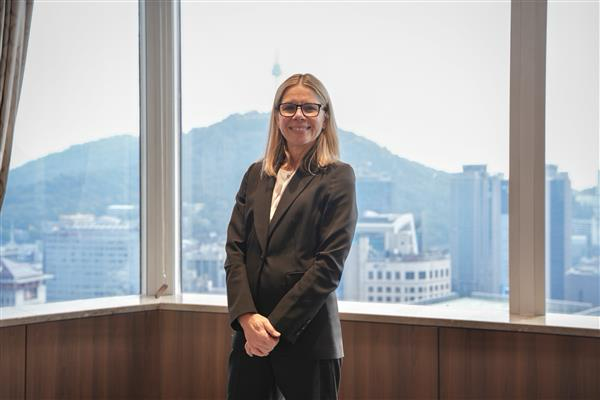
South Korea serves as a role model for developing countries, having achieved growth by setting a clear direction for expansion, according to a senior executive at the World Bank.
Anna Bjerde, managing director of operations at the multilateral institution, visited Korea to attend this week's Asia-Pacific Economic Cooperation CEO Summit in Gyeongju, North Gyeongsang Province.
"Over the decades, Korea has gone from an impoverished country relying on donor funds from the likes of the World Bank to being one of the largest, most innovative economies in the world," Bjerde told The Korea Herald in an interview held in central Seoul, Thursday.
In 1962, Korea relied on World Bank loans to rebuild itself from the devastation of war. Supported by financing, the country experienced rapid growth and ceased borrowing by 1973. Just four years later, in 1977, Korea returned as a donor to the association.
"What Korea has done is amazing because there was such an intentional focus on innovation and technology, positioning itself as an export-oriented country, and at the same time, investing in human capital. The combination has been what took Korea out of an extremely difficult position to become a role model economy to the rest of the world," she said.
Bjerde highlighted a clear direction for growth as a key factor that propelled the economy’s rapid rise.
"Often, we use Korea as an example of how you can transform a country in a relatively short period of time when you have a clear strategy and ambition with marked change decade by decade,” she said.
In a move to build on Korea’s growth experience, the World Bank and Korea’s Ministry of Economy and Finance agreed in December to establish a Digital Knowledge Center at the bank's Korea office.
"The World Bank is a bank, but we are a knowledge bank. That is the thing that all of our clients, including low-income countries, come to us for — our knowledge bundled with financing,” she said.
“Being able to tap into the knowledge of other countries, in this case, Korea's digital knowledge, makes us able to play that role as a multilateral development institution that is focused on development because knowledge and finance are intertwined."
During the APEC CEO Summit 2025, Bjerde, who oversees the institution’s global development projects and strategies to support economic growth, gave a speech, highlighting job creation as a key factor that can drive growth in the region.
“For the region to grow, it needs to grow in such a way that the growth creates jobs. You do not want high, jobless growth. In this region, it is also a lot about the quality of jobs with a focus on an increase in salaries, opportunities for upward mobility and skilling."
She further emphasized the need for the region to adopt AI — but in a purposeful way that drives real growth.
“We basically distinguish between ‘big AI’ and ‘small AI,’” she said, referring to AI technologies that require large-scale data and computational power versus those designed for targeted, practical applications.
By choosing localized models that do not require massive computing power, AI can be used more widely, enhancing the daily lives of the general public. For instance, a farmer could apply small AI tools to tend to crops, while a doctor could use them for diagnosis, she explained.
“We see an opportunity to step up these types of solutions in developing countries,” she said.
Bjerde stressed the Asia-Pacific region can further flourish through strengthened regional connectivity.
"Even though the APAC region is one of the more integrated regions, we still see that there is room to improve because we know economies do much better when they are connected,” she said, citing the potential to pursue enhanced interregional trade and greater connectivity through electricity grids.
silverstar@heraldcorp.com