Despite 2.5% rate freeze, Korean won slips to six-month low against US dollar
The Bank of Korea's monetary policy board held its base interest rate steady at 2.5 percent for the third consecutive meeting Thursday amid concerns about the weakening local currency and the still-overheated property market. The won dipped further to its weakest level since April.
The rate freeze was supported by five out of six members of the monetary policy board, excluding BOK Gov. Rhee Chang-yong, whose individual vote is not disclosed. One of the six members suggested bringing down the rate by 0.25 percentage point.
After executing two rate cuts earlier in the year, the BOK has kept the rate unchanged since May, pausing its monetary easing cycle.
The sharp depreciation of the Korean won, driven by uncertainty over the country's tariff negotiations with the US, supported the decision to keep the rate on hold. A widened rate gap with the US drives an outflow of foreign capital from Korea, weakening the won.
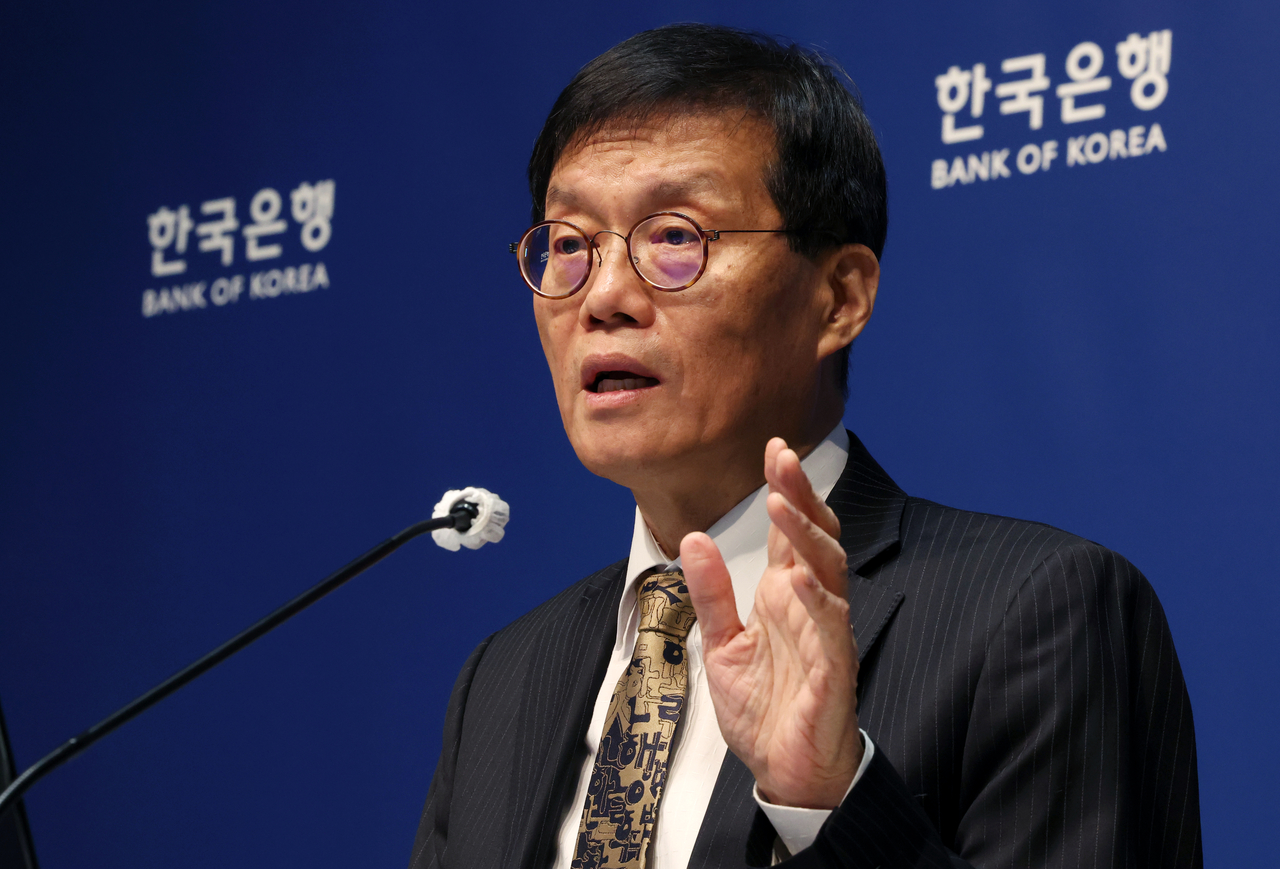
"Since the rate-setting meeting in August, the won has weakened by more than 35 won per dollar," Rhee said at a press conference held at the central bank, shortly after the rate-setting meeting.
"About one-quarter of this movement is driven by the stronger dollar, while the remaining three-quarters reflect regional and domestic factors, including the yuan weakened by US-China tensions, Japan’s expansive monetary policies leading to a weaker yen, and concerns about tariffs for Korea and funding the $350 billion (investment in the US)."
Despite rate holding steady, the won plunged to its weakest level per greenback in nearly six months. It was quoted at 1,439.6 per dollar as daytime trading ended on Thursday, losing 9.8 won from the previous session.
The won ended the day at its weakest closing level since April 28, when it stood at 1,442.6 per dollar. During the session, the currency dipped as low as 1,441.5, nearing a six-month low.
Rhee pointed out that uncertainty remains high through November, with several variables still in play, including Korea’s tariff negotiations, US-China trade talks, and the semiconductor cycle.
The rate freeze also reflects the central bank’s cautious stance amid lingering uncertainties in the overheated real estate market in the greater Seoul area.
“A rate cut could accelerate risks in the real estate market,” Rhee said. "Since the rate was held steady, the market can anticipate that the BOK will proceed gradually in both the pace and size of rate reduction, while remaining in a rate-cutting cycle."
Following the press conference, market analysts projected that the timing of the next rate cut is likely to be delayed from November to early next year.
"It would be difficult for the BOK to slash the rate in November, considering the government's stringent measures to curb real estate demand," Kiwoom Securities analyst Ahn Ye-ha said, adding that any additional rate cut is expected to be delayed until the first quarter of next year.
"Given that the BOK would need more time to assess financial stability, such as a slowdown in the pace of real estate price increases, a rate cut is expected to be further delayed," said Kim Ji-man, a senior analyst at Samsung Securities.
silverstar@heraldcorp.com