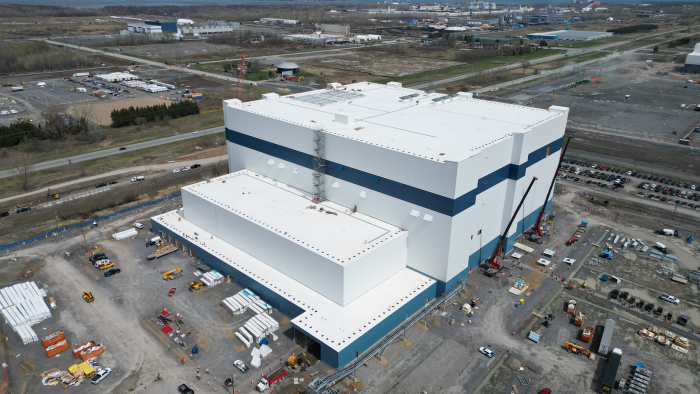
Posco Future M plans to begin delayed operations at its joint cathode materials plant with General Motors in Quebec, Canada, next October, signaling a renewed push to expand its presence in the North American electric vehicle battery supply chain.
According to media reports on Monday, Posco Future M finalized a schedule to begin phase 1 operations at its joint venture, Ultium CAM, in late October 2026. The joint venture, owned 85 percent by Posco Future M and 15 percent by GM, will produce 20,000 tons of high-nickel cathode materials annually -- enough to power about 500,000 EVs -- with the entire output to be supplied to Ultium Cells, GM’s battery joint venture with LG Energy Solution in the US.
Originally slated for completion in September 2023, the facility’s launch had been postponed indefinitely due to a slowdown in global EV demand despite an initial 13.2 trillion won long-term supply contract with Ultium Cells.
Posco Future M and GM are also planning a phase 2 expansion to raise capacity to 33,000 tons of cathode materials and 45,000 tons of precursor materials, though the timeline has not yet been confirmed.
Posco Future M’s latest move comes as tensions ease between Canada and the US over their recent tariff dispute, which reignited earlier this year after Washington reimposed targeted levies on Canadian steel, aluminum and other industrial goods, prompting Ottawa to roll out limited retaliatory measures.
Industry insiders indicate that the cathode materials produced by Ultium CAM in Canada are expected to be exempt from US tariffs, as the output is likely to qualify as Canadian-origin under the US-Mexico-Canada Agreement rules of origin.
“Posco Future M’s recent efforts to reduce reliance on Chinese battery materials -- including spherical graphite used in anodes -- are gaining momentum, offering a potential breakthrough for a global battery industry strained by the prolonged tariff conflict between the US and China,” said an industry source on condition of anonymity.
hyejin2@heraldcorp.com