Former president appears voluntarily as special counsel moves to execute warrant, stays silent
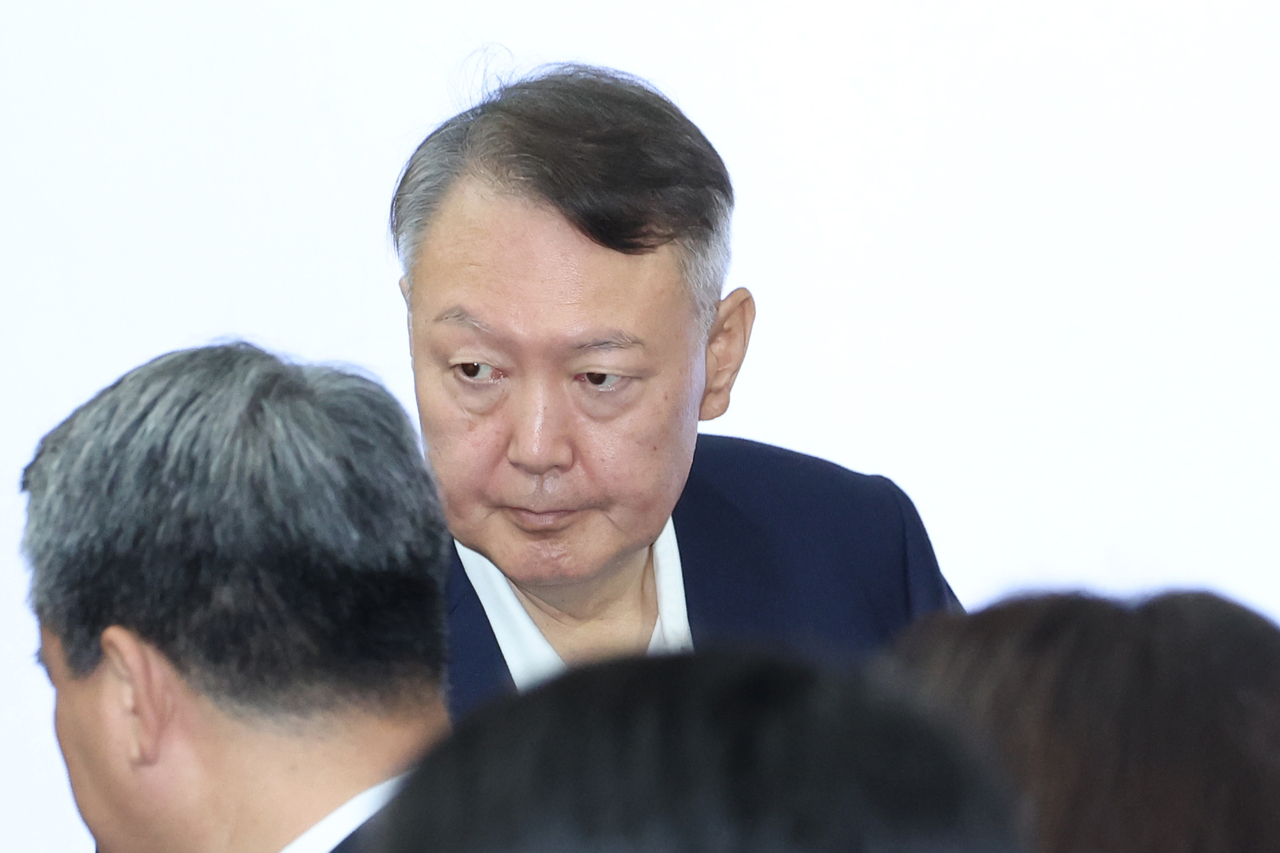
Disgraced former President Yoon Suk Yeol voluntarily attended questioning on Wednesday, complying with a special counsel summons for the first time since he was detained following his arrest on July 10.
The special counsel team — led by Cho Eun-suk — investigating whether Yoon’s martial law declaration could constitute treason, said it summoned Yoon for questioning over allegations that he ordered the sending of drones to Pyongyang last year.
“Former President Yoon appeared for the special counsel questioning in connection with treason allegations,” said assistant special counsel Park Ji-young during a press briefing at the Seoul High Prosecutors’ Office in Seocho-gu, Seoul, Wednesday. “But the former president exercised his right to remain silent during questioning.”
The special counsel team explained that it had requested an arrest warrant for Yoon on suspicion of treason in late September, which was granted Oct. 1. The team headed to the Seoul Detention Center in Uiwang, Gyeonggi Province, to execute the warrant the following day, but failed. A second attempt was set for this week.
“Considering the criminal trial schedule, the Seoul Detention Center planned to execute the arrest warrant around 8 a.m. Wednesday. But when the correctional officials informed Yoon in advance about the warrant execution, the former president chose to voluntarily appear for questioning,” Park said. “The warrant was not executed.”
The special counsel team had previously summoned Yoon twice, on Sept. 24 and Sept. 30, but Yoon snubbed both summonses, claiming procedural flaws.
Yoon’s legal representatives said that the former president chose to comply with the special counsel's summons to relieve the burden on detention center staff, who had been burdened by the special counsel team’s "excessive" use of arrest warrants.
Yoon is suspected of having ordered Maj. Gen. Kim Yong-dae, head of the military’s Drone Operations Command, to carry out a drone operation over Pyongyang in October 2024, without complying with the official chain of command, including the Ministry of National Defense and Joint Chiefs of Staff.
The team suspects that Yoon may have issued the instruction to provoke North Korea and create a pretext for declaring martial law in December.
Meanwhile, some in legal circles say the special counsel team could lose momentum in its investigations, as the Seoul court dismissed the team’s request to issue a detention warrant for former Justice Minister Park Sung-jae.
The Seoul Central District Court rejected the special counsel’s request, which was made on Oct. 9 as part of its investigation into Yoon and his alleged insurrection.
Cho’s team suspect Park played a key role in martial law imposition and abusing his power by deploying prosecutors to an investigative agency set up under the martial law command.
“There is a lack of sufficient grounds to justify the validity of the detention or to establish concerns about flight and destruction of evidence,” the court said Wednesday.
Among those who participated in the Cabinet meeting that took place before Yoon’s declaration on Dec. 3, Park is the second to avoid detention by the investigative agency, following then-Prime Minister Han Duck-soo.
Though the special counsel team reportedly planned to wrap up its investigation into other high-profile individuals accused of similar charges as Park, including former National Intelligence Service Director Cho Tae-yong and former People Power Party Floor Leader Choo Kyung-ho, it is likely that the special counsel team will first review the court’s decision to refuse the former justice minister's arrest warrant.
Assistant special counsel Park commented, “The court’s decision must be respected.”
But she claimed that it is difficult to accept the court’s arrest warrant dismissal considering the former justice minister’s position and constitutional responsibilities, adding that the team would promptly review the decision and reapply for the arrest warrant.
sj_lee@heraldcorp.com