Won falls to five-month low as authorities issue first joint warning in 18 months
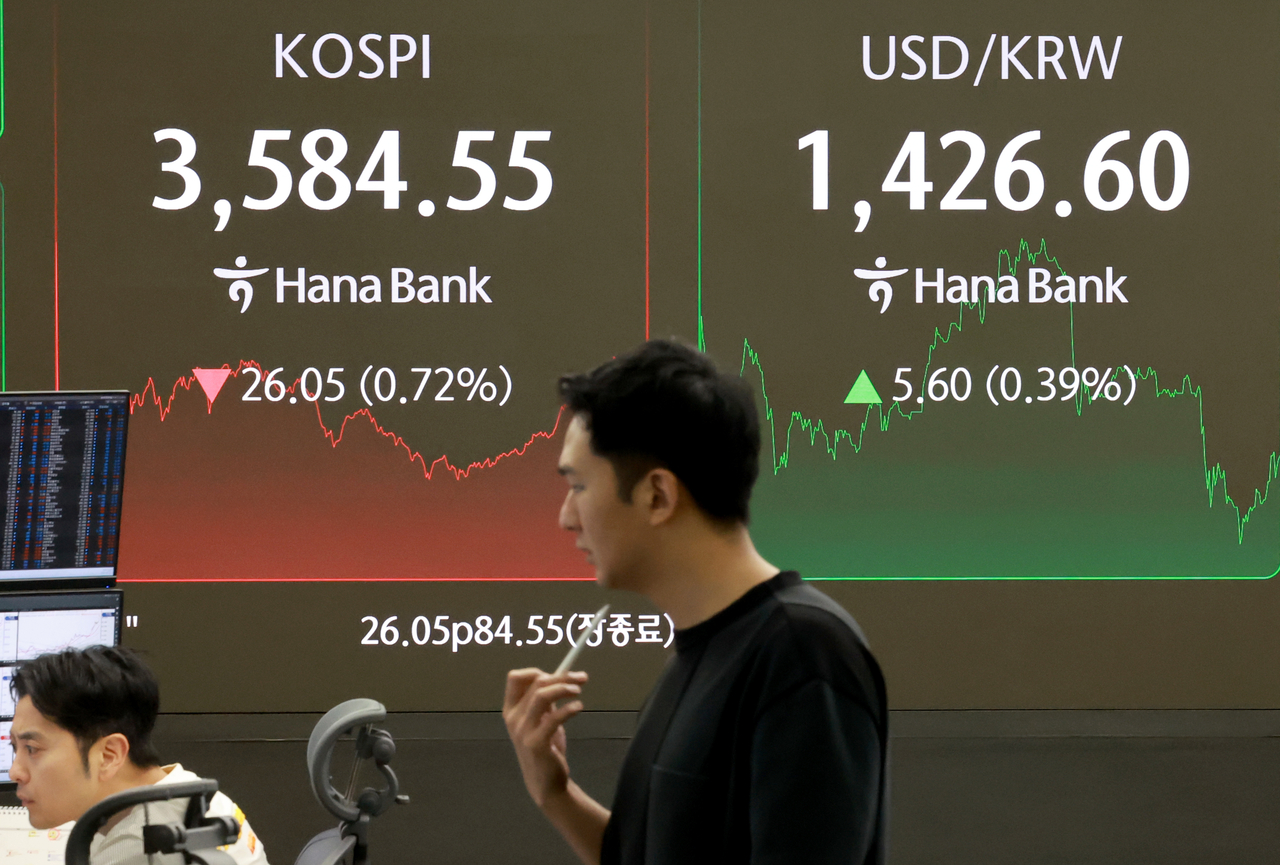
Amid renewed concerns over an escalation of the trade war between the United States and China over rare earth exports, South Korea’s benchmark Kospi index retreated Monday from Friday’s record high above 3,600, while investor risk aversion deepened and the Korean won fell to a five-month low.
The Kospi closed trading at 3,584.55, down 26.05 points, or 0.72 percent, from the previous trading day. After opening at 3,550.08, paring the gains from Friday, the index slipped as low as 3,522.54 in early trading. It rebounded to reclaim the 3,580 level in the afternoon hours.
The drop came just one trading day after the index hit a record high of 3,617.86 on Friday, surpassing the 3,600 mark for the first time.
Blue-chip semiconductor shares, including Samsung Electronics and SK hynix, plunged on concerns over Chinese export restrictions of rare earths, dragging down the index.
Retail investors poured in 1.16 trillion won ($778 million) on the bourse, but the amount was not enough to hold the line for the Kospi, as foreign investors and institutional investors dumped shares worth 821 billion won and 448 billion won, respectively.
While heightened trade uncertainty brought down the stock index, the Korean won sharply depreciated against the dollar.
The won wrapped up daytime trading at 1,425.8 per dollar on Monday, weakening by 4.8 won from the previous close. After starting trading at 1,430 per dollar, the won's valuation quickly nose-dived to its weakest level in five months, at 1,434 per dollar.
Foreign exchange authorities — namely the Bank of Korea and the Finance Ministry — stepped up, issuing a verbal intervention.
“We are closely monitoring the market with caution over potential imbalances amid the recent increase in volatility of the Korean won due to domestic and external factors,” the statement read.
It was the first time for forex authorities to issue a joint verbal intervention on the market since April 2024, when the won's valuation dipped amid escalated tensions in the Middle East.
Though a verbal warning is a weaker form of intervention for forex authorities, the statement signals that authorities could intervene by buying or selling dollars to ease excessive volatility on the market.
"Verbal intervention is the most effective form of intervention for the forex authorities as it keeps the market in check. But when utilized too often, the warning can lose impact," said Lee Hyo-seob, a senior research fellow at the Korea Capital Market Institute.
Market analysts viewed that Korea must settle its $350 billion investment plan bound for the US to curb excessive volatility in the Korean won’s value. Demands from the US for upfront cash investment have been triggering a sharp depreciation of the local currency.
"Domestically, uncertainty over the $350 billion in US-bound investment negotiations is acting as a downward pressure on the won,” analyst Moon Da-woon at Daishin Securities said.
“It remains uncertain whether the upcoming Korea-US summit at the end of the month will result in agreements favorable to the won.”
silverstar@heraldcorp.com