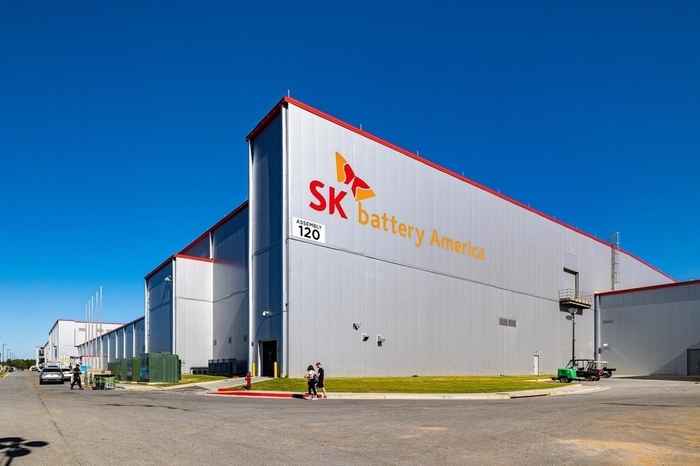
SK On is expanding its Georgia plant into a full-scale US production base for both electric vehicle and energy storage system batteries, bolstering its position amid tightening restrictions on Chinese battery imports.
In September, SK On signed its first major US ESS deal with Colorado-based renewable developer Flatiron Energy Development, valued at about 2 trillion won ($1.4 billion) for 7.2 gigawatt-hours of cost-efficient lithium iron phosphate batteries. To deliver the four-year contract starting next year, the company plans to convert part of its nickel-cobalt-manganese electric vehicle battery lines at its SK Battery America plant in Georgia into LFP production lines, with mass production slated for the second half of 2026.
With the agreement, SK Battery America is evolving into a dual-chemistry production site for both NCM and LFP batteries, enabling SK On to respond more flexibly to shifts in US market demand across the EV and ESS sectors.
By adding LFP cell production capacity, SK On — alongside LG Energy Solution — is set to become the only battery-makers operating standalone North American plants capable of manufacturing both NCM and LFP batteries. Samsung SDI, which does not yet have its own US facility, is reportedly considering converting part of its joint venture lines with Stellantis to produce LFP batteries for ESS.
Industry insiders say SK On’s two-track strategy is well-suited to the US market, where demand for high-energy, long-range NCM batteries remains strong in EVs, while LFP batteries are gaining traction in ESS for their cost efficiency and safety.
According to data from the International Energy Agency, high-nickel NCM batteries made up 90 percent of US EV installations in 2023, rising to 92 percent this year. Mordor Intelligence also reported that major automakers favor NCM for balancing range and safety. Eric Kuyper, chief technology officer of US EV maker Slate — which signed a supply deal with SK On in April — explained that achieving long range “was only possible with NCM” due to limited space under the vehicle floor.
In contrast, LFP is rapidly taking over the US ESS market, once led by China. However, rising US tariffs — now at 40.9 percent and set to climb to 58.4 percent next year — are eroding Chinese competitors’ cost advantage. Media reports suggest that Chinese LFP prices are expected to increase from $73 per kilowatt-hour in 2023 to about $87 this year, nearly matching US-made Korean cells at $85-90 per kilowatt-hour.
“By diversifying its lineup, SK On is building a more stable foothold for growth in the US market,” said an industry source familiar with the matter. “With Washington tightening restrictions on Chinese batteries, the capability to produce both NCM and LFP cells locally has become strategically significant.”
hyejin2@heraldcorp.com