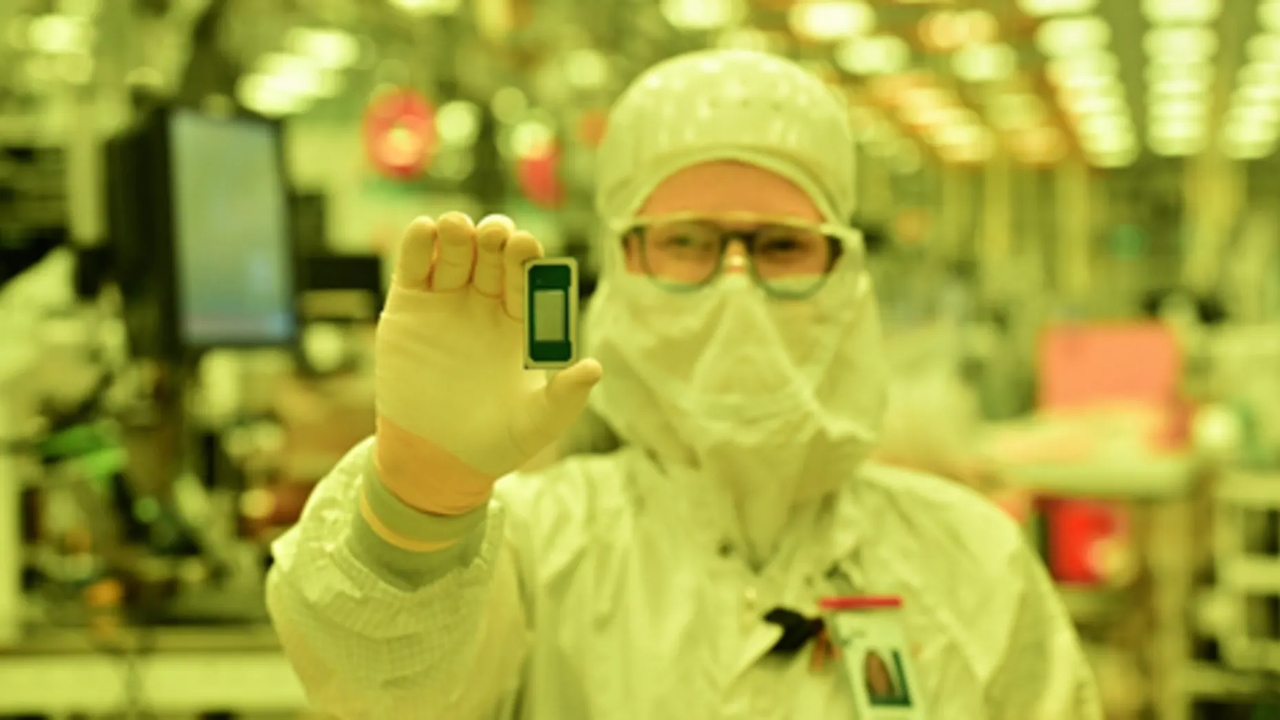
Intel has jumped ahead of Samsung Electronics and Taiwan’s TSMC in the next-generation chip race, announcing mass production of 1.8-nanometer chips and intensifying competition in the world’s most advanced contract chip manufacturing sector.
The chip giant on Thursday unveiled its Panther Lake CPU architecture, its first AI PC platform built on the 18A process node, which will be adopted in laptops later this year. The new chips, built at Intel's Ocotillo Fab 52 facility in Arizona, will be launched under Intel Core Ultra series 3 branding, according to the company.
Intel's surprise unveiling comes as foundry leaders TSMC and Samsung prepare to launch their own 2 nm-class products later this year. Until now, only the two Asian chipmakers had been capable of producing chips using sub-5 nm technology.
The announcement marks the world's first official mass production of 2 nm-class chips, and is seen as a major comeback for Intel, which in recent years has lagged behind its Asian rivals in advanced chipmaking.
Industry experts remain cautious over Intel's foundry push, noting that the company was struggling with yields of around 10 percent for its cutting-edge process node earlier this year. Typically, a yield rate of 70 to 80 percent is required for stable mass production.
TSMC has reportedly surpassed 60 percent yield on its 2 nm process in the first half of this year. Samsung has also improved yields but has yet to announce full-scale production.
"The most important factor is yield, and then securing big tech customers," said Lee Jong-hwan, a system semiconductor engineering professor at Sangmyung University.
"Raising yield rate is not easy, but if Intel really did it, it shows how desperate the company is. It is their only path forward. With AI semiconductors now the industry's most critical product, Intel has no choice but to completely reinvent itself, or survival would be difficult."
Intel has faced years of financial strain after failing to keep pace with surging demand for advanced chips. Its success is now closely tied to Washington's broader push to rebuild domestic semiconductor manufacturing.
In August, the US government acquired a 10 percent stake in Intel worth $8.9 billion as part of its strategy to strengthen local chip production. Japan's SoftBank also invested $2 billion in Intel, while Nvidia agreed earlier this month to invest $5 billion to codevelop data center chips with Intel.
As Intel moves to claim its share of the advanced foundry market, both TSMC and Samsung are preparing to introduce their 2 nm products this year.
Samsung is gearing up to begin production of its own 2 nm mobile processor, the Exynos 2600, soon, targeting integration into next year’s Galaxy S26 smartphones.
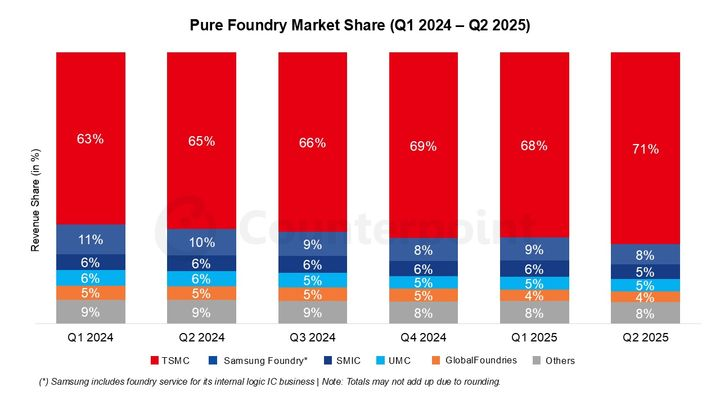
According to market research firm Counterpoint Research on Friday, TSMC maintained its dominance in the second quarter with a 71 percent share in the global foundry market, followed by Samsung at 8 percent and China's SMIC at 5 percent. Samsung’s market share fell 2 percentage points from a year earlier, while TSMC’s rose by 6 points.
herim@heraldcorp.com



![[Graphic News] Average parental age of S. Koreans rises](https://wimg.heraldcorp.com/news/cms/2026/09/27/news-p.v1.20260927.0bcbf944ca9043c4a6ad4401fcfae25c_T1.gif?type=h&h=800)