Many South Korean defense capabilities could contribute to deterring an assertive China, a senior Pentagon official said Tuesday, stressing that the United States' defense priorities should focus on addressing the "most serious" military threat of the Asian superpower.
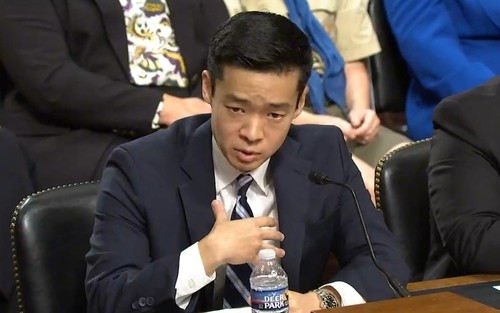
Deputy Assistant Secretary of War for East Asia John Noh, the nominee for assistant secretary for Indo-Pacific security affairs, made the remarks in his written answers to advance questions from the Senate Committee on Armed Services, asserting the need for South Korea and other allies to "dramatically" increase their defense spending and take greater responsibility for regional security.
"While the ROK should focus primarily on leading the US-ROK alliance's conventional deterrence against the DPRK, many capabilities could also contribute to a deterrence of China," Noh said. ROK and DPRK stand for the respective official names of South Korea and North Korea, the Republic of Korea and the Democratic People's Republic of Korea.
"Capabilities, such as long-range fires, integrated air and missile defense, space and electronic warfare capabilities, could provide a meaningful impact to strengthen deterrence in the region against both threats," he added.
His remarks came as Seoul and Washington are working to "modernize" the alliance in the midst of an intensifying Sino-US rivalry -- in what US officials have called an effort to ensure that the alliance is "strategically sustainable."
Regarding a question about China's naval activities in the Yellow Sea, Noh said that those activities appear to be aimed at "intimidating" South Korea. The activities in question apparently refer to China's installation of steel structures in the Provisional Maritime Zone, an overlapping sea zone between the two countries.
"If confirmed, I will work with my US government colleagues and ROK counterparts to review these activities and propose appropriate responses," he said.
Noh pointed out that the "most significant challenge" facing him, if confirmed, will be addressing the military threat from China, noting that Beijing is undergoing an "unprecedented and historic military buildup."
His emphasis on deterrence against China followed last month's news report that the Pentagon's new National Defense Strategy prioritizes protecting the US homeland and Western Hemisphere -- a move away from its yearslong focus on deterring the "pacing threat" from China.
"I believe our defense and security priorities in the Indo-Pacific region should be centered around deterring China, which remains our most serious military threat," he said.
"I believe we need to focus on efforts to prioritize the deployment of combat-credible military forces west of the international dateline, modernize our force posture across the region and strengthen critical capabilities, including integrated air and missile defense and advanced strike systems."
He, moreover, highlighted the importance of cooperation with regional allies in tackling Chinese threats.
"We also need to work with our allies and partners throughout the region, including Japan, Australia and the ROK, to strengthen their defense capabilities while asking that they significantly increase their own defense investments and take greater responsibility for regional security," he said.
Asked whether US troops in South Korea should remain focused on defending Korea or should also be available for regional or global operations, Noh said that American troops on the Korean Peninsula are postured and stationed to "advance US interests."
"If confirmed, I will work with the ROK government to ensure US forces on the Korean Peninsula are appropriately focused for the current security environment," he said.
The official noted growing nuclear threats from North Korea and China in response to a question about whether the US needs to forward-deploy strategic military capabilities in the Indo-Pacific.
"Both China and the DPRK are dramatically increasing their nuclear arsenals," he said. "If confirmed, I will work to ensure the US and the ROK are capable of deterring and defending our interests against these threats."
During the Senate confirmation hearing, Noh was also asked about security challenges facing Taiwan.
He stressed his backing for President Donald Trump's statement that Taiwan should spend "upwards to 10 percent" of its gross domestic product on defense.
"I strongly support that," he said.
The assistant secretary position covers security issues concerning the two Koreas, China, Japan, Australia and India, among others. (Yonhap)










