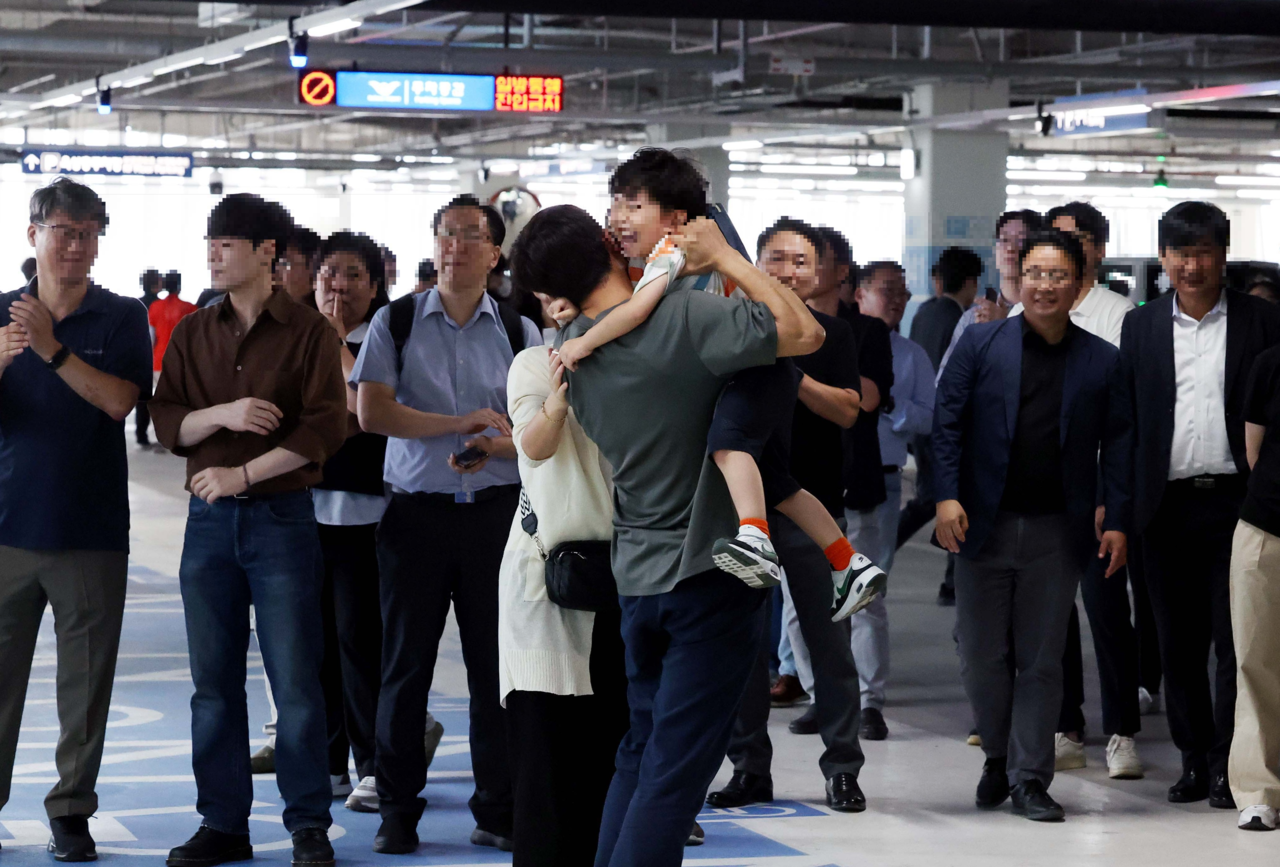
After being detained in the United States for a week, 316 South Korean and 14 foreign workers landed at Incheon Airport on Friday afternoon, ending a tense week following their arrest in an immigration sweep at a joint LG Energy Solution-Hyundai Motor battery plant under construction in Georgia.
The workers, flown to Korea on a chartered plane paid for by LG Energy Solution, headed home in vehicles provided by the company. All returnees will reportedly receive four weeks of paid leave through the end of the Chuseok holiday and medical checkups before resuming work.
Hyundai Engineering, which also had workers who were detained, is expected to offer similar care for partner-company staff.
The government is also paying close attention to psychological care for those returning.
Regarding future reentries to the US, the presidential office said that preparations are already underway for those who are currently eligible to return. "The matter will be taken care of in accordance with visa clarifications. However, for now, LG Energy Solution is recommending rest and mental recovery first," said Presidential Chief of Staff Kang Hoon-sik, who greeted the group at the arrivals hall of Incheon Airport Terminal 2.
The return capped a frantic diplomatic push by Seoul. Kang said officials worked “with the feeling they were rescuing our own family and friends,” apologizing for not bringing them home sooner.
Foreign Vice Minister Park Yoon-joo confirmed that all the Koreans were released except one worker who chose to stay in the United States to pursue legal action. That individual, whose family members are US permanent residents, is seeking bond with the help of the Korean Consulate in Atlanta.
Attention now shifts to what comes next. Kang declared the unprecedented case “a new beginning for Korea-US relations” and announced that Seoul will aggressively pursue reforms to the US visa and residency systems.
Asked about future travel, Kang said LG Energy Solution will not recommend immediate redeployment to US facilities and that reentry will depend on how visa issues are resolved.
“There are reasons we can’t go into specifics on certain visa matters. We ask for your understanding, as this information could help guide future diplomatic and legal adjustments.”
Foreign Ministry officials said more than 20 Korean companies investing in the US have already held consultations with Seoul, and a new Korea-US working group will coordinate legal interpretations of the B-1 business visa at the heart of the dispute.
“There are differences in how the B-1 visa is interpreted between the two countries," Kang said. "From our perspective, facility installation and related work were permitted, and we didn’t have these issues until now. But this time, the US side raised objections."
"Reforming the system will take time, but we’re doing our best to adjust in line with US expectations," he added. "Long term, the working group will take the lead, and that’s how we maintain trust and investment with the US."
National security adviser Wi Sung-lac said Friday that the government will work to remove uncertainty for Korean companies operating in the United States by improving current visa practices and exploring new visa categories.
Speaking at a press briefing at the presidential office in Yongsan, Wi stressed the need for “urgent but phased measures” to address the visa problems exposed by the detention of Korean workers at an LG Energy Solution-Hyundai Motor battery plant in Georgia.
“To solve this issue, we are considering both improvements to the current visa system and the possible creation of a new visa type,” Wi said. “Because the matter requires urgent action, a step-by-step approach is necessary.”
He added that Seoul will seek a clear US government guideline on the use of B-1 business visas and ESTA travel authorizations to ensure consistent enforcement by US law enforcement agencies.
Wi outlined plans to ease burdens on Korean firms by shortening visa processing times, reducing costs and providing flexible options for small partner companies that depend on multiple visa categories.
“In the long term, we will actively discuss ways to create a dedicated visa quota for Koreans or establish a new visa type through legislation,” he said, while acknowledging that congressional approval would be difficult.
He also revealed that Foreign Minister Cho Hyun recently proposed forming a joint working group on visa issues during a meeting with US Secretary of State Marco Rubio.
“Both sides responded positively,” Wi said, noting that follow-up talks were already under way among diplomatic and homeland security officials from both governments. “We will soon announce developments on the establishment of this working group.”
jychoi@heraldcorp.com