Despite pushback from business circles, bill widely expected to be passed by ruling Democratic Party’s parliamentary majority
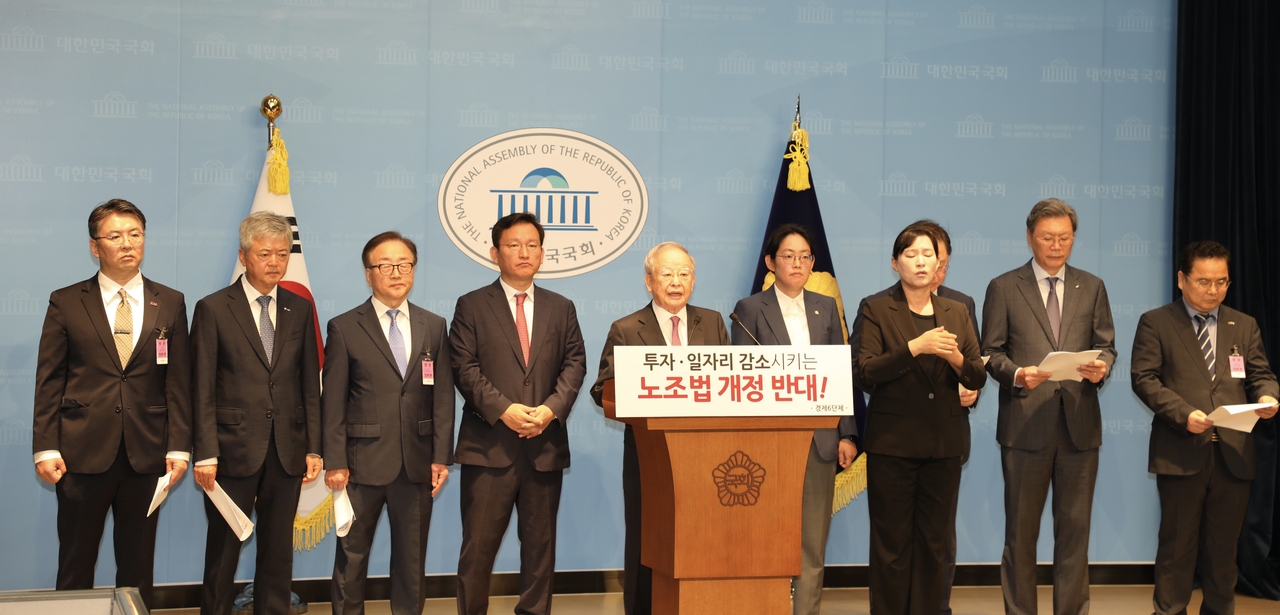
South Korea’s six major business groups on Monday urged lawmakers to revise a disputed pro-labor union bill and postpone its enforcement by at least one year, cautioning that the legislation could disrupt workplace relations and erode the country’s manufacturing sector.
The last-minute appeal comes as the proposed amendment to articles 2 and 3 of the Trade Union and Labor Relations Adjustment Act -- revisions commonly known as the “Yellow Envelope” law -- is barreling toward passage by the ruling Democratic Party-controlled National Assembly this week.
The groups, including the Korea Enterprises Federation, Korea Chamber of Commerce and Industry, Federation of Korean Industries, Korea International Trade Association, Korea Federation of SMEs and the Federation of Middle Market Enterprises of Korea, issued a joint statement at the National Assembly, joined by Rep. Kim Hyung-dong of the main opposition People Power Party.
They expressed disappointment that despite repeated appeals to maintain the current law and allow for further labor-management discussions, lawmakers are moving forward with a bill that largely reflects the demands of labor unions.
The bill, which would likely be passed given the Democratic Party’s majority in parliament, would stretch the definition of “employer” to encompass anyone who “substantially and specifically controls” working conditions, which could give bargaining power to unions representing workers in indirect or outsourced jobs.
Another measure in the revision would prevent companies from seeking compensation for losses caused by legitimate labor union strikes.
The groups said they have proposed alternatives that would address the bill’s aim of easing the financial burdens on workers from damage claims related to illegal strikes. They suggested setting caps on damage claims through a government decree and prohibiting the seizure of wages.
The associations also requested delaying enforcement by at least a year, if the bill is passed, to allow sufficient time for labor-management consultations and to minimize disruptions at worksites.
The industry groups raised particular concern over the broad definitions of "employer" and "labor dispute," which could destabilize workplace order.
“If the definition of employer is expanded, it could lead to tens or hundreds of subcontractor unions demanding negotiations, making it impossible for parent companies to respond to each one individually and throwing workplaces into chaos,” said the joint statement.
They also objected to a clause broadening labor dispute definitions to include managerial decisions such as restructuring or overseas investment. “Should corporate restructuring and global investment become subject to strikes, it will be difficult for Korean companies to do business normally amid fierce global competition," it said.
In early July, foreign business chambers, including the American Chamber of Commerce in Korea and the European Chamber of Commerce in Korea, also raised alarm that the legislation could discourage foreign companies from investing in and operating in Korea.
But with President Lee Jae Myung backing the law, observers say it’s just a matter of time before it is enacted.
For around a decade, progressive lawmakers have attempted to revise the labor union law since it was first introduced in 2015, but have failed to pass it due to opposition from conservative parties and business groups. In 2023 and 2024, the bill passed the Democratic Party-controlled Assembly but was vetoed twice by then-President Yoon Suk Yeol.
The Democratic Party aims to bring the bill to a floor vote on Thursday, as part of its push to pass key items in the August extraordinary session. While the opposition party can attempt a filibuster to delay proceedings, they lack the numbers to block passage. The bill is expected to be approved over the weekend.
The legislation takes its name from a 2014 campaign where citizens sent cash donations in yellow envelopes to support a group of SsangYong Motor workers facing massive damage lawsuits over their occupation of the company's main factory.
sahn@heraldcorp.com