Proposal includes restoring inter-Korean relations, pursuing pragmatic diplomacy
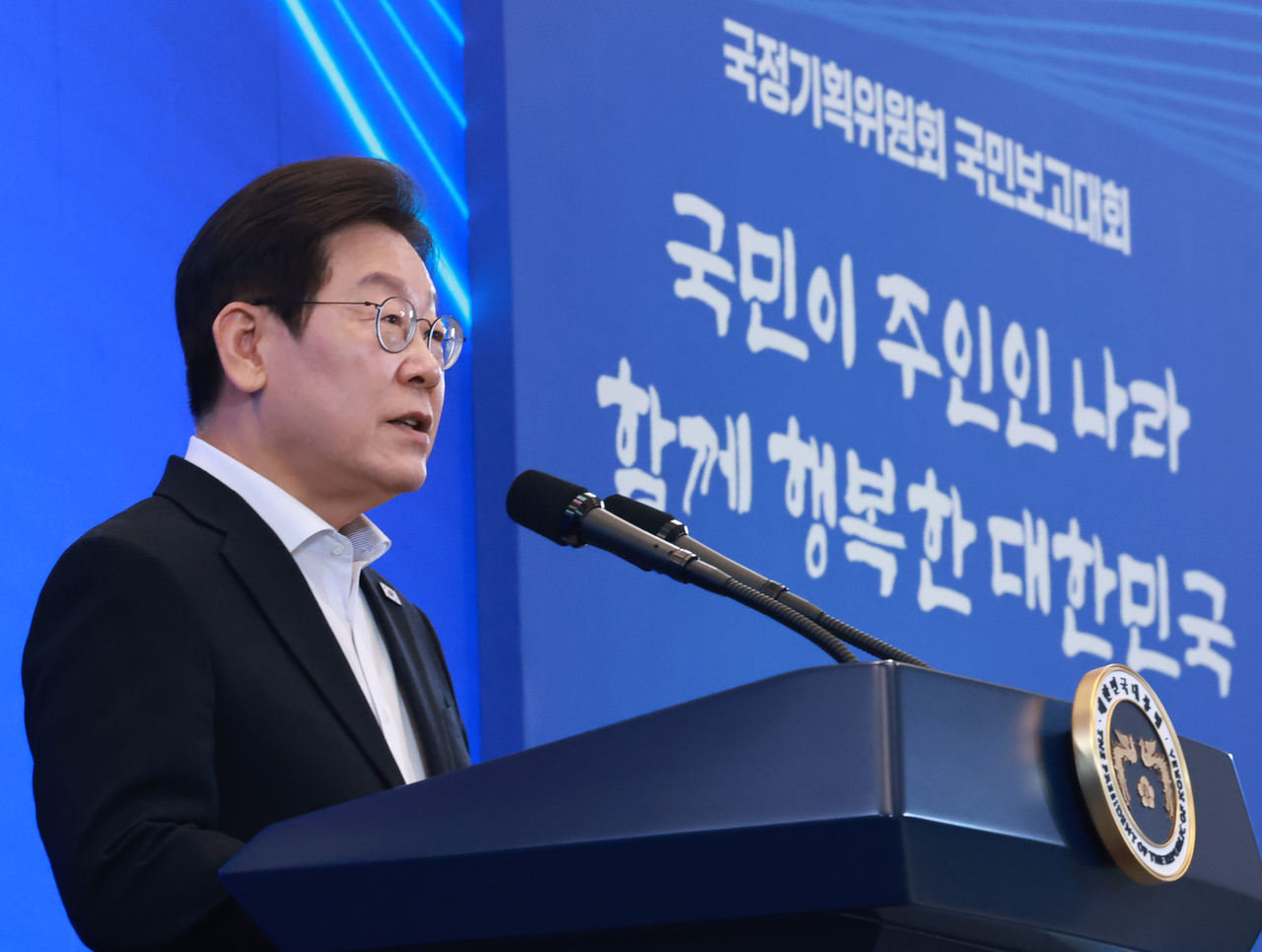
The transition of wartime operational control from the United States to South Korea has been designated as a key national security priority in the Lee Jae Myung administration's five-year governance plan that was unveiled Wednesday.
According to the State Affairs Planning Committee — a de facto transition team tasked with drafting the administration's long-term agenda — the government aims to establish and implement a road map for the OPCON transfer during Lee's term.
The plan calls for strengthening South Korea's operational planning and command capabilities to enhance deterrence against North Korea, while reaffirming that the transition will proceed in close coordination between the South Korea and US alliance.
The OPCON transfer has long been a point of discussion between Seoul and Washington.
South Korea has not held wartime operational control of its troops since the outbreak of the Korean War in 1950, when the authority was relinquished to the United Nations Command. It was later transferred to the South Korea-US Combined Forces Command, which remains under the leadership of a US four-star general.
In 1994, under the liberal Kim Young-sam administration, South Korea regained peacetime operational control. However, wartime command authority continues to reside with the US under the current Combined Forces Command structure.
With President Lee expected to hold his first summit with US President Donald Trump later this month in Washington, the OPCON issue is likely to resurface as a key agenda item. Broader alliance matters, including the level of the US troop presence in South Korea and defense cost-sharing, are also expected to be discussed.
Lee, who attended the committee's briefing session, stressed that the committee's overall five-year plan should not be seen as finalized government policy, but as a set of recommendations.
"These are not a confirmed plan," Lee said. "It is a set of proposals outlining the desirable direction of state affairs. We will take them into account, and they may be revised through the process of consultation and coordination."
He added that the government would "thoroughly and swiftly review" the committee's proposals and implement "as much as possible within feasible bounds."
Caution remains within the military. Gen. Xavier Brunson, commander of the South Korea-US Combined Forces Command, reiterated last week that the transition must proceed under the agreed conditions.
"If we choose to take shortcuts, that could endanger the readiness of the force here on the peninsula," Brunson said during a press conference at Camp Humphreys in Pyeongtaek, Gyeonggi Province. "The hope is — the hope has always been — that OPCON transfer would happen at some point in the future when the conditions are met."
In addition to OPCON, the administration plans to upgrade South Korea's three-axis defense system, which was developed in response to growing threats from North Korea. The system consists of the Kill Chain preemptive strike platform, the Korea Air and Missile Defense system and the Korea Massive Punishment and Retaliation strategy.
To address the steadily shrinking number of military personnel, the government plans to restructure military branches, expand the use of civilian resources and improve the readiness of reserve forces. It also pledged to support the defense industry by fostering high-tech sectors such as artificial intelligence, drone systems, advanced engines and space technologies, as well as by pursuing innovation in weapons acquisition.
Meanwhile, the blueprint also calls for the dissolution of the Defense Counterintelligence Command, with its core functions to be transferred to other agencies.
The unit, tasked with countering North Korean espionage, has come under scrutiny for its role in former President Yoon Suk Yeol's martial law declaration on Dec. 3, 2024. It was reported to have attempted to locate lawmakers and gain access to the National Election Commission during the incident.
Inter-Korean policy, pragmatic diplomacy
The blueprint also outlines a major shift in inter-Korean policy, moving away from confrontation and toward reconciliation.
The government aims to restore inter-Korean relations by reopening communication channels, resuming talks and civilian exchanges and restarting humanitarian cooperation — a broader effort that, according to the committee, also includes pursuing a basic agreement between the two Koreas, modeled after the 1972 treaty between East and West Germany.
The committee emphasized that any path toward unification must be grounded in public consensus, pledging to broaden civic participation in policymaking, promote peace and unification education and foster a more balanced public perception of North Korea.
In broader diplomacy, the Lee administration promised a pragmatic approach based on national interest.
The government seeks to evolve the alliance with the US into a future-oriented comprehensive partnership, pursue forward-looking relations with Japan, deepen strategic ties with China and manage relations with Russia in a stable and constructive manner.
The plan also reaffirmed Seoul's commitment to expanding its outreach to G7 nations, building upon the New Southern and New Northern policies, and to strengthening engagement with countries in the Global South.
flylikekite@heraldcorp.com