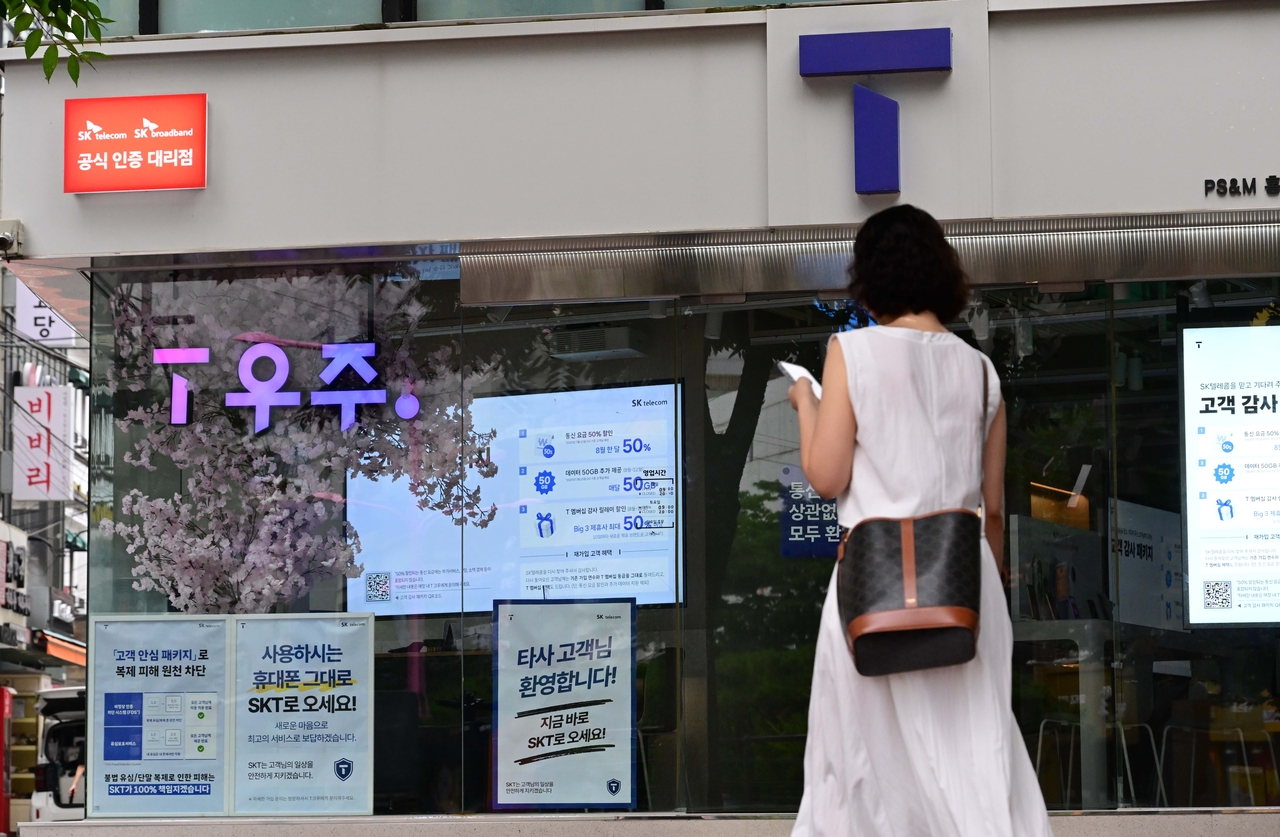
SK Telecom, South Korea’s largest mobile carrier, reported Wednesday that its second-quarter profits plummeted after a major data security breach triggered widespread customer defections and costly compensation expenses, weighing heavily on its primary wireless business.
For the April-June period, operating profit fell 37.1 percent from a year earlier to 338.3 billion won ($244 million), missing analysts’ expectations. Net income plunged 76 percent to 83.2 billion won, while revenue dropped 1.9 percent to 4.34 trillion won, the company said in a regulatory filing. Compared to the previous quarter, operating profit and net income were down 40.4 percent and 77 percent, respectively.
The decline follows a hacking incident at the telecommunications giant that led to a massive leak of customers’ USIM data in April. Between April 22, when the breach was revealed, and the July 14 deadline for customers to terminate their contract without a fee, around 835,000 customers left the company for its rivals.
According to the latest government data, SKT’s subscriber count fell to 22.5 million in May, marking the first time the company’s market share had dipped below 40 percent since 2015.
The company also cited one-off costs, such as free USIM replacements for all customers and compensation to retail stores for their losses, as key factors behind the earnings drop. According to Chief Financial Officer Kim Yang-seob, these expenses totaled approximately 250 billion won, as disclosed during a conference call following the earnings release.
Yet, the financial fallout from the breach is still not over.
The company said it expects additional costs to drag down earnings in the second half, as its customer compensation program ― such as mobile bill discounts for August and extra data ― as well as the exemption of early termination fees are factored in.
“The financial impact of the cybersecurity incident began to be reflected starting from the second quarter and we expect it to appear on a larger scale in the second half of this year,” Kim told investors. “The 50 percent mobile bill discount, the impact of which will be particularly substantial, is scheduled for the third quarter, so a decline in both revenue and operating profit compared to the second quarter is inevitable.”
Despite the turbulence, the company said its artificial intelligence business had fared well, with AI-related sales rising 13.9 percent on-year.
The AI data center business posted revenue of 108.7 billion won, up 13.3 percent on-year, thanks to higher utilization. Sales in the AI transformation business climbed 15.3 percent to 46.8 billion won in the same period, bolstered by increased sales of business-to-business solutions.
In June, the company announced plans to build the country's largest AI data center in Ulsan, in partnership with Amazon Web Services and other SK Group affiliates. The facility is set to commence operations in 2027. SKT projects its AI data center business will generate over 1 trillion won in annual revenue by 2030, once both its existing Seoul facility and the new Ulsan center are fully operational.
sahn@heraldcorp.com