Trade analysts say Korea must secure firm US commitments before concessions
With a looming US tariff deadline threatening Korean exports, top officials from Seoul will head to Washington this week for high-stakes trade talks aimed at averting major tariff blows to autos, steel and other key industries.
South Korea and the US are set to hold a "2+2" meeting on trade and finance in Washington on Friday, the first under President Lee Jae Myung’s new Cabinet.
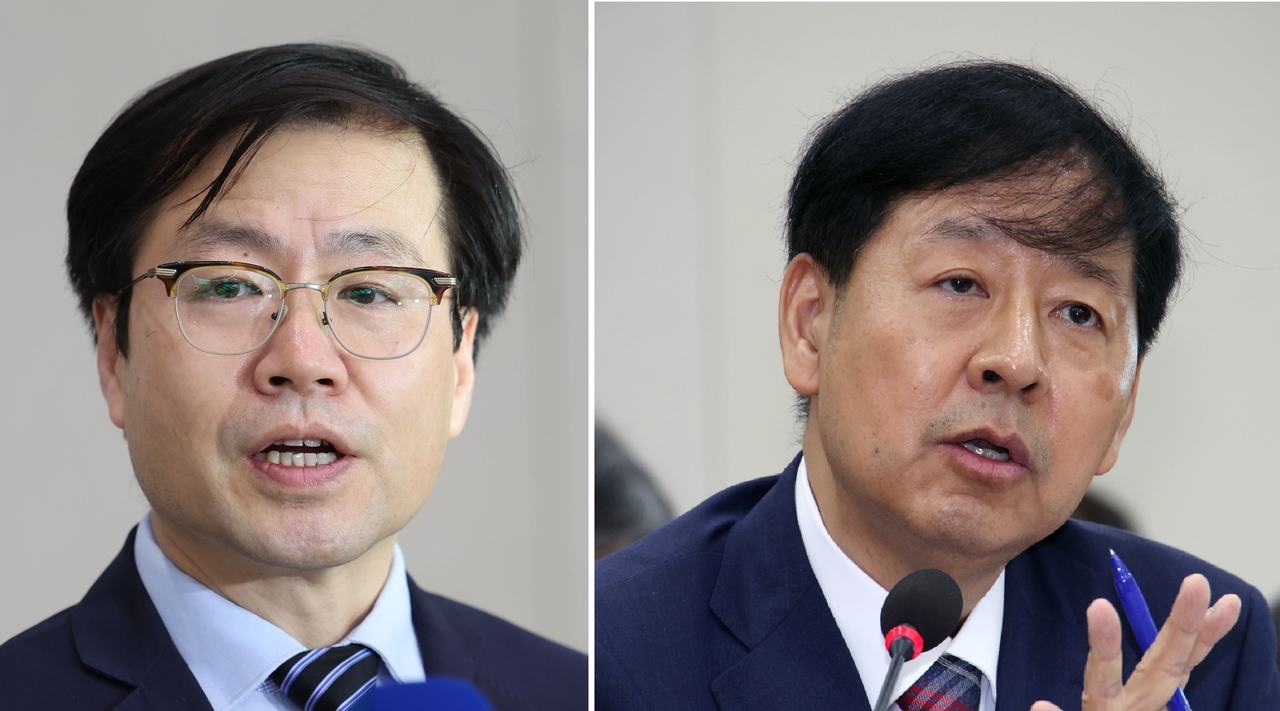
Trade Minister Yeo Han-koo departed for the US on Tuesday to represent Seoul in the upcoming talks, where he will be joined by Deputy Prime Minister and Finance Minister Koo Yun-cheol. They are set to meet with US Treasury Secretary Scott Bessant and US Trade Representative Jamieson Greer.
With just 10 days left before a potential 25 percent "reciprocal tariff" is imposed on Korean goods, a measure pushed by US President Donald Trump, Seoul is seeking to reduce product-specific duties while limiting the impact of non-tariff barriers tied to currency policy, agriculture and digital platform regulations.
On Tuesday, Korea’s top economic officials convened an emergency strategy session in Seoul to align positions ahead of the Washington talks.
“All relevant ministries have agreed to work as one team, pursuing a thorough and coordinated response with a focus on the national interest and pragmatism,” Koo said during a post-meeting briefing.
The upcoming tariff talks had initially been expected to include Industry Minister Kim Jung-kwan, but the US requested Seoul to dispatch Yeo, Korea’s chief trade negotiator, instead.
The industry minister will travel separately to the US on Wednesday to meet his counterpart, while Foreign Minister Cho Hyun is also planning a visit this week.
Korean exports are already subject to a 10 percent base tariff with additional duties on key products such as cars and steel. Absent progress, the baseline tariff is set to rise to 25 percent in August, compounding pressure on Asia’s fourth-largest economy.
Beyond tariffs, the US is pressing for concessions on a range of sensitive non-tariff issues. Washington has reportedly called for greater market access for American agricultural and livestock products, an easing of Korean regulations on American digital platforms, and approval for the overseas transfer of high-resolution maps with a 1:5,000 scale — a data classification currently restricted for national security reasons.
Discussions are expected to include the removal of age limits on US beef imports, an expansion of Korea’s rice import quota and a potential opening of the market to US apples, according to officials familiar with the matter.
In response, Seoul is weighing its own set of trade-offs.
The government is reportedly preparing a broader package that includes increased imports of US liquefied natural gas, industrial cooperation in shipbuilding and manufacturing, and potential participation in the Alaska gas pipeline project as part of a reciprocal deal.
Trade experts said Seoul should secure firm guarantees from Washington before offering any concessions.
“We need to negotiate properly, but only in a way that ensures clear and binding commitments in return and safeguards against any policy reversals,” said Kim Yang-hee, professor of economics at Daegu University.
While Washington is ramping up pressure on dozens of countries ahead of its Aug. 1 tariff deadline, only the UK has finalized a deal so far, she noted.
“Despite its aggressive stance, the US is not in a clearly advantageous position. If it proceeds with imposing all the tariffs as planned, it will face significant headwinds from inflation, rising bond yields and a weakening dollar,” she said.
Aligning Korean regulations with international norms could serve as a practical starting point in negotiations, according to Lee Hye-min, former chief negotiator for the Korea-EU FTA and visiting professor at Hankuk University of Foreign Studies.
“Korea could first address issues that fall short of global standards as part of efforts to narrow gaps in the talks,” he said.
Easing restrictions on US beef imports could be one such area, though Korean farmers’ groups strongly oppose the move.
Imports are currently limited to cattle slaughtered at under 30 months — a safeguard introduced after the mad cow disease scare in the early 2000s. US industry groups argue the rule is outdated, pointing out that China, Japan and Taiwan have since relaxed similar bans.
While the full economic fallout from tariffs has yet to be felt, Korea’s growth is already showing signs of strain. Gross domestic product shrank 0.2 percent in the first quarter from the previous three months and declined 0.1 percent on-year, marking four straight quarters of near-zero growth.
Analysts estimate the tariff hike could reduce shipments to the US by 2 to 4 percent and shave up to 0.1 percentage point off Korea’s full-year growth.
hnpark@heraldcorp.com











