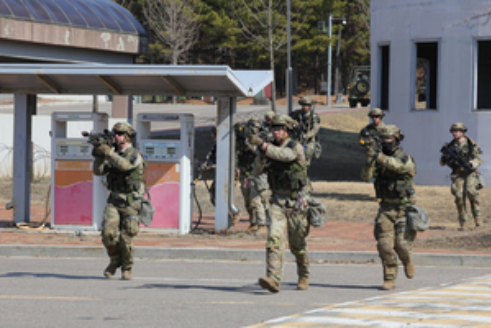
A US think tank recommended a reduction of the US Forces Korea troop level to about 10,000 from the current 28,500 in a report released Wednesday, amid speculation that the Pentagon might weigh the idea of a troop drawdown on the Korean Peninsula to prioritize deterring Chinese threats.
Defense Priorities, a Washington-based institution, released the report, titled "Aligning global military posture with US interests," saying that the US troop presence should be reduced even further if Seoul limits the US ability to use USFK assets to address other regional security crises outside the peninsula.
The report was written by Jennifer Kavanagh, senior fellow and director of military analysis at the think tank, and Dan Caldwell, a former senior adviser to Defense Secretary Pete Hegseth.
The think tank recommended cutting all ground combat units not tied to base security from South Korea, along with Army signal, intelligence, and headquarters units, and some of their associated support and sustainment units -- a reduction that would remove most of the 2nd Infantry Division from Korea, including the rotational brigade combat team and Army combat aviation units.
It also said that the US should cut airpower based in Korea, moving two fighter squadrons from US bases in South Korea back to the US and that about a third of air maintenance and other support units and personnel can also be returned stateside.
"In total, this would reduce the total US military presence in South Korea by more than 50 percent, leaving about 10,000 personnel along with two fighter squadrons (including a larger super squadron) and support forces," the report said.
"The ground personnel left would be primarily for support, sustainment, logistics, and maintenance, leaving the responsibility for combat operations in the event of any crisis on the peninsula to South Korean forces."
The think tank called for the troop reduction, arguing that Seoul has not offered the US "unrestricted contingency access" to use its bases for operations elsewhere in the theater during a conflict.
"(US) forces left in South Korea might be sidelined in the event of a regional war," the report noted.
In May, The Wall Street Journal reported that the US is weighing the idea of pulling out roughly 4,500 troops from South Korea and moving them to other locations in the Indo-Pacific, including Guam.
The Pentagon dismissed the report as "not true," reaffirming that America remains "fully" committed to the defense of South Korea.
Making the recommendation for a troop reduction, the authors said that the US military posture in East Asia should be realigned to focus on balancing Chinese power and protecting US interests, while calling for moving US forces away from the Chinese coast and shifting more frontline defense responsibilities to allies, including Japan and the Philippines.
They also underscored the need to focus a US global military posture review on four priorities: defending the homeland, preventing the rise of a rival regional hegemon in key areas, burden shifting to allies and partners, and protecting US economic security.
Kavanagh, one of the authors, told Yonhap News Agency that the report has been shared widely in Washington, and the authors hope to discuss it with Trump administration officials.
Last month, Ambassador Matthew Whitaker, US permanent representative to the North Atlantic Treaty Organization, said that the US' global force posture review is expected to be completed in late summer or early fall.
Under Secretary of Defense for Policy Elbridge Colby is expected to play a key role in reshaping the US force posture and missions.
During an interview with Yonhap News Agency in May last year, Colby advocated for an adjustment of USFK's role to focus more on threats from China rather than "being held hostage" to countering North Korean challenges.
He also stressed the need for South Korea to undertake "overwhelming" responsibility for its own defense, while saying that if the US gets heavily involved in a war with North Korea, it would be a "perfect distraction" when America should prioritize countering Chinese threats. (Yonhap)










