Policy optimism lifts domestic sentiment, offsets foreign outflows
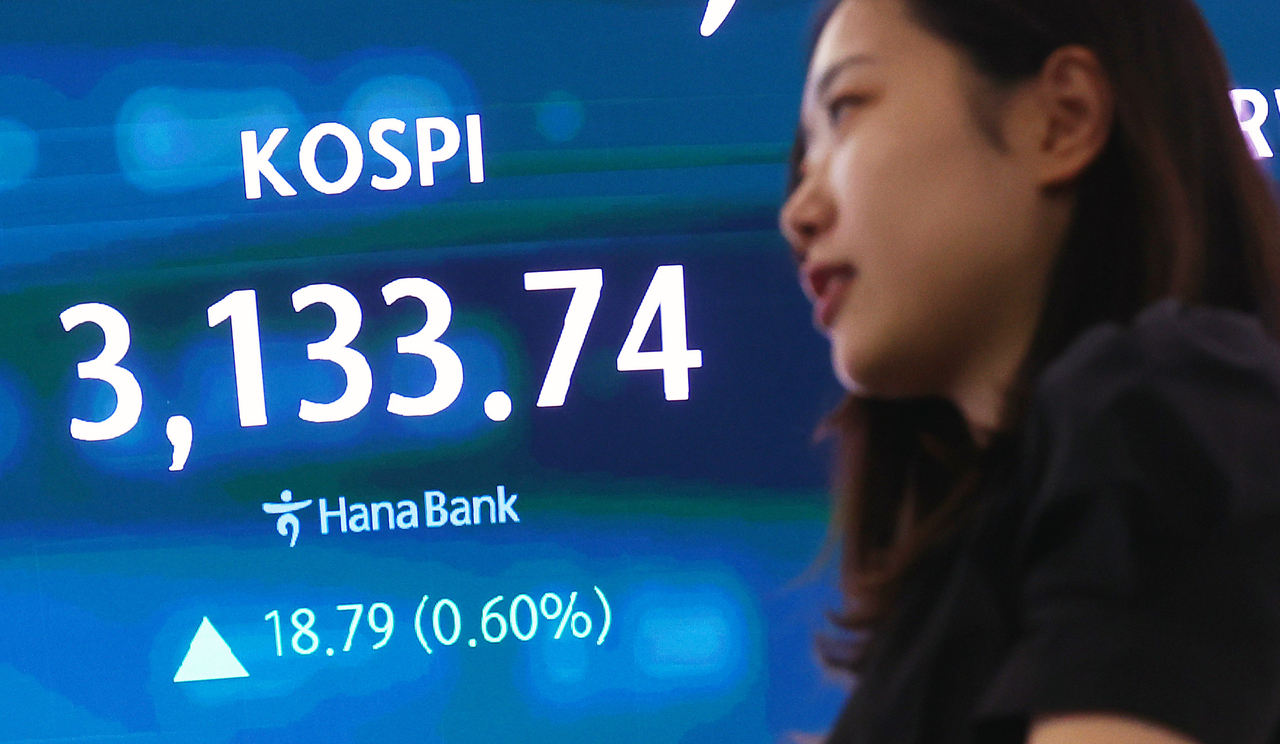
South Korea’s benchmark Kospi climbed to a new annual high Wednesday, as optimism over market-friendly reform lifted domestic sentiment despite persistent foreign outflows amid global uncertainty.
The index touched 3,137.17 around 1:30 p.m., up 0.7 percent from Tuesday’s close. It marked a fresh 2025 peak just eight days after reaching 3,131.05 on July 1, and the highest intraday level since Sept. 28, 2021, when it hit 3,134.46.
Early gains were capped by heavy foreign selling, which dampened retail momentum and kept the index near its opening level of 3,123.22. Like global peers, the Kospi has experienced heightened volatility as Washington continues to threaten tariff hikes, with potential increases now delayed until Aug. 1.
Still, signs of pro-market reform have kept domestic investor confidence firm, helping offset external pressure. On Tuesday, lawmakers from the ruling Democratic Party of Korea were reported to be drafting legislation to strengthen corporate accountability, including a proposal to mandate the cancellation of treasury shares by set deadlines to better protect minority shareholders.
The Kospi eventually closed at 3,133.74, with retail investors net buying 431 billion won ($312.7 million), while foreigners and institutions sold 425 billion won and 58 billion won, respectively.
Brokerage and insurance stocks with large treasury holdings led Wednesday’s rally. Shinyoung Securities surged 17.2 percent, while Daishin Securities gained 11 percent. Smaller peer Bookook Securities soared 29.9 percent to a record high. Among insurers, Hanwha Life jumped 10.4 percent and Mirae Asset Life advanced 7.4 percent.
Still, broader market uncertainty was reflected in the uneven performance of large-cap stocks. Among the Kospi bellwethers, Samsung Electronics, KB Financial Group and Hyundai Motor posted losses, while Hanwha Aerospace and Samsung Biologics traded higher.
Policy momentum has supported the market since the inauguration in early June of President Lee Jae Myung, who has moved swiftly to deliver on campaign pledges. Last week’s passage of a Commercial Act revision — aimed at improving corporate governance and protecting minority shareholders — was seen as a key milestone. As of Wednesday, the Kospi had climbed more than 16 percent from its preelection close of 2,698.97 on June 2.
The secondary Kosdaq index also posted modest gains, rising 0.78 percent to 790.36 points, with foreigners net buying 51 billion won of shares.
Market watchers expect externally driven volatility to persist, but note that further room for gains remains.
“Uncertainty still lingers over the local market, but unlike the sharp correction after April’s ‘reciprocal tariff’ announcement, stocks are showing greater resilience — suggesting improved tolerance to Trump-related tariff risks,” said Han Ji-young, an analyst at Kiwoom Securities.
“With more upside potential in play, we may see another round of rotation into previously overlooked stocks, and any pullbacks in leading names should be viewed as buying opportunities,” Han added.
jwc@heraldcorp.com