Kospi surges to four-year high after on bill's passage, but businesses express concerns
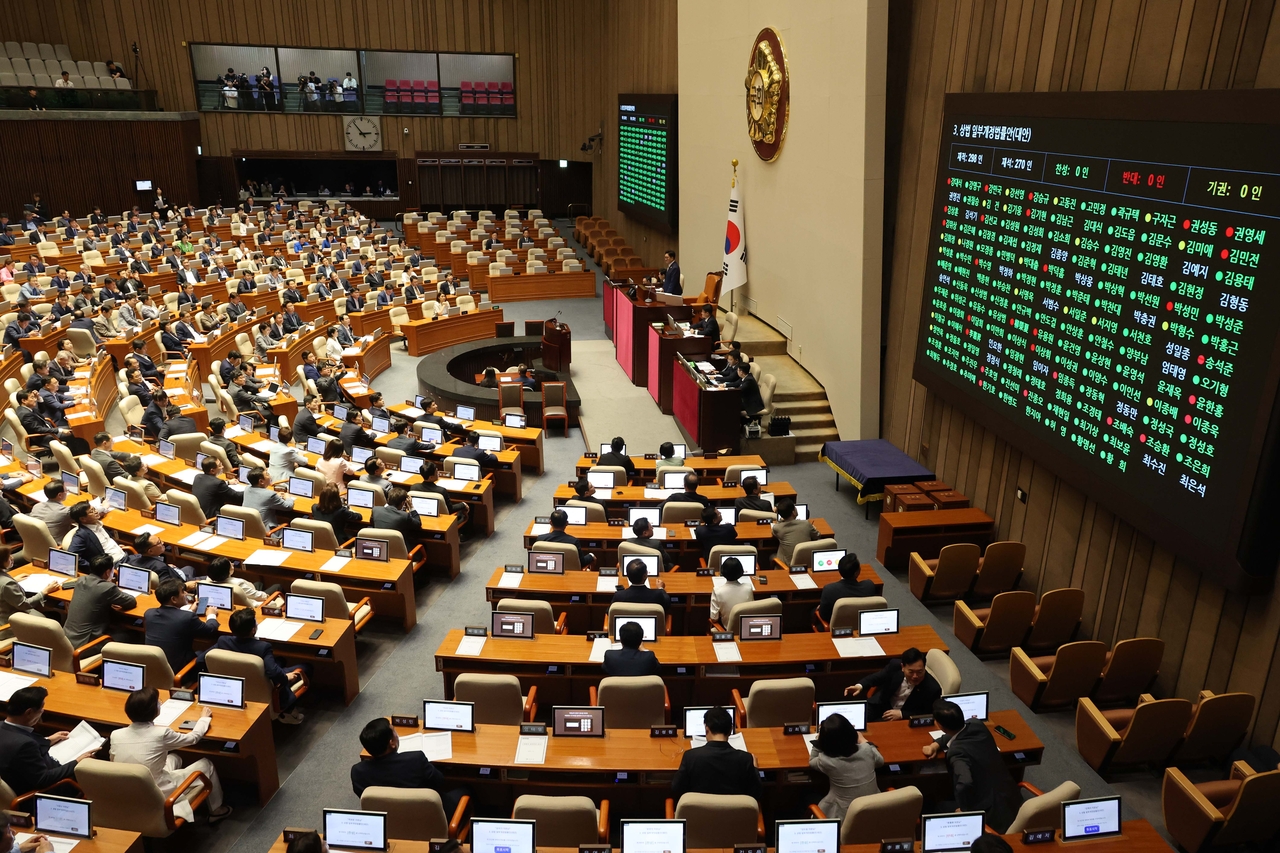
Boardrooms across South Korea could see dramatic changes after the National Assembly passed a revision to the Commercial Act on Thursday, holding corporate directors legally accountable to all shareholders, not just their companies.
The move was hailed by investors as a watershed moment in tackling the long-standing “Korea discount” that has chronically undervalued South Korean equities.
In contrast, the business community voiced concerns that the bill could hinder long-term growth, trigger a wave of lawsuits and leave companies vulnerable to pressure from activist funds.
The revision was approved with 220 votes in favor, 29 against, and 23 abstentions, with 272 lawmakers of the 298-member Assembly present during the plenary session.
The amendment, which aims to protect minority shareholders and improve corporate governance at Korea’s family-owned conglomerates, now awaits final approval from President Lee Jae Myung, who is widely expected to sign it into law.
The bill’s most consequential change expands directors’ fiduciary duty beyond just serving “the company” to serving “the company and its shareholders.” The new law stipulates that directors must act in the interest of all shareholders, preventing them from favoring particular groups, including the founding families of chaebol groups. This rule will take effect immediately after being signed into law.
Another contentious provision for the business community is the so-called “3 percent rule,” in which top shareholders and related parties will have their voting rights capped at 3 percent when electing audit committee members.
Under the revision, the 3 percent limit, which previously applied only when appointing internal directors to the audit committee, will now also apply to the election of outside directors to the committee.
The revision also mandates that listed companies with assets of more than 2 trillion won ($1.47 billion) must hold electronic shareholders meetings, in addition to in-person gatherings. Additionally, the legislature agreed to replace the term “outside director” with “independent director,” a largely symbolic shift that aims to stress greater separation from company leadership to exercise independent oversight.
The bill clearing the Assembly came with no surprise, given President Lee's liberal bloc, which supports the legislation, holds a majority in the unicameral parliament, with 167 seats. On the campaign trail, Lee had pledged the revision, arguing it would help solve the “Korea discount” and lift South Kora’s benchmark stock index Kospi to 5,000.
The revision follows a failed attempt earlier this year, when a previous version of the bill passed the Assembly but was vetoed by then-acting President Han Duck-soo.
The new version came after a rare bipartisan compromise after intense negotiations between the ruling Democratic Party and the opposition People Power Party, which were at odds until just a day earlier over whether to include the “3 percent rule.”
The two sides ultimately agreed to include the provision, but deferred other contested reforms, including mandatory cumulative voting and increasing the number of separately elected audit committee members from one to two, for future public hearings.
On Thursday, South Korea’s stock market responded positively to the legislation, with Kospi jumping 41.21 points, or 1.34 percent, to close at 3,116.27, hitting the highest close since September 27, 2021.
Analysts said the anticipation of governance reforms and shareholder friendly initiatives was behind the rally.
“The ‘hot potato’ 3 percent rule was included. This restricts the largest shareholders voting rights while protecting minority shareholders,” said Kim Doo-un, analyst at Hana Financial Investment. “The revision of the Commercial Act is a signal that Korea is beginning to resolve the ‘Korea discount’”
Kim added that the revision will likely boost the Kospi through increased foreign investment flows.
Meanwhile, the business sector, which includes some of the major conglomerates, voiced concerns.
“Activist campaigns are likely to be launched against companies vulnerable to management control disputes,” said an industry official requesting anonymity. “Practically, aligning the interest of all shareholders is difficult. Corporate directors may become overly conscious of shareholder sentiment and potential lawsuits.”
Korea’s eight major business association, including the Federation of Korean Industries, Korea Chamber of Commerce and Industry, Korea Enterprises Federation, Korea International Trade Association, Korea Federation of SMEs, Federation of Middle Market Enterprises of Korea, Korea Listed Companies Association and Kosdaq Listed Companies Association, expressed regret over the bill, saying the changes could weaken corporate governance and increase the influence of speculative investors.
“We agree with the bill’s purpose of revitalizing the capital market and establishing a fairer business environment,” the groups said in a joint statement. “But we are deeply concerned that the revision did not provide a means of defending against lawsuits and the strengthened ‘3% rule’ has increased possibility of appointing speculative forces as audit committee.”
They urged lawmakers to begin discussions on complementary measures, including incorporating the business judgement rule into law, amending the breach of trust provisions and introducing mechanisms to protect management rights.
sahn@heraldcorp.com