Concerns remain over risks to monetary sovereignty, financial stability
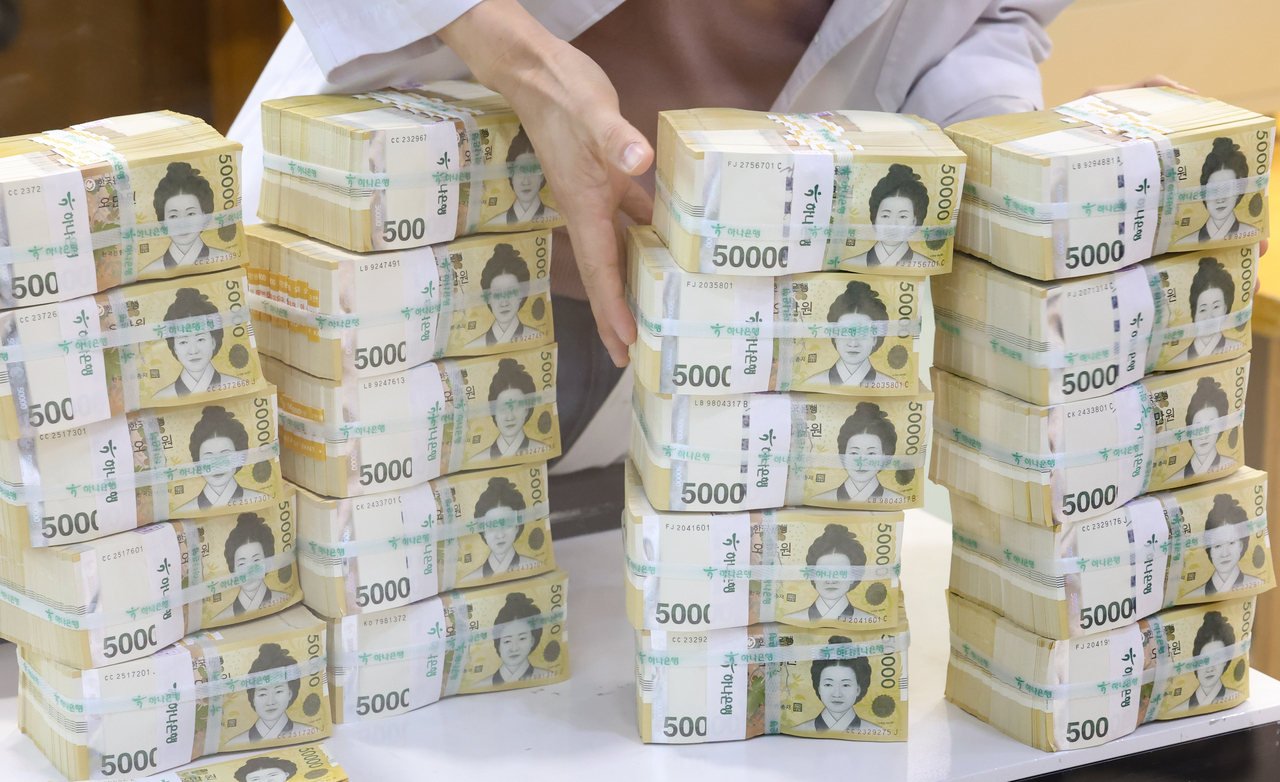
South Korea is poised to create its own stablecoin, backed by growing support for a won-pegged version under newly-elected President Lee Jae-Myung, even as debate continues over early adoption risks and fears of lagging behind.
Stablecoins have become a major focus in financial circles, capturing the attention of commercial banks, fintech firms, central banks and lawmakers alike, as momentum builds for a version pegged to the Korean won.
A stablecoin is a type of crypto asset linked to the value of another asset — typically a fiat currency like the US dollar or a commodity such as gold. Unlike volatile cryptocurrencies like Bitcoin, stablecoins aim to maintain a steady valuation, often by being pegged one-to-one and backed by equivalent reserves.
With President Lee's new administration pledging to create a won-based stablecoin market, regulatory efforts are accelerating to bring digital assets into the traditional financial framework.
Other countries are moving ahead. In Singapore, stablecoins are increasingly being explored for use in payments. Retail giants like Walmart and Amazon are reportedly considering issuing their own. Last week, France’s major lender Societe Generale unveiled plans to launch a publicly tradable, dollar-backed stablecoin.
Still, there has been pushback here. The Bank of Korea and other institutions have flagged concerns that a domestic stablecoin could erode trust in the sovereign currency and introduce new risks to financial stability.
Political tailwinds
President Lee’s promise of Korean won-based stablecoins reflects concern that rising demand for dollar-backed versions could lead to capital outflows.
When Korean investors buy dollar-based stablecoins, such as tether or circle, they are betting on the greenback, thereby strengthening the dollar’s hegemony in the global digital asset market and weakening the won's status.
According to the Bank of Korea, the total trading volume of dollar-pegged stablecoins on Korea’s five major cryptocurrency exchanges -- Upbit, Bithumb, Korbit, Coinone and Gopax -- reached 56.95 trillion won ($41.6 billion) in the first quarter of this year, marking a threefold increase from 17.06 trillion won in the third quarter of 2024.
The appointment of Kim Yong-beom, former first vice finance minister and former head of the crypto think tank Hashed Open Research, as the president's top economic adviser has fueled speculation that Korea’s crypto asset industry could soon gain traction at the policy level.
During his tenure at the think tank, Kim publicly asserted that “a regulated Korean won-backed stablecoin could be controlled more precisely than fiat currency.”
On Tuesday, Rep. Min Byoung-dug from the Democratic Party of Korea introduced the Digital Asset Framework Act, a bill that would intensify competition between banks and non-banking entities for leadership in the stablecoin market.
The bill proposed to allow corporations, including non-financial firms, with a minimum capital of 500 million won ($360,000) to issue won-backed stablecoins.
Riding this wave of optimism, shares of Kakao Pay, a fintech affiliate of the country’s tech giant Kakao, have nearly doubled in just a week, buoyed by anticipation that it could play a major role in the won-backed stablecoin market.
Local banks are rushing to lay the groundwork for stablecoins, competitively launching task forces and seeking tech partners, signaling a major shift in the nation's financial landscape.
“At this point, stablecoins are not yet a lucrative area for banks. But if the won-based stablecoin materializes, banks would, of course, want to play a pivotal role,” an official from a local commercial lender said.
A threat to the BOK?
Like its dollar-backed counterparts, which are backed by US government debt and money market funds, a won-based stablecoin would be guaranteed by short-term, low-risk Korean financial instruments if it were to follow the same model.
While talk of won-pegged stablecoins has gained traction, the BOK remains wary as the new instrument could undermine the status of the country's fiat currency.
"Allowing a non-banking institution to freely issue won-based stablecoins could seriously weaken the effects of monetary policy,” said BOK Gov. Rhee Chang-yong at a press conference held in May.
If won-pegged stablecoins are established as a major means of payment in the domestic economy, this would undermine the central bank’s ability to control monetary flows.
"The issuance of stablecoins could increase the money supply and potentially affect the status of the won. It is necessary to approach the matter with caution,” an official from the BOK said.
Another potential loophole lies in cross-border transactions, possibly threatening the country’s financial stability.
Individuals could convert won-based stablecoins into dollar-pegged stablecoins and transfer funds overseas, bypassing traditional financial channels that are subject to regulatory oversight for cross-border capital flows.
While similar concerns exist with bitcoin, its transactions are more closely monitored under local regulatory frameworks, such as the "travel rule," which requires exchanges to verify senders’ identities for international transfers over 1 million won.
silverstar@heraldcorp.com