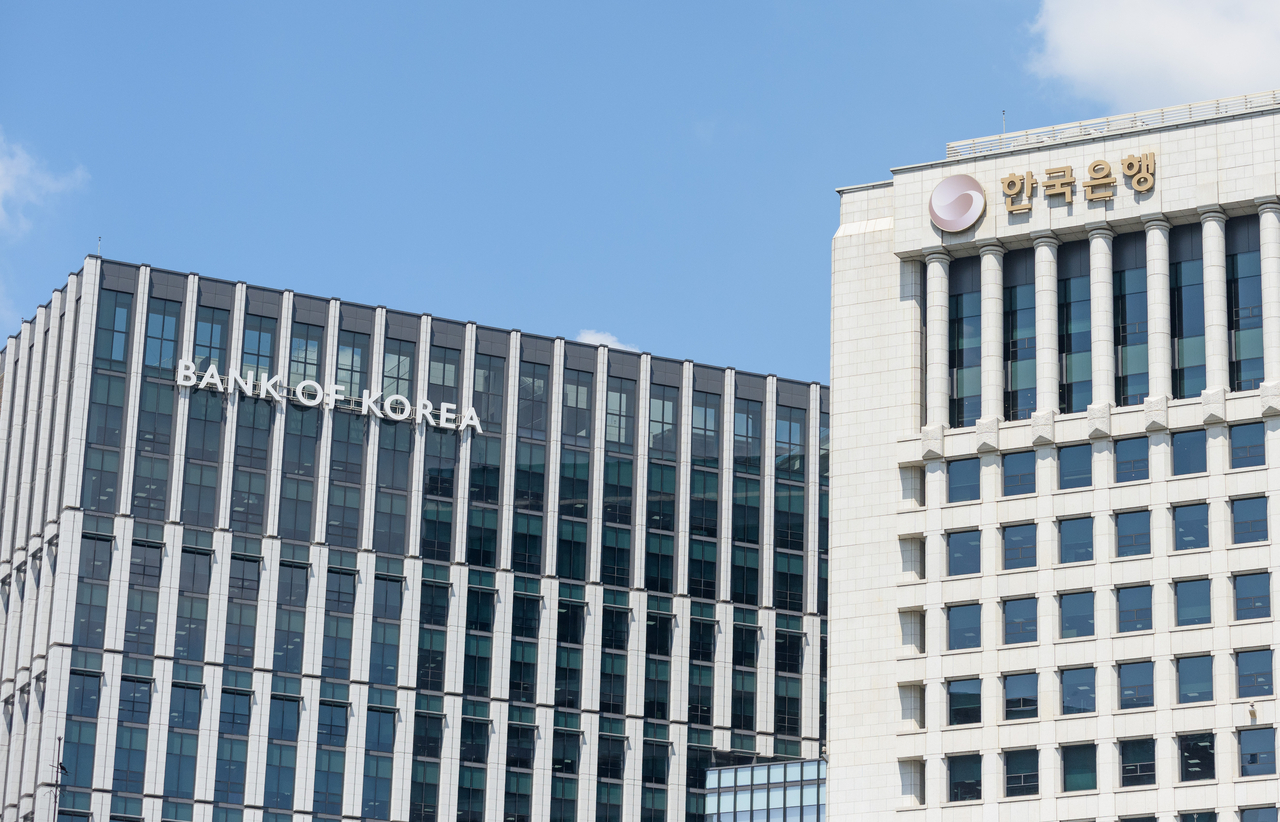
Major global investment banks are raising their projections for South Korea’s real gross domestic product growth this year, citing expectations of large-scale fiscal stimulus measures under the new administration and signs of easing trade tensions between the US and China, according to their latest reports.
Goldman Sachs recently raised its 2025 growth outlook for South Korea from 0.7 percent to 1.1 percent. In a report released May 16, the firm cited easing US tariff risks, improved economic prospects and the likelihood of fiscal support as reasons behind the revision.
The bank estimated that if China’s exports recover by 5 percent, Korea’s exports to China could rise by approximately 1.6 percent, potentially adding 0.1 percentage point to GDP growth.
Additionally, it projected that a second supplementary budget — expected to be at least 1 percent of GDP — would follow the first round of stimulus worth 13.8 trillion won ($10.1 billion), boosting growth by around 0.3 percentage point.
Barclays also increased Korea's growth forecast from 0.9 percent to 1 percent, and raised its 2026 forecast from 1.4 percent to 1.7 percent.
The report, released on May 30, emphasized that expansionary fiscal policy is likely to remain a core principle of the new administration, regardless of political leadership. However, it also warned that such fiscal expansion could limit the Bank of Korea’s monetary policy flexibility if inflation rises.
Morgan Stanley joined the upward trend, raising its 2025 forecast from 1 percent to 1.1 percent and its 2026 outlook from 1.4 percent to 1.5 percent.
Meanwhile, the Bank of Korea has offered a cautiously optimistic view.
At a press conference on May 29, Gov. Rhee Chang-yong said, “There’s a possibility that the impact of US tariffs will weaken, and we must also consider the effects of the new government’s fiscal policies.”
He added that private consumption appears to have bottomed out in the first quarter and is expected to recover gradually, with the construction sector likely to rebound in the second half of the year.
Despite these upward revisions, concerns over prolonged low growth persist. According to the International Finance Center, the average 2025 growth forecast from eight major global investment banks remained at 0.8 percent as of the end of May, unchanged from the previous month.
hyelimchung@heraldcorp.com