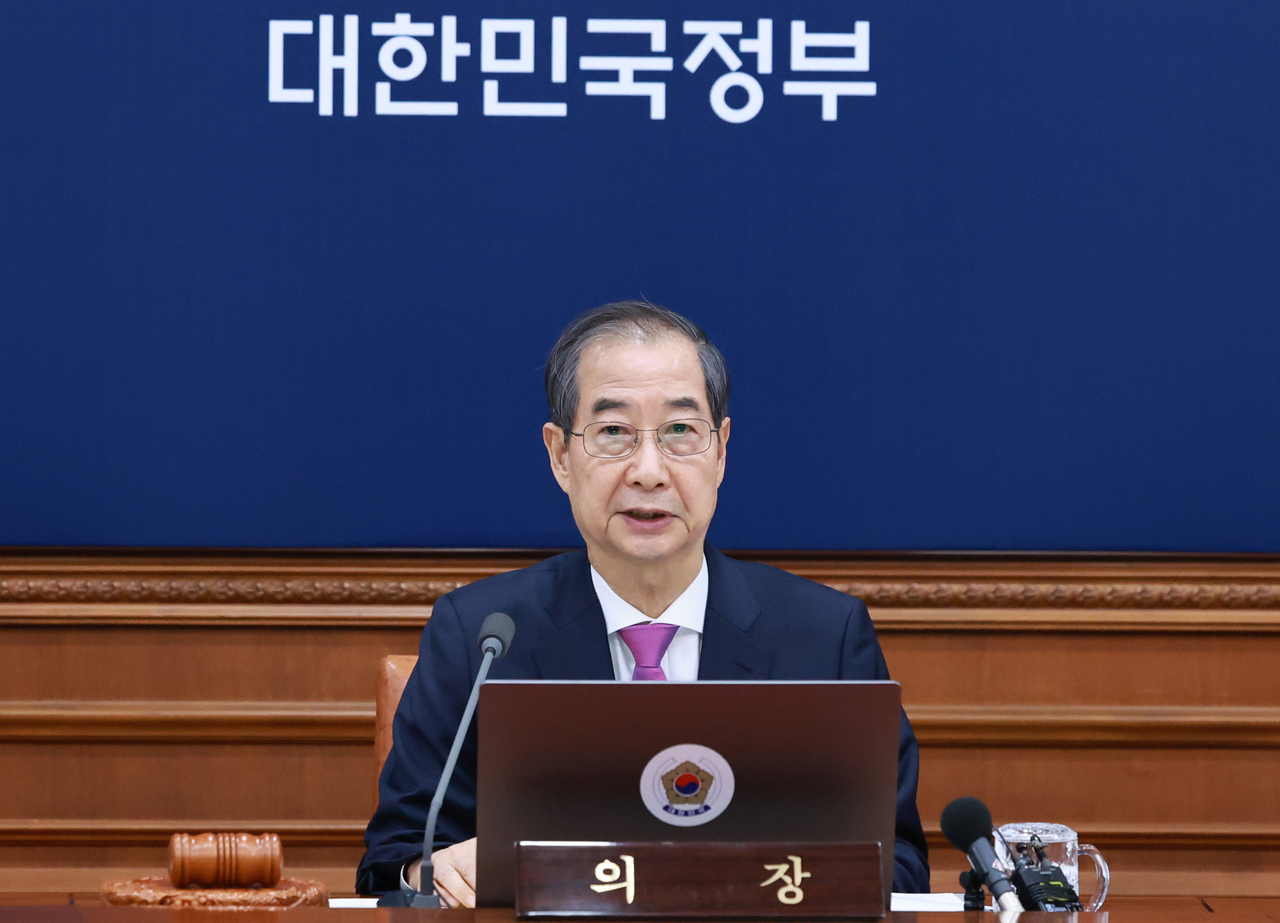
South Korea's opposition condemned acting President Han Duck-soo's nomination of two Constitutional Court judges on Tuesday, claiming that, as acting president temporarily standing in for the removed president, he lacks the constitutional right to do so.
Han named Minister of Government Legislation Lee Wan-kyu and Director General of the Seoul High Court Ham Sang-hoon to fill two upcoming vacancies on the nine-member court. The announcement comes as acting Chief Justice Moon Hyung-bae and Justice Lee Mi-son are set to step down on April 18, marking the end of their six-year terms.
Han, former President Yoon Suk Yeol's appointed prime minister, was recently reinstated as acting president and prime minister, following the Constitutional Court's divided ruling March 24 on his impeachment two months prior. The National Assembly voted to impeach him on Dec. 27 for grounds including his failure to appoint three new justice candidates nominated by the Assembly.
Han's nominations Tuesday marked the first time an acting president has exercised the presidential authority to nominate justices.
According to Article 6 of the Constitutional Court Act, of the nine-member bench, three justices should be selected by the president, three should be selected by the National Assembly and three shall be selected by the chief justice of the Supreme Court.
Some experts argued that while Article 71 of the Constitution allows the prime minister to act on behalf of the president while the position is vacant or the president is unable to perform their duties, the nomination of Constitutional Court justices exceeds the scope of the power entitled to him or her in such a case.
With suggestions floating for the resolution of the matter through a constitutional dispute lawsuit, one legal expert pointed to a paradoxical procedural flaw regarding the case.
“This has to do with the presidential authority, which means that someone — the president — needs to claim infringement of presidential power. But we don’t have a president right now,” professor Jang Young-soo of Korea University Law School told The Korea Herald.
What’s left for the two nominees are mandatory confirmation hearings at the National Assembly. If an opposition party, like the main opposition Democratic Party of Korea, files an injunction or requests a suspension of the nominations, the process could be delayed or blocked. The eventual appointment of the Constitutional Court justices by the president, however, does not require the Assembly's approval.
Meanwhile, on Wednesday, Lee Wan-kyu, one of the two nominees and a close ally of former President Yoon, told lawmakers that he respects Han’s decision to nominate him, adding he agrees with the viewpoint that the acting president’s authority should still be executed in certain situations.
The Democratic Party demanded Lee’s immediate withdrawal as justice nominee, calling his nomination "unconstitutional and politically motivated.” The party also passed a bill through the Assembly’s Legislation and Judiciary Committee aimed at revising the Constitutional Court Act to prevent an acting president from making nominations in future.
The opposition lawmakers also raised questions as to the nominee's close ties with Yoon.
“Lee took part in a secret meeting shortly after the Dec. 3 martial law declaration. He is an accomplice to the insurrection and someone with a particularly serious level of culpability,” said Kim Yong-min, deputy floor policy leader of the Democratic Party.
The ruling People Power Party, meanwhile, countered the main opposition's claim, arguing that Han's decision was aimed at preventing a potential judicial vacuum.
"His actions are legal and necessary under the current political instability," said the party’s Floor Leader Rep. Kweon Seong-dong.
ddd@heraldcorp.com