Korean analysts are raising alarms over US President Donald Trump’s sweeping new tariff plan, calling it a “worst-case scenario” that threatens to disrupt Korea’s financial markets and economic stability.
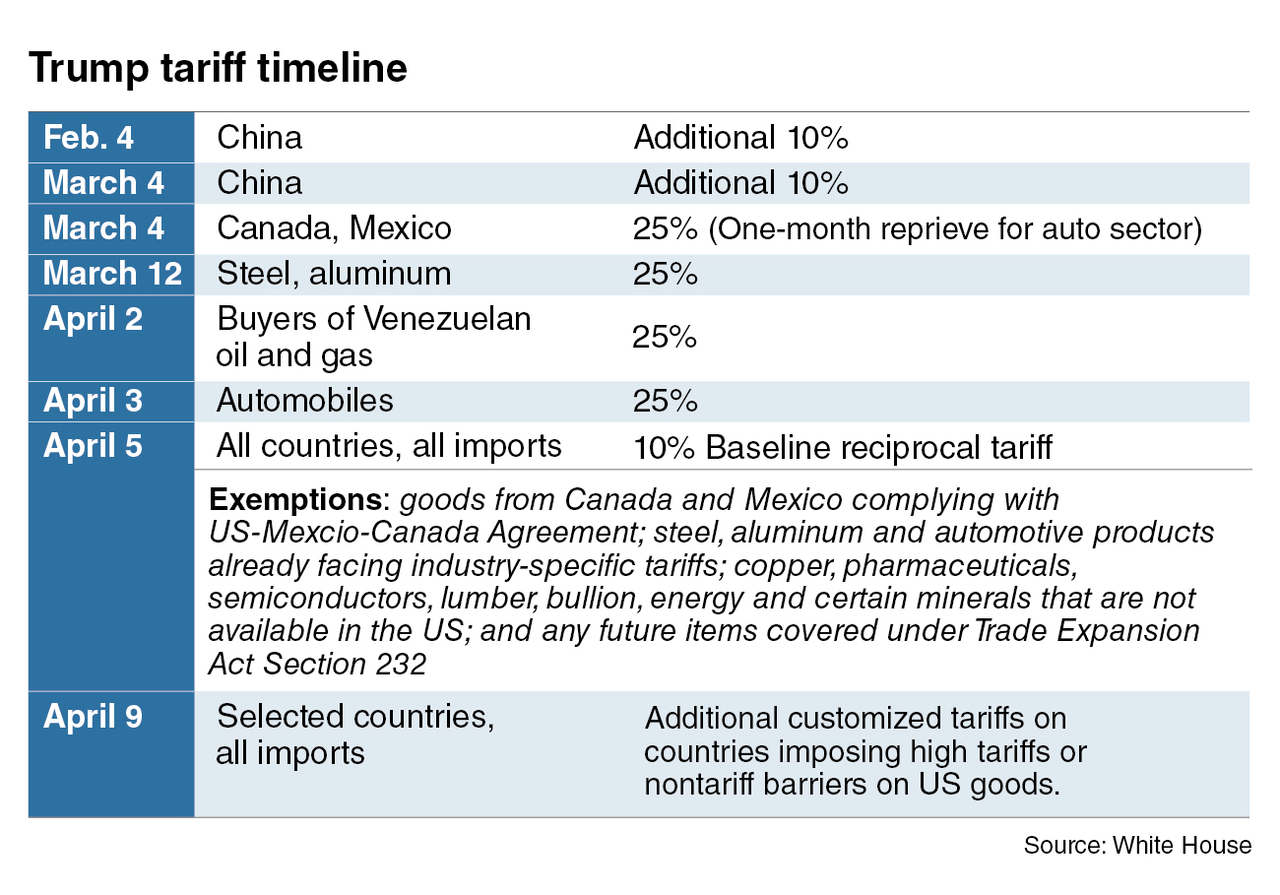
The Trump administration on Thursday unveiled its plan to impose 10 percent universal tariffs on all imports to the US, alongside steep "reciprocal" tariffs on about 60 countries with trade surpluses — including a 25 percent levy on South Korean goods.
While Trump announced a 25 percent tariff on Korea, a subsequent White House order stated it would be 26 percent, stoking further confusion.
"Reciprocal tariffs have materialized as the worst-case scenario," said Park Sang-hyun, an analyst at iM Securities, warning they could deliver a major shock to financial markets while also slowing the US economy and increasing inflationary pressures.
Park predicted a substantial and unavoidable blow to Korea’s economy. “From the second quarter onward, slowing exports to the US and ASEAN countries could further drag down domestic growth, making it increasingly likely that economic growth could fall below 1 percent this year,” he said. ASEAN refers to the 10-member Association of Southeast Asian Nations bloc.
Citi economist Kim Jin-wook said that the US global reciprocal tariffs were "sharper than expected," and their negative impact on Korea’s gross domestic product would be at least around minus 0.375 percent over a year.
"The US global reciprocal tariffs suggest downside risks to our 1.0 percent 2025 GDP growth forecast for Korea," he said.
The negative impact should be larger if we consider the indirect impact from the US reciprocal tariffs to Vietnam, Taiwan and Japan, according to Kim.
Jung Yeo-kyung, an analyst at NH Investment & Securities, expects Korea’s export recovery to slow further in the second quarter, citing ongoing uncertainties surrounding Trump’s tariffs and retaliatory measures from affected countries.
“At this stage, companies are unable to execute investment plans with stability. We expect stable new orders to emerge only after reciprocal tariff negotiations conclude in the second quarter,” she said.
Korea’s automobile industry is bracing for a loss of competitiveness, with nation-specific US tariffs raising costs and pressuring exports. Hyundai Motor and its smaller affiliate Kia, which have manufacturing plants in Vietnam, India and Indonesia, will face even higher reciprocal tariff rates than those for South Korea itself.
Meanwhile, the European Union, Brazil, Turkey and Singapore lack production lines for key US-bound sport utility vehicles and Genesis models, limiting their ability to offset supply chain disruptions.
“Unless reciprocal and import tariffs on automobiles are adjusted through country-specific negotiations, increasing US-based production will be inevitable. However, as more production shifts to the US to avoid tariffs, exports from Korean plants to the US will inevitably decline — further weakening Korea’s already slipping position in global auto manufacturing, which has fallen from fifth to seventh place,” said Moon Yong-kwon, an analyst at Shinyoung Securities.
Separately, the 25 percent tariff on automobiles announced by Trump on March 26 officially took effect Thursday.
With automobiles ranking as Korea’s top export to the US, the impact is expected to be severe. Last year, Korea exported $34.7 billion of automobiles to the US, accounting for 49.1 percent of Korea’s total global auto exports.
hnpark@heraldcorp.com











