As US President Donald Trump's announcement on retaliatory tariffs draws closer, tensions are mounting across Korea’s industrial sectors. Fears of increased tariffs are sending shock waves through the domestic market, according to industry sources Sunday.
The automobile and steel industries, already hard hit by sector-specific tariffs, are particularly concerned that an additional layer of retaliatory tariffs could be imposed on top of the existing 25 percent duties. It has raised significant alarm among key players in the sector.
The semiconductor and battery industries are also wary of expanding uncertainty in the global supply chain. Companies are meticulously reviewing strategies, including increasing local production in the US, to minimize potential losses.
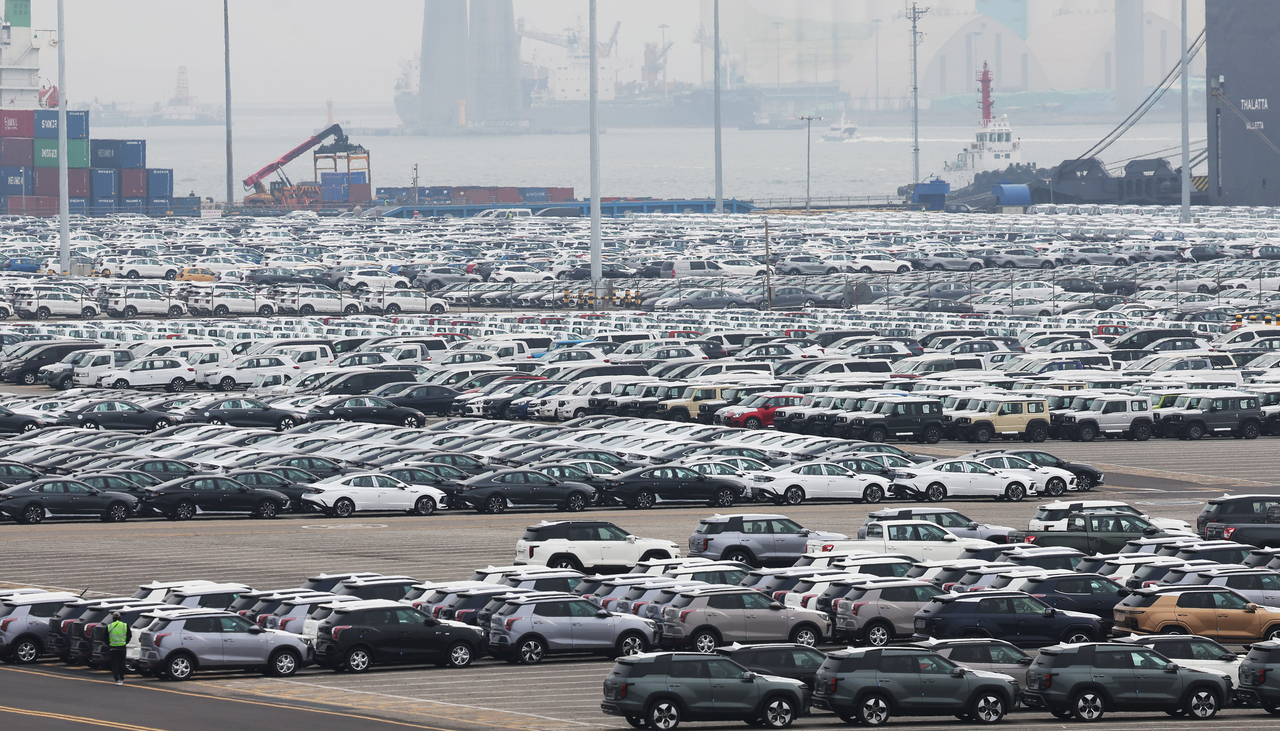
Last year, Hyundai Motor Group exported some 1 million vehicles to the US tariff-free under the Korea-US Free Trade Agreement. Even with maximum local production expansion, an estimated 500,000 to 700,000 vehicles would be subject to the tariffs.
According to credit rating agency S&P Global, a 20 percent tariff could shrink Hyundai and Kia’s operating profits by up to 19 percent. NICE Investors Service further estimated that if a 25 percent tariff is imposed on cars imported from Mexico and Korea, Hyundai and Kia’s earnings before interest and taxes could decline by 34 percent.
Despite these concerns, Hyundai appears to be taking a wait-and-see approach, having already made substantial investments in the US. Last week, the company announced a $21 billion investment across the US automotive, logistics, steel and future energy industries by 2028.
The investment amount surpasses the $20.5 billion the automaker has already invested in the US and marks the first major response from a Korean conglomerate to the Trump administration’s second-term policies.
Industry watchers are divided on whether the latest investment will help mitigate tariff impacts, with some expecting a positive influence while others remain cautious given the ongoing uncertainties.
The steel sector, which was among the first to be hit with a 25 percent tariff, is anxiously monitoring whether additional retaliatory tariffs will be imposed.
Hyundai Steel is actively exploring large-scale investments in the US to construct new plants able to produce automotive-grade steel. This move aims to offset the tariff burden on steel shipments to Hyundai’s American manufacturing facilities and ensure a stable supply chain.
Posco is also considering investments in upstream steelmaking operations in the US, such as blast furnaces and electric arc furnaces, to process raw iron ore into semifinished products.
With Trump vowing to impose a minimum 25 percent tariff on imported chips, the Korean chip industry is closely monitoring policy developments.
Though direct exports of semiconductors to the US accounted for only 7.5 percent last year — far lower than China (32.8 percent), Hong Kong (18.4 percent), Taiwan (15.2 percent) and Vietnam (12.7 percent) — the potential indirect impact remains a concern.
Experts suggest that since Korea leads in advanced semiconductor production, particularly high-bandwidth memory, there are limited alternatives to Korean-made chips. As a result, the direct tariff impact might be less severe. However, if both sector-specific and retaliatory tariffs exceed 25 percent, it could have broader implications.
Additionally, many semiconductors undergo assembly and processing in Taiwan before being exported to the US. The extent of the tariff impact will depend on how the US defines and enforces its trade restrictions.
Expanding US-based production remains an option, but given the high costs, complex approval processes and long construction timelines, domestic companies are proceeding with caution. Korean chipmakers Samsung Electronics and SK hynix have committed to building large fabrications in the US, but further investments are under careful evaluation.
Battery and consumer electronics manufacturers, particularly those with operations in Canada and Mexico, are also scrambling for contingency plans. Canada, a major source of key minerals, hosts significant investments from Korean battery firms LG Energy Solution, Posco Future M and EcoPro BM.
These companies are closely monitoring US trade policies to mitigate operational uncertainties. Higher tariffs on Canadian lithium and nickel could raise battery production costs, affecting product competitiveness.
In Mexico, where Samsung Electronics and LG Electronics operate home appliance and TV manufacturing facilities, the risk of increased tariffs is prompting firms to consider shifting production to the US.
LG currently produces washing machines and dryers at its Tennessee plant and is prepared to relocate other key operations to the US if Mexican tariffs are imposed.
“We’re preparing a diverse supply chain and implementing countermeasures, enabling it to respond promptly to US tariff policies,” said Hwang Tae-hwan, head of sales and marketing of digital appliances at Samsung Electronics, at the tech giant’s press briefing Friday.
yeeun@heraldcorp.com