'Parasite' director discusses 'Mickey 17,' his first film in six years, starring Robert Pattinson as expendable clones
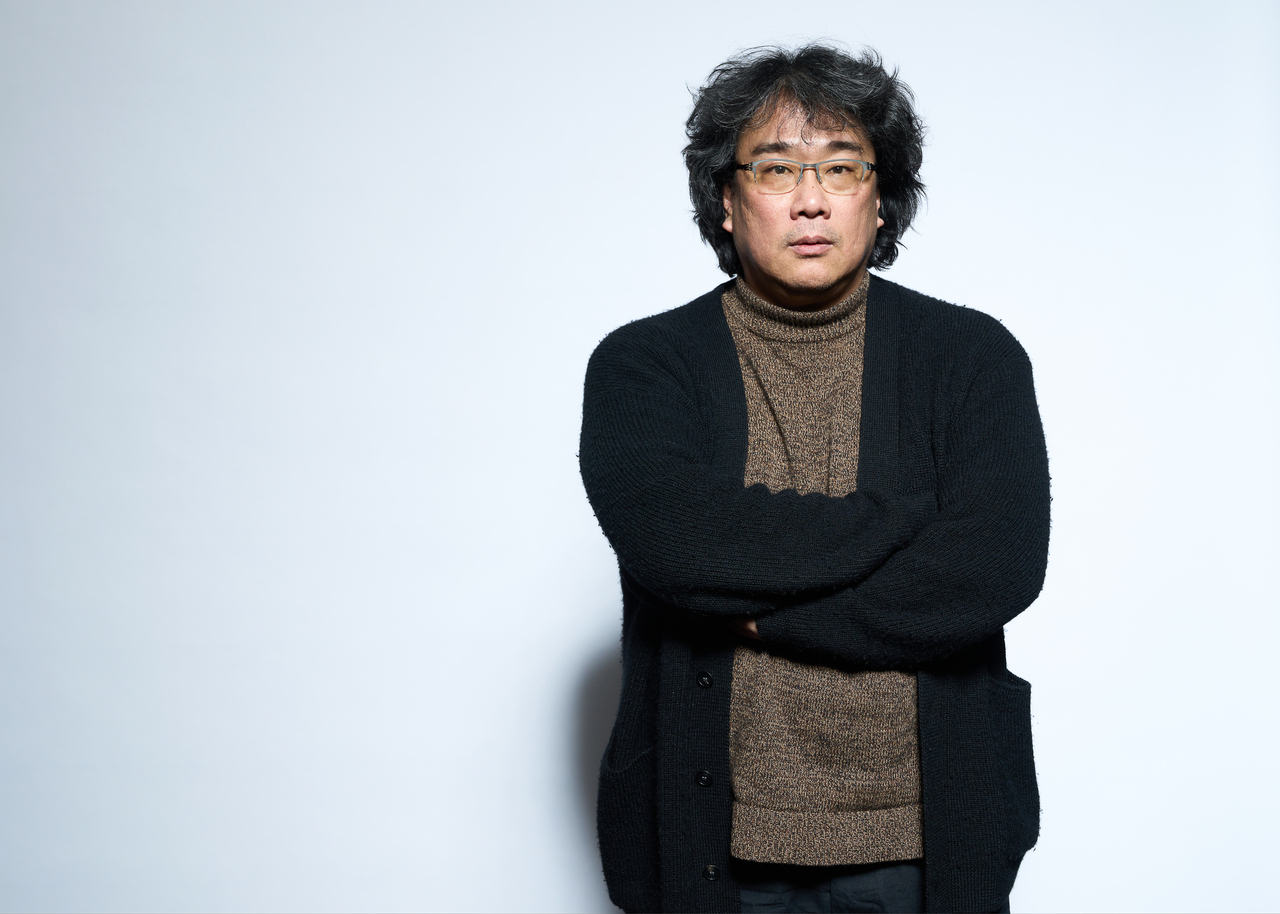
"I've never been freeloading," Bong Joon-ho quips with a mischievous glint. The Oscar-winning director is speaking to reporters at a hotel in Yeouido, Seoul, Wednesday, discussing his first film in six years.
"People might think I've been out of work, but I've been working on Mickey 17 and an animation project that's still in production. The studio keeps calling."
The film "Mickey 17" stars Robert Pattinson in a dual role as expendable clones on a distant ice planet. It's Bong's fourth venture into science fiction, following "The Host" (2006), "Snowpiercer" (2013) and "Okja" (2017). But as with those earlier works, the director's interest lies more in human nature than technological speculation.
For Bong, science fiction has been a lens through which to examine contemporary reality. His previous genre works — whether exploring environmental disaster in "The Host" or class warfare in "Snowpiercer" — used fantastical premises to illuminate present-day concerns. Mickey 17 continues this tradition, with its story of a disposable worker serving as a mirror for modern-day labor exploitation.
"Rather than focusing on the sci-fi elements, I was most strongly drawn to the concept of human printing itself," Bong says. "I wanted to explore Mickey as a person — this poor, kindhearted but pathetic young man, and how he might survive such extreme circumstances. Instead of grand philosophical worldbuilding, I wanted to look into Mickey's mind, his emotional state."
This humanist approach led Bong to significantly reshape the source novel, "Mickey7" by Edward Ashton. He brought the setting closer to our present, shifting the timeline to 2054 for greater immediacy. The protagonist Mickey, originally an academic, became an orphaned drifter fleeing a loan shark alongside his childhood friend Timo (Steven Yeun). These changes help ground the story in a more recognizable reality, despite its futuristic trappings.
Unlike his previous English films "Snowpiercer" and "Okja" which were cowritten with native English-speaking writers, Bong wrote Mickey 17's script entirely in Korean before translating it later into English.
"It was a continuous back-and-forth process," he says. He worked closely with interpreter Sharon Choi, considering word choices and nuances that would carry through to English. In an unusual move, Bong even personally supervised the Korean subtitling.
"I directly oversaw the Korean subtitles — my name will be in the credits alongside Sharon's," he says. "We had four extensive review sessions, going through every scene with professional translators. It was like coming full circle, returning to my original Korean script after years of evolution through storyboards, actor improvisations and audio recording."
Five years after the historic Oscar sweep with "Parasite," Bong insists little has changed. "I was 50 when 'Parasite' won. It was wonderful, but I took it all in stride. My work habits, my lifestyle — they've all stayed the same. 'Mickey 17' is simply the result of continuing that path."
With the film's release nearing, Bong admits to the familiar butterflies. "Just like Mickey, who says it hurts every time he dies, I feel the same nervousness with each new release," he says. "Even though this is my eighth film — making me Bong 8, in a sense — the anxiety never goes away. You always want to know how people will respond."
His creative priorities remain steadfast. "My greatest goal when making a film is to keep the audience so absorbed they can't check their phones for two hours. Before any message or politics, I want to keep them completely engaged from start to finish. That's what matters most."
Mickey 17 opens Feb. 28 in theaters in Korea.
moonkihoon@heraldcorp.com