NHRC discusses protective measures for four military commanders on trial for insurrection, emphasizes several of Yoon's arguments
South Korea’s human rights agency is facing criticism for its defense of the rights of President Yoon Suk Yeol and his military commanders accused of following orders during the short-lived martial law that Yoon declared Dec. 3-4, 2024, which repeated some of the presidents' self-justifications.
Despite denunciations even coming from dozens of its own staff, the National Human Rights Commission of Korea has continued to defend key figures involved in the declaration.
The NHRCK convened a meeting Tuesday to discuss measures to protect the rights of four former and active military commanders accused of playing a part in President Yoon's alleged insurrection. The meeting was held in response to a request made by former Defense Minister Kim Yong-hyun, who held the post at the time of martial law.
It was reported that the NHRCK on Friday investigated the military facility where the four generals are being held. The agency is also reviewing potential action on rights protections for Kim.
NHRCK’s recommendations are not binding by law, but the agencies that received such recommendations "shall respect and endeavor to implement the said recommendations" under Article 25 of the National Human Rights Commission of Korea Act.
The rights body's actions to protect the rights of the military generals comes a day after it said the president's right to a legal defense must be protected during his ongoing trials.
The NHRCK said Monday that the Constitutional Court must strictly abide by lawful standards in the impeachment trial and that there was no justification for detaining him during his separate criminal trial.
The Criminal Procedure Act says criminal suspects should not be detained during an investigation unless there is probable cause to suspect he or she may destroy evidence or flee.
The Seoul Western District Court last month issued an arrest warrant for Yoon, concluding there was substantial concern that Yoon could destroy evidence related to the charges against him.
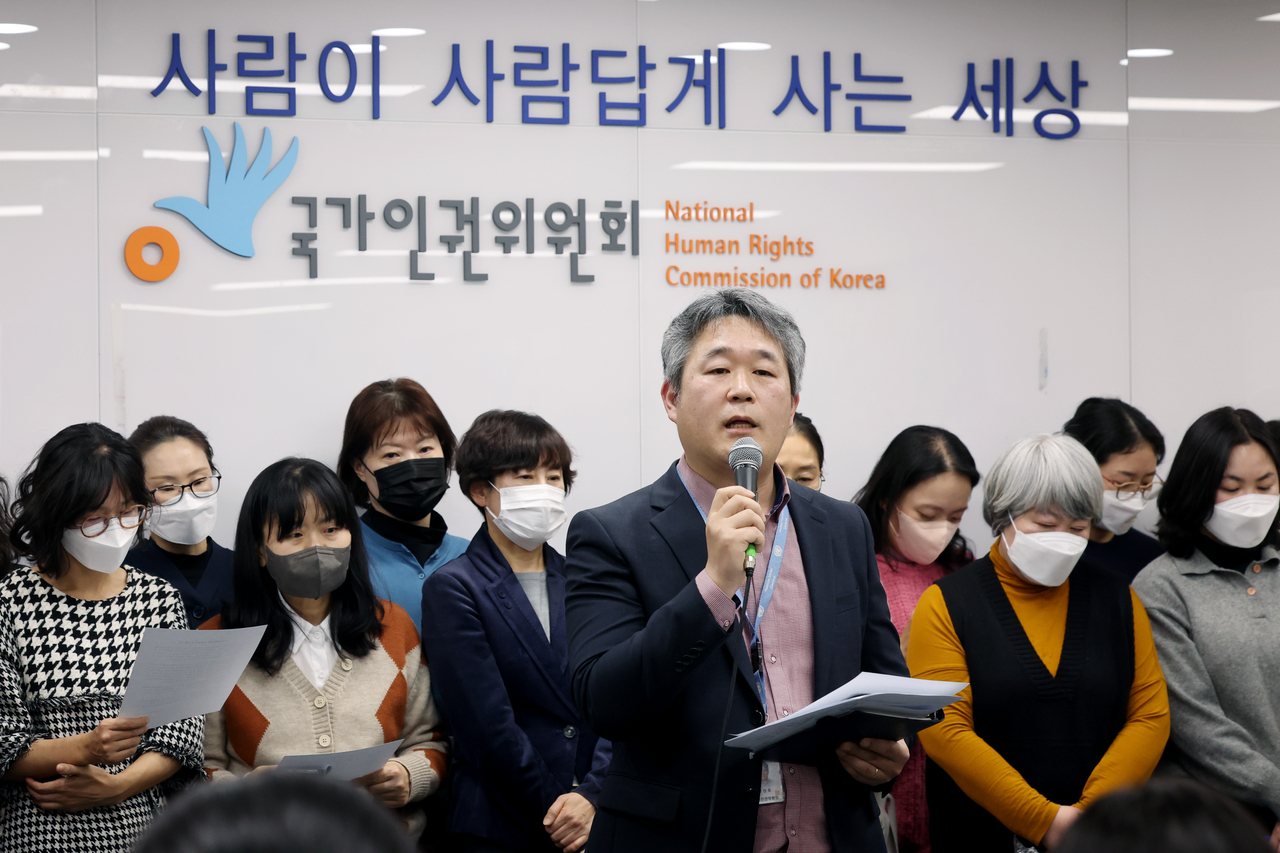
The NHRCK adopted its resolution on Yoon's right to defense last week, which sparked criticism from four of the 11 standing commissioners and even some of the agency's officials. Some 50 employees of the NHRCK decried the resolution in a press conference on Feb. 11 and issued a public apology for failing to stop it.
Controversial resolution defends Yoon
The rights watchdog's statement on Monday said consideration should be given to Yoon's argument that, since a martial law declaration was an act of governance with a high level of political and military characteristics, and that the Assembly was therefore limited in its right to judge whether it was justified.
The watchdog also concurred with Yoon's argument that the opposition-controlled National Assembly seeking the impeachment of 29 high-ranking officials during the Yoon administration -- ultimately impeaching 13 of them -- could be considered abuse of its authority, though it said it could not be grounds for imposing martial law.
The proposal of the much-disputed recommendation was led by commissioners of the NHRCK believed to be supportive of Yoon. They include Kim Yong-won, who recently wrote on his Facebook page that the Constitutional Court "must be smashed to pieces" if it confirms the president's impeachment. He is also reported to be leading the move to protect the human rights of the military commanders and the former defense minister accused of insurrection.
The NHRCK stressed that the recommendation was not trying to defend the martial law itself, and is intended only to protect Yoon's human rights. But the motion sparked fierce opposition from among the watchdog's own members, who decried it as "disregarding the constitutional independence of the court."
The statement also included comments from commissioners in opposition, who said that Yoon's declaration of martial law was an unconstitutional and unlawful measure, given that South Korea was not at war or in a state of national crisis that required the military to maintain civil order. They said the legitimacy of the parliament's impeachment of government officials, which is within its constitutional rights, should be determined by the Constitutional Court, not the human rights commission.
Lawyer Kim Yong-jik, a commissioner at the NHRCK, contended that it was irregular to protect the human rights of the president, as he is not socially disadvantaged and is already represented by multiple lawyers. He said that the agency has lost its sense of balance by calling for the protection of Yoon's human rights without criticism of the martial law declaration itself.
minsikyoon@heraldcorp.com