Martial law imposition was 'high-level political act': Yoon's statement to court
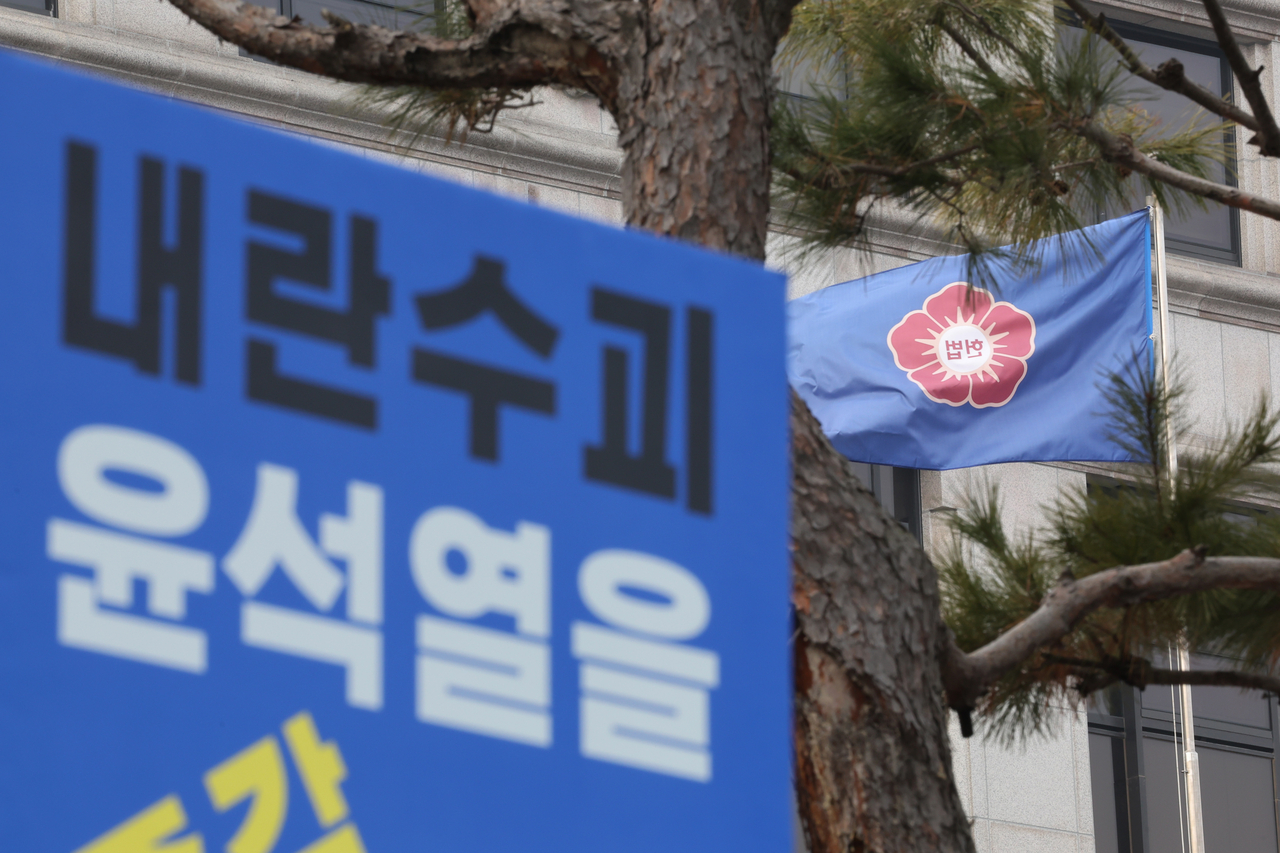
With suspended President Yoon Suk Yeol taken into custody by the joint probe team Wednesday morning, it is likely that Yoon's second hearing in his impeachment trial scheduled for Thursday will take place without his attendance.
According to police, Yoon can be held and questioned for up to 48 hours from 11 a.m. on Wednesday, making it unlikely that Yoon will appear in court for his hearing scheduled for Thursday at 2 p.m.
His first hearing on Tuesday, which was only attended by his legal representatives, ended after a little more than four minutes due to Yoon’s absence. Yoon’s lawyers said at the time that Yoon was not able to attend due to concerns that investigators might arrest him based on a court-ordered warrant to do so if he were to appear at court in Jongno-gu, Seoul.
His team has repeatedly stressed that Yoon will appear in court "at an appropriate time" to defend himself and explain the reasons behind his actions.
According to Article 52 of the Constitutional Court Act, defendants are not required to appear in court for their hearing. If a defendant decides to not attend again, the court will proceed with the trial in his or her absence.
In 2017, then-President Park Geun-hye never showed up in court for her impeachment trial. The same was the case for then-President Roh Moo-hyun in 2004.
While Thursday’s hearing is expected to include oral arguments by Yoon’s lawyers and the National Assembly's legal team on whether Yoon’s declaration of martial law was constitutional or legal, local media reported Wednesday that Yoon’s team argued that the martial law declaration “was not a violation of the constitutional order.”
In two written statements submitted to the court on Tuesday — one 60 pages long and the other 10 pages long — Yoon’s team detailed the background of his martial law decree, claiming that the April 10 election results were unreliable due to alleged mismanagement of the election system by the National Election Commission, necessitating an investigation.
It was also reportedly written that Yoon's Proclamation No. 1, which was nearly identical to a text written during the military dictatorship of the 1980s, was "copied and pasted" directly from what was provided by then-Defense Minister Kim Yong-hyun.
"The mistake in the phrasing was overlooked by Yoon due to carelessness. The wording in the proclamation was poorly done," the statement said, adding that even though the phrasing was incorrect, there was no intent to violate the constitution.
Additionally, the statement included claims that the main opposition Democratic Party of Korea had attempted to paralyze the government by proposing impeachment motions against ministers and prosecutors, as well as by cutting the government’s budget, stripping the Yoon administration of its confidential funds.
"Preventing dictatorship by the Democratic Party of Korea is an absolute and urgent duty of our nation in this era," the statement read, according to news reports.
Yoon’s team claimed that these circumstances had amounted to a “state of emergency,” legally justifying his declaration of martial law.
Many of the arguments mentioned in the statement overlap with the points Yoon made in his 29-minute public address on Dec. 12, in which he stated, “whether I am impeached or investigated, I will face it with confidence.”
Yoon’s team also wrote in the statement that his declaration of martial law was a “high-level political act” of the presidency, claiming it was thus not subject to judicial review.
Meanwhile, it was revealed on Wednesday that the Constitutional Court rejected Yoon’s request to recuse a specific justice from his trial since there was no “objective circumstances impeding the expectation of a fair trial.”
“The issue raised by the petitioner (Yoon) is not about the relationship between the justice and the petitioner in the main case, but rather about the relationship between the justice's spouse and one of the petitioner’s legal representatives," the court said in a statement. "… This relationship is neither one of kinship nor of familial ties but merely a relationship between the chairman of a foundation and an employee or member of the foundation. Such a circumstance alone cannot be considered an objective condition impeding the expectation of a fair trial."
Earlier, Yoon’s side argued that there was a conflict of interest, since Justice Jung Gye-seon’s husband, Hwang Pil-kyu, is affiliated with the human rights law foundation where the co-CEO is Kim Yi-soo, a member of the National Assembly’s legal team. But the court, on Tuesday, dismissed the request from Yoon’s team to recuse Justice Jung from the trial.
ddd@heraldcorp.com