Finance minister now wears four hats as acting president, PM, finance minister, and emergency head of deadly plane crash
South Korea’s top financial authorities on Monday reaffirmed that the country has enough room to handle market volatility, which has been heightened by concerns over the country's leadership vacuum following the impeachment of then-acting President and Prime Minister Han Duck-soo last Friday.
Bank of Korea Governor Lee Chang-yong presided over a gathering of economic and financial leaders, dubbed the F4 meeting, to discuss macroeconomic and financial issues. It was led by Financial Minister Choi Sang-mok until he took on the role of acting president to replace Han.
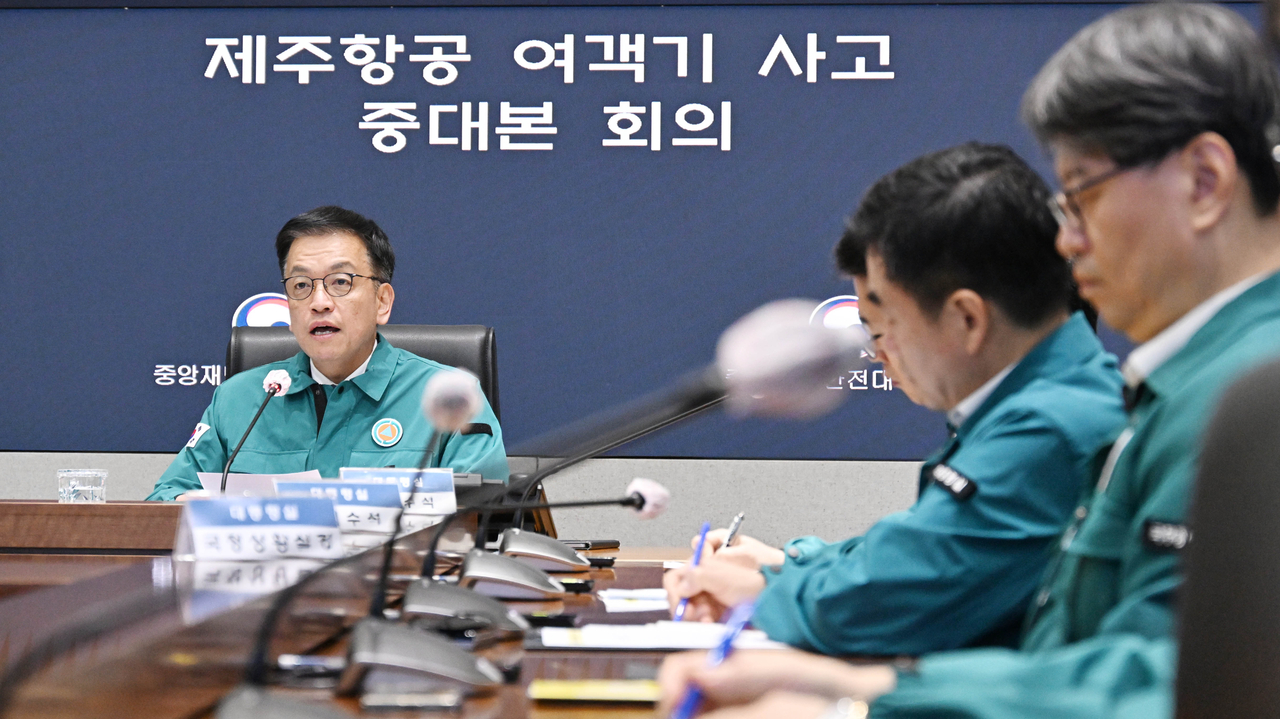
While Choi presided over a meeting of the Central Disaster and Safety Countermeasures Headquarters on Sunday’s plane crash that killed 179 people at Muan International Airport, First Vice Finance Minister Kim Beom-seok attended the F4 meeting along with Financial Services Commission Chairman Kim Byung-hwan and Financial Supervisory Service Chairman Lee Bok-hyun.
“Since the National Assembly passed an impeachment motion against the prime minister last week, volatilities in the financial and foreign exchange markets have expanded, including the Korean currency’s fall,” the attendees said in a statement released by the Finance Ministry. “We will muster all available means to bring stability to the markets.”
The statement went on to cite that the size of net external financial assets -- the value of its net claims on the rest of the world -- stands at $977.8 billion, which ranks ninth in the world. Additionally, the bond market stabilization fund is worth 27 trillion won ($18.3 billion), meaning the government and central bank have sufficient capacity to respond to market fluctuations. “If the market is excessively biased in one direction, additional market stabilization measures will kick in in a timely manner,” they said.
Last week, the BOK purchased an additional 5 trillion-won worth of repurchase agreements, providing a total of 38.6 trillion won of short-term liquidity since Dec. 4.
On the last trading day of 2024, the Korean won opened at 1,474.0 won against the US dollar, down 6.5 won from the previous session.
Since late November, prior to President Yoon Suk Yeol's sudden declaration of emergency martial law on Dec. 3, the Korean currency logged a sharp fall of over 5 percent from 1,396.5 won against the greenback to 1,470 won.
Though authorities made every effort to stabilize the market, such as pledging to provide “unlimited liquidity” and expanding foreign exchange swaps with the state-run National Pension Service, it was not enough to prevent the exchange rate from a freefall.
Uncertainties appear to remain unresolved as reflected in the won’s drop even under the leadership of acting President Choi Sang-mok, who took the job after the impeachment motions of President Yoon and Prime Minister Han were passed in succession.
Other economic indicators also reveal the country’s struggle to make a breakthrough in the face of the private consumption slump and sluggish construction.
According to data released by Statistics Korea on Monday, Korea's factory output fell more sharply than expected in November amid slowing exports and weakening business confidence.
The industrial output index slid 0.7 percent over the month on a seasonally adjusted basis, after no change in October. On an annual basis, the index was up 0.1 percent, slower than the previous month's gains of 6.3 percent.
The construction industry's production has decreased for seven months, setting the record for the longest decline ever since the statistics were first compiled.
Amid a grim economic outlook, Choi is under pressure having stepped into the interim leadership role following Han's suspension.
The Jeju Air passenger plane accident at Muan International Airport in Muan, South Jeolla Province, is expected to increase Choi's workload in addition to his duty to make decisions on the government's economic and financial policies.
"The international community is watching whether the Korean government will be able to swiftly find stability. If the current instability continues, it may have a negative impact on our external credibility and add direct or indirect shock to our economy as a whole,” the F4 members said.
hnpark@heraldcorp.com











